
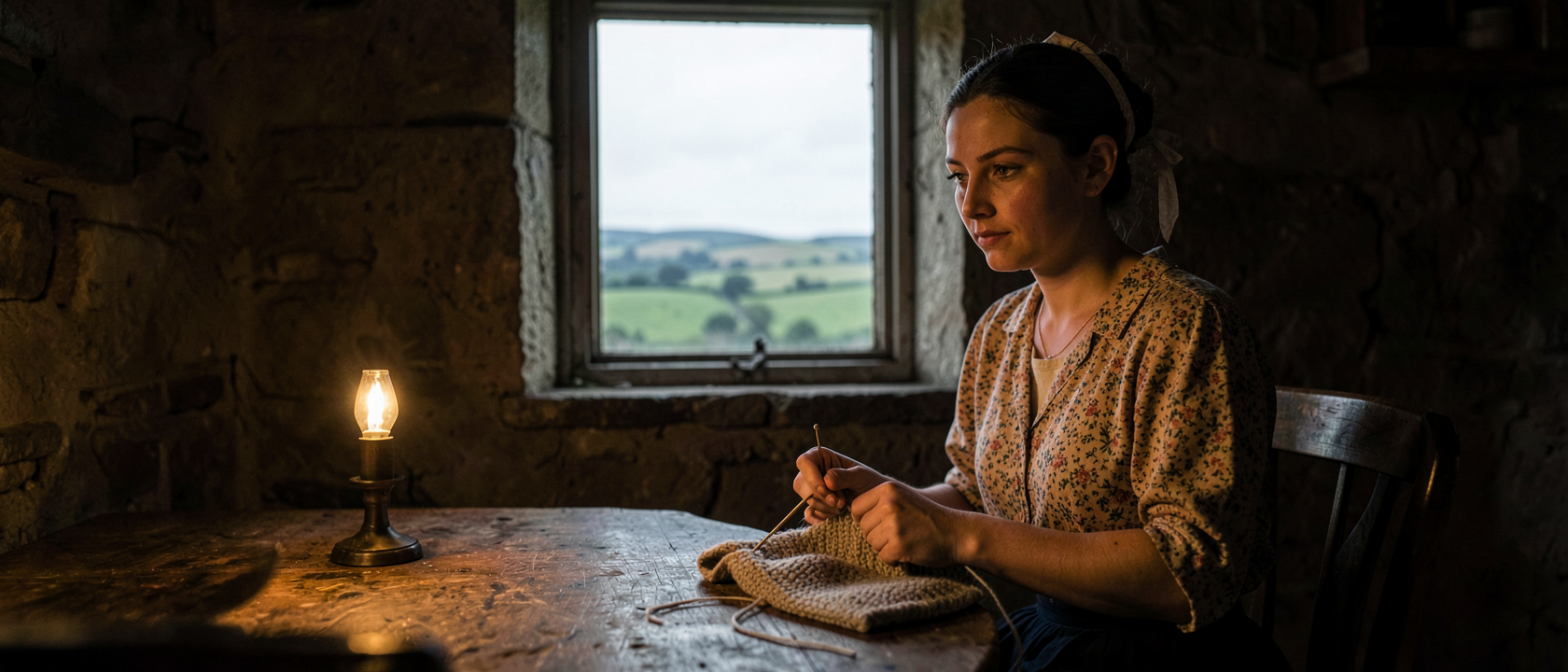
The Window on the Rail Line
World War I, occupied Belgium, c. 1914-1918
Picture a Belgian woman at a window during the German occupation of 1914-1918, needles moving while a troop train passes below. Her stitches run plain and even until the train goes by, then for a few rows she works a visibly bumpy purl into the smooth fabric. No name survives for her; she stands in for a story told in secondary accounts of occupied Belgium, of women stationed near rail lines who turned a scarf or sock into a running log of what moved past their windows, later read off, bump by bump, by a resistance contact. No independent archive confirms the practice, but it fits a method that resurfaces again and again across these decades.
Why No One Searched Her
World War I, occupied Europe
Under occupation, a woman caught passing military intelligence faced interrogation and often execution. The method worked because checkpoint guards did not see a woman with knitting needles as a plausible threat. Men’s pockets were turned out and papers checked line by line; a basket of yarn went through untouched. Guards were looking for soldiers and saboteurs, not grandmothers with needlework, and that gap in attention is what let the method function at all.
Molly Rinker’s Yarn Balls
American Revolutionary War, 1770s-1780s
This story predates both world wars by more than a century. Molly “Old Mom” Rinker is said to have sat on a hilltop above Wissahickon Creek near Philadelphia, knitting in plain view while watching British troop movements during the Revolutionary War. According to local tradition, she hid written notes inside balls of yarn and dropped them to American soldiers waiting below. No contemporary paper trail backs this up; it survives as legend, not documented record. It is, as far as the record goes, the first telling of an idea that keeps resurfacing: a woman knitting in public, trusted because she looked harmless.
Madame Levengle’s Heels
World War I, occupied France and Belgium
Historian Kathryn Atwood records the case of Madame Levengle, who sat knitting by an open window with German officers billeted nearby. As her needles worked, she tapped coded information about troop movements with her heels against the floor, while her children, sitting beside her, wrote down the code without drawing attention. A mother knitting with her family around her drew no second glance from an occupying officer. The knitting here was not the code; it was cover for a signal carried by foot instead.
The Sweater That Probably Wasn’t a Code
October 1918, Britain
In October 1918, Britain’s Pearson’s Magazine reported that German knitters were coding military information into sweaters, knots measured letter by letter against marks scratched into a door frame. Historians who have examined the claim call it likely exaggerated, possibly unverifiable outright, no coded garment has ever surfaced, and no intelligence record backs the story up. Reports that Britain also restricted the mailing of knitting patterns during the First World War are far less solidly sourced than the pattern bans that followed in the Second World War, when both Britain and the United States did restrict them by law. The firmer, better-documented case belongs to that later war, not this one.
Rail Yards Again, Twenty Years Later
World War II, c. 1940-1945, Belgium and the United States
Two decades after the first occupation, the same method turned up again. Belgian resistance networks are reported to have stationed older women near rail yards and had them log train traffic using two symbols: a dropped stitch, leaving a small hole, for one category of train, and a purled stitch, leaving a bump, for another. That account, like the earlier Belgian story, comes down through secondary sources rather than an archive, but the pattern is consistent: the idea hadn’t needed reinventing, it had simply gone quiet and come back. Across the Atlantic, Elizabeth Bentley, who spied for Soviet intelligence in the United States before becoming a government informant, allegedly carried documents on early B-29 bomber plans and aircraft data hidden inside a knitting bag, a detail that is alleged rather than firmly documented, consistent with how much of her broader espionage record has been argued over since.
2,000 Codes in Her Hair
May 1944, Normandy, France
In May 1944, Special Operations Executive agent Phyllis Latour Doyle parachuted into occupied Normandy at age 23. She carried roughly 2,000 reusable one-time codes printed on a strip of silk, wound around a knitting needle and tucked inside a flat shoelace she used to tie up her hair. She would unwind the silk to work out messages with Morse code equipment, then mark each used code with a pinprick. Here the needle itself was built to hide a working intelligence tool, not a stitch standing in for information and not knitting used as harmless backdrop. Doyle operated as an active agent in occupied territory, under the same threat of capture and execution as anyone caught doing her job.
What It Cost, and What Outlived the War
1918 through 2023
No deaths or financial losses are recorded as directly tied to the knitting-code method itself. What is documented is the danger these women operated under: the unnamed grandmother at her window, Madame Levengle with her children beside her, Doyle on the ground in Normandy, all working with the threat of capture and execution hanging over them. Doyle was searched by German authorities on several occasions; her hair tie was never examined. She relayed 135 messages to the British military before France’s liberation in August 1944, described her methods to New Zealand Army News in 2009, was made a Chevalier in France’s Legion of Honor in 2014, and died in 2023 at age 102, by then noted as the last surviving woman who had served as an SOE agent. On the institutional side, Britain and the United States both banned mailed knitting patterns during the Second World War, treating a domestic craft as a risk serious enough to regulate by law.
Madame Defarge Was Never Real
1859, in fiction, set against the full wartime record
The best-known knitting spy in popular memory never spied on anyone. Madame Defarge, from Charles Dickens’s A Tale of Two Cities, published in 1859, knits the names of condemned aristocrats into her needlework during the French Revolution. She is a novelist’s invention, not a documented case, and not tied to any single real spy. Researchers who study this history point out that most real knitting spies used the craft as social camouflage rather than a literal cipher, the dropped stitches on a Belgian windowsill and the heel-tapped code under Madame Levengle’s needles are the exception, not the rule. Defarge likely explains why the legend never died: she gave the idea a memorable shape, and the real cases, documented and undocumented alike, have been measured against her ever since.