
The Fjord Fills Up
On the morning of July 29, 1693, ships began crowding into Smeerenburgfjorden (“blubber town fjord”), on the northwestern coast of the Svalbard archipelago. French naval logs stretch the fighting into the second week of August, but for the fleet gathered that day trouble started on the 29th. By evening about five dozen Dutch and Danish whaling ships rode at anchor, waiting to form a convoy home. This was routine: for decades crews from the Dutch Republic, Denmark, and England had hunted bowhead whales from shore stations around the fjord, the Dutch and Danish off Amsterdam Island, the English further south around Fairhaven and English Bay. Each short Arctic season ended the same way, with the separate national fleets meeting in the one channel they all knew and sailing out together for safety.
The ships waited within sight of three cemeteries along the shore: the largest, by one long-standing account, at Ytre Norskøya (Outer Norway Island), another at Jensenvannet, and a third on a spit the whalers called Likneset, “Corpse Point.” Newer surveys count more registered graves at Likneset than at Ytre Norskøya, but in 1693 nobody was counting. The cemeteries were simply part of the shoreline the fleet passed each year.
What a Man Packed Before He Sailed North
Men did not sign on for an Arctic whaling season expecting an easy return. Brawls broke out among crews packed onto small ships for months. Men drowned launching boats after whales, froze in sudden weather, or wasted from scurvy over a season with little fresh food. Whale blubber is generally thought to carry enough vitamin C to have kept the disease off, though that claim rests on a single modern source rather than settled research, and nobody in the fishery would have made the connection at the time.
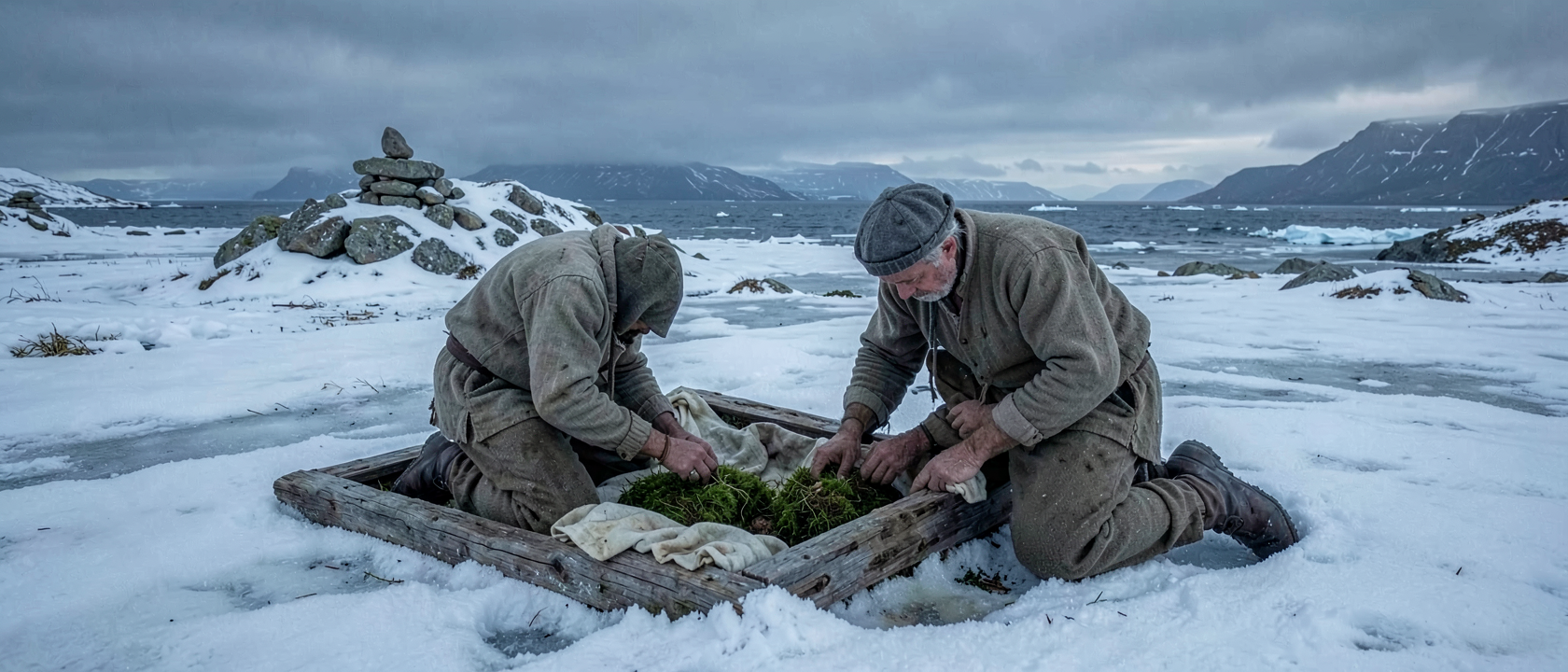
Because death was a known cost of the voyage, crews are said to have prepared for it before leaving home. According to one account, burial kits traveled north in the hold alongside harpoons and casks: timber already cut for a coffin, fabric to line it, and a small quantity of moss carried from the men’s own countries, so that if a man died up there, some piece of home went into the ground with him. That detail comes from a single source and has not been confirmed in the peer-reviewed excavation reports, but it fits what isotope testing later showed about how mixed these crews were.
De la Varenne’s Fleet
The convoy had gathered to protect itself from the sea, not an enemy fleet. In 1693, France and the Dutch Republic were well into the Nine Years’ War, and Louis XIV had sent a squadron north under Antoine d’Arcy, Seigneur de La Varenne, aboard the fifty-gun Le Pélican. The king’s order allowed no exceptions: every ship flying the English, Dutch, or Hamburg flag was to be burned or sunk.
La Varenne’s squadron found exactly that, sixty ships bunched at anchor with a season’s catch in their holds. French guns burned and sank Dutch, English, and Hamburg-flagged vessels, killing men who had already survived a full Arctic season in a war that had nothing to do with whaling. No source gives a death toll or ship count. What survives is the attack itself: a naval squadron reaching into a fjord that otherwise answered only to weather and labor.
Burying the Dead Beside the Dead
Whoever was left afloat did what whaling crews always did at season’s end: they buried their dead. The newly killed went into pine coffins laid on sawdust and wrapped in blankets, some with a pillow beneath the head, the same preparation given any year to men lost to drowning or sickness. The graves went in beside ones already there from earlier seasons, at Ytre Norskøya, Jensenvannet, and Likneset.
Digging in Svalbard meant working against permafrost, frozen a few feet down regardless of season. Crews cut as deep as the summer thaw allowed and no deeper, then capped each grave with a cairn heavy enough to keep arctic foxes and polar bears out, marked by a plain wooden cross. Archaeologists have since registered roughly 800 such graves across the Svalbard whaling era; the men buried here in 1693 joined a cemetery already old by local standards, which would keep filling for another century.
What the Permafrost Kept
The same cold that made digging hard preserved what went into the ground. Excavations at Likneset recovered near-complete 17th-century outfits: wool and linen garments and knitted stockings pulled whole from graves that had never thawed enough to rot the cloth, including an indigo-dyed wool jacket found alongside a pair of brown wool knee breeches on one skeleton. Isotope analysis on a small sample of skeletons found one whaler whose bone chemistry pointed to the Netherlands and two others with signatures matching a cold, fish-heavy diet consistent with western Norway, a hint of how mixed these crews were.
Moss said to have been carried from home has reportedly turned up in some graves too, alongside coffin timber and lining fabric, though this detail comes from a single account and has not been independently confirmed in the published archaeology. No record sorts the moss by nation, no grave carries a name, and nobody has counted how many of the roughly 800 registered graves on Svalbard held foreign plant material rather than none at all. The practice, if it occurred as described, is not fully documented.
An Empty Fjord
The bowhead whale population that had drawn Dutch, Danish, and English ships north for most of a century could not absorb the hunting forever. By the close of the 18th century, whole seasons passed in Svalbard waters without a single bowhead sighted. Fridtjof Nansen is said to have written, of these same waters, of a land settled back into winter stillness once the whales that had drawn men there were gone, a passage that survives through a single secondary source and cannot be checked against the original.
The burial kits, real or partly legend, had been built to answer the ordinary risks of a thriving trade: brawls, drowning, cold, scurvy, and on one day in 1693, a French fleet with royal orders. They were never built to survive the end of the trade itself. When the whaling stopped, so did the ships that had once carried coffin timber and whatever else came with them across the North Atlantic. Sixty vessels had once crowded into Smeerenburgfjorden in a single afternoon. What Nansen is said to have found afterward was a fjord with nothing left to gather for.