
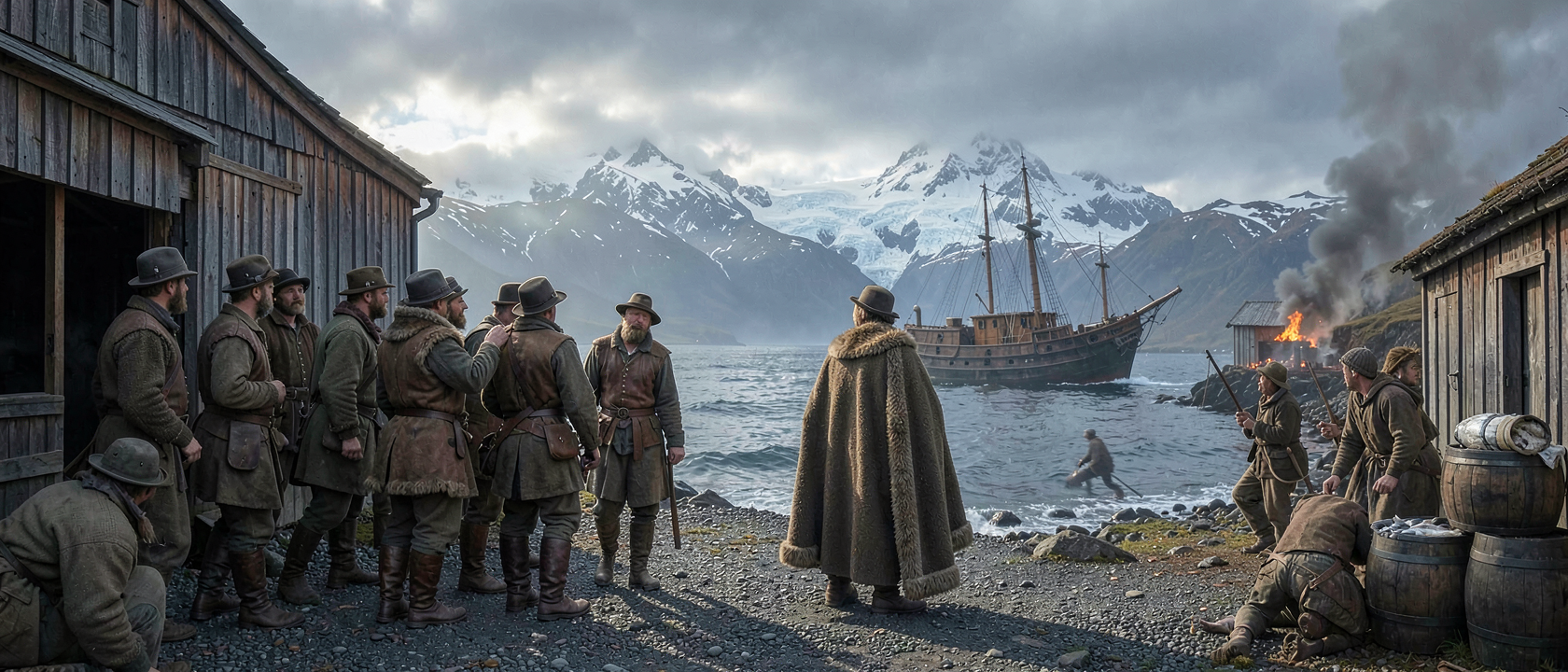
The Harbor at Rif
In autumn 1467, shortly after Michaelmas on September 29, an English ship from Bishop’s Lynn, the medieval name for today’s King’s Lynn in Norfolk, lay at anchor in the harbor of Rif, on the northern coast of Iceland‘s Snæfellsnes peninsula. Björn Þorleifsson walked down to meet it. This was routine work for a governor tasked with overseeing trade.
Björn, known as Björn ríki (“Björn the Rich”), had served since 1457 as hirðstjóri: the senior royal governor over all of Iceland, answerable to King Christian I of Denmark and Norway. He had come to the post after a hard episode of his own. In 1455, Scottish pirates near Orkney had seized Björn and his wife, Ólöf Loftsdóttir, and held them in Scotland until Christian paid their ransom. The king then placed Björn over Iceland with a specific brief: keep English merchants out of the island’s trade. Walking up to inspect an anchored English crew was ordinary business for him, the kind of check he had made many times before.
A Bad Season in the Western Quarter
The months leading up to that autumn had been difficult ones in Iceland’s Western Quarter. Stockfish, the dried cod that underpinned the Icelandic economy, had been stolen in quantity. So had livestock, bolts of wool cloth, and boats, taken from Björn’s own holdings, from a local monastery, and from ordinary farmers on the Snæfellsnes peninsula.
Investigators caught some of the men responsible, and some of them were executed, a sign of how seriously the crown treated theft on this scale. Björn did not believe the matter ended there.
Björn’s Suspicion
In his own account, Björn described certain Icelanders as “anglicised” (engaðir), his term for farmers and middlemen he believed were dealing directly with English ships instead of trading through channels the crown approved. To him, the wave of theft and the illegal trade looked like one problem: goods leaving Iceland off the books, past a governor whose entire job was to stop exactly that.
That link is Björn’s own accusation, recorded as his belief rather than proven by independent evidence. How much of it reflected an organized smuggling network, and how much was his own reading of an ordinary crime wave, is something the surviving record cannot settle. What is clear is that he judged the moment had come to confront the traders he suspected.
Three Powers, One Island
On paper, Iceland belonged to the Kalmar Union, the single crown joining Denmark, Norway, and Sweden since 1397, which carried Norway’s Atlantic territories, Iceland among them, into the same arrangement. Trade with the island was meant to run through merchants licensed by that crown. The Hanseatic League, the federation of German trading cities, held long-standing privileges of its own.
English ships had been coming regardless since at least 1408 or 1409, the earliest recorded English trading and fishing voyages to Iceland, and likely before that. By the 1460s, vessels from English ports such as Bishop’s Lynn were a regular, largely unauthorized presence off the Icelandic coast, buying fish and trading goods outside the crown’s licensing system. Later historians, following the Icelandic scholar Björn Þorsteinsson, would call this stretch of Iceland’s history its “English Age.” A governor questioning an English crew on the dock was never only a local matter. It was one point of contact in a three-way contest that ran from Iceland to Copenhagen to London.
The Killing
At Rif, the encounter turned violent. The English sailors killed Björn Þorleifsson.
No surviving source records what was said or done in the moments before. There is no account of an argument, an order, or a single incident that turned a dockside confrontation into a killing. That gap in the evidence has never been closed, and nothing reliable fills it.
What the King’s Letter Says
What is known of the aftermath comes chiefly from one document: a letter King Christian I sent to the council of Bishop’s Lynn within about a year of the killing. It is the strongest contemporary source for the episode. It does not name Björn or Rif outright, but its details match Icelandic sources that do.
According to the letter, the crew went further than killing the governor. They stripped his wife, children, and household of gold, silver, clothing, and other goods. They burned houses and other buildings, took revenues that belonged to the crown, and caused damage across part of the country through plunder and fire. Then they carried Björn’s body to their ship and threw it into the sea.
This is a king’s letter of complaint, addressed to the town the crew had sailed from, not a court record or an independent inquiry, and it reads that way: forceful and one-sided. But on the central facts, a killing at an Icelandic harbor and a body put into the sea, it is the closest thing to firsthand testimony that survives.
A Wider War
Björn’s death did not stay a local matter. Tensions between England and the Hanseatic League had already been building for years, through revoked trading privileges, seized ships, and failed peace talks at Hamburg in 1465. The killing of a Danish crown official by English sailors became one more grievance in that standoff. In 1468, Danzig privateers chartered by the Danish crown began seizing English merchant ships in the Baltic Sound; England responded the following year by seizing the Hanseatic trading base in London. The Hanseatic cities met at Lübeck and chose war. What followed is known as the Anglo-Hanseatic War, fought from roughly 1468 to 1473, though sources differ on exactly when it ended. Björn’s death did not start that war on its own, but it helped feed the fire that was already burning.
No Reckoning
No source records a trial, a punishment, or even a named defendant among the crew from Bishop’s Lynn. No Icelandic or Danish retaliation against the ship or its home port is documented. Christian’s letter demands satisfaction. Nothing in the surviving record shows that he got it.
The larger contest over Icelandic trade went on without a clean resolution either. Hanseatic merchants began sailing regularly to Iceland in 1470, trading mainly at Hafnarfjörður. Then in 1490, Denmark and England agreed that English ships could fish and trade in Iceland freely, the very right Christian had sent Björn north to stop. The governor who died trying to keep English traders off Icelandic docks was followed, within a generation, by a treaty that let them stay.