
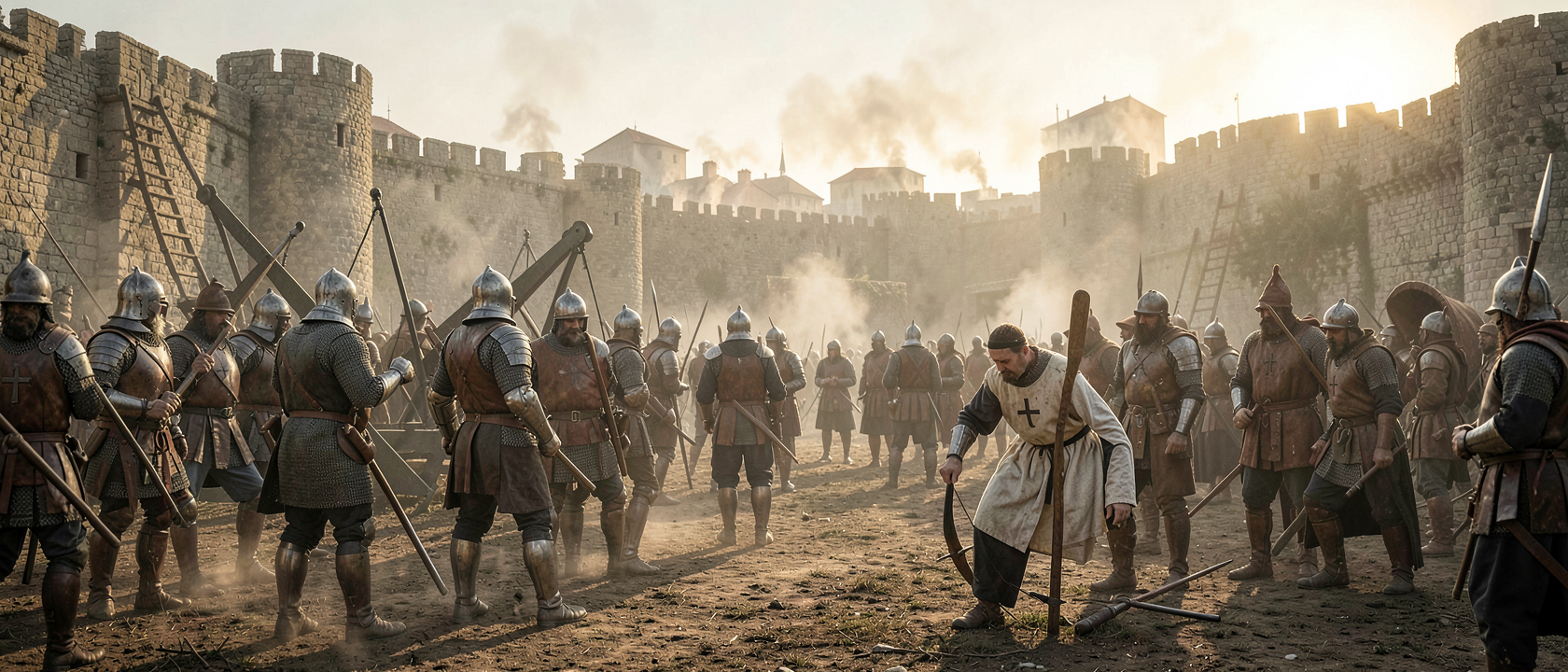
A Town Under Double Pressure
By the start of September 1212, the town of Moissac, in the Languedoc region of southern France, had been under siege for about a month. An army of crusaders had surrounded it as part of the Albigensian Crusade, the campaign Pope Innocent III called in 1208 against heresy in Languedoc, waged by crusading armies from 1209 to 1229. Moissac stood in the crusaders’ path, a town to take before they reached the larger target further south.
A siege in this period followed a familiar pattern: block the roads and gates, cut off supply, and batter the walls until hunger or breached stone forced a surrender. At Moissac, a second pressure bore down on the town while that blockade was still underway. The pope had placed Moissac under an interdict, a penalty that fell on an entire community rather than on any single person accused of sin. Under its terms, any priest still inside the walls was forbidden to say mass, baptize an infant, hear a confession, or bury the dead in consecrated ground.
Heresy, or the Excuse for It
The charge that brought the crusaders to Moissac’s walls came from Arnaud Amaury, the Cistercian abbot of Cîteaux and the pope’s legate in Languedoc, the Church’s representative empowered to act in Innocent III’s name. Amaury accused the town’s population of sheltering and defending local heretics. No surviving record spells out what that accusation actually involved: which beliefs, which people, which specific offense. The charge did not need that detail to do its work. Once leveled, it turned a siege over territory and submission into a war fought in defense of the faith.
That framing reached well past Moissac itself. In the language used by the crusade’s preachers and supporters, Toulouse was described as a new Sodom and Gomorrah, a city so given over to heresy that it called for purification rather than ordinary conquest. Moissac, smaller and directly in the crusaders’ path, was treated as a step toward that larger reckoning.
The Defenders Fight Back
Moissac’s resistance did not come only from its own residents. Towns under this kind of pressure often hired mercenaries, soldiers paid to fight rather than levied from the land, because a feudal muster could not be counted on to hold a wall for weeks under bombardment. It was this mixed force, hired soldiers and townspeople together, that kept the crusading army outside the walls for as long as it stayed there.
Near the end of the siege, one of the defenders fired a crossbow at a monk who had ridden close to the walls to urge the crusaders on. The bolt went through his robe and through his saddle. He survived unhurt, though shaken by how near it had come. That monk was Peter of les Vaux-de-Cernay, who later wrote the Historia Albigensis, the chronicle that remains the fullest surviving account of the crusade through 1219.
Moissac eventually surrendered to the crusading army. No source gives the date, or the terms on which the town gave up the fight.
With Great Enthusiasm
What followed the surrender is recorded in a single surviving account. The crusaders killed the mercenaries who had defended Moissac, doing so, in the chronicle’s own words, “with great enthusiasm.” No second narrative of the siege survives to confirm or complicate that phrase, which means it carries the weight of one witness’s account rather than a corroborated record.
By the time those killings took place, Moissac had gone weeks without the rites the Church normally granted the dying and the dead. Nothing in the record suggests the interdict had been lifted. Under its terms, the men killed after the surrender would have gone without a mass said over them, just as anyone who died during the siege itself had gone without one.
What the Record Doesn’t Say
Almost everything known about the siege of Moissac rests on that one chronicle, written by a man with a stake in how the story came out. Peter of les Vaux-de-Cernay wrote the Historia Albigensis to persuade a skeptical audience at the papal court, Innocent III among them, that the crusade’s conduct had been justified. He recorded the month-long siege, the crossbow bolt through his own robe, and the killings that followed Moissac’s surrender, and he had reason to shape all three toward that same argument.
The gaps in the record are plain once they are set out. There is no firm date for when the siege began or when Moissac surrendered, only the relative marker that by early September it had lasted about a month. The forces on each side go uncounted, both the crusaders outside the walls and the garrison inside them. The specific heresy charge against Moissac’s people is never spelled out. And nothing in the record says what became of the town’s ordinary residents after the surrender; only the mercenaries’ fate is written down.
The crusade that reached Moissac’s walls in 1212 continued for another seventeen years. Crusading armies went on to besiege Toulouse itself from September 1217 to July 1218. It ended with the Inquisition established in that city in November 1229, the same Toulouse the crusade’s preachers had once branded a new Sodom and Gomorrah.