
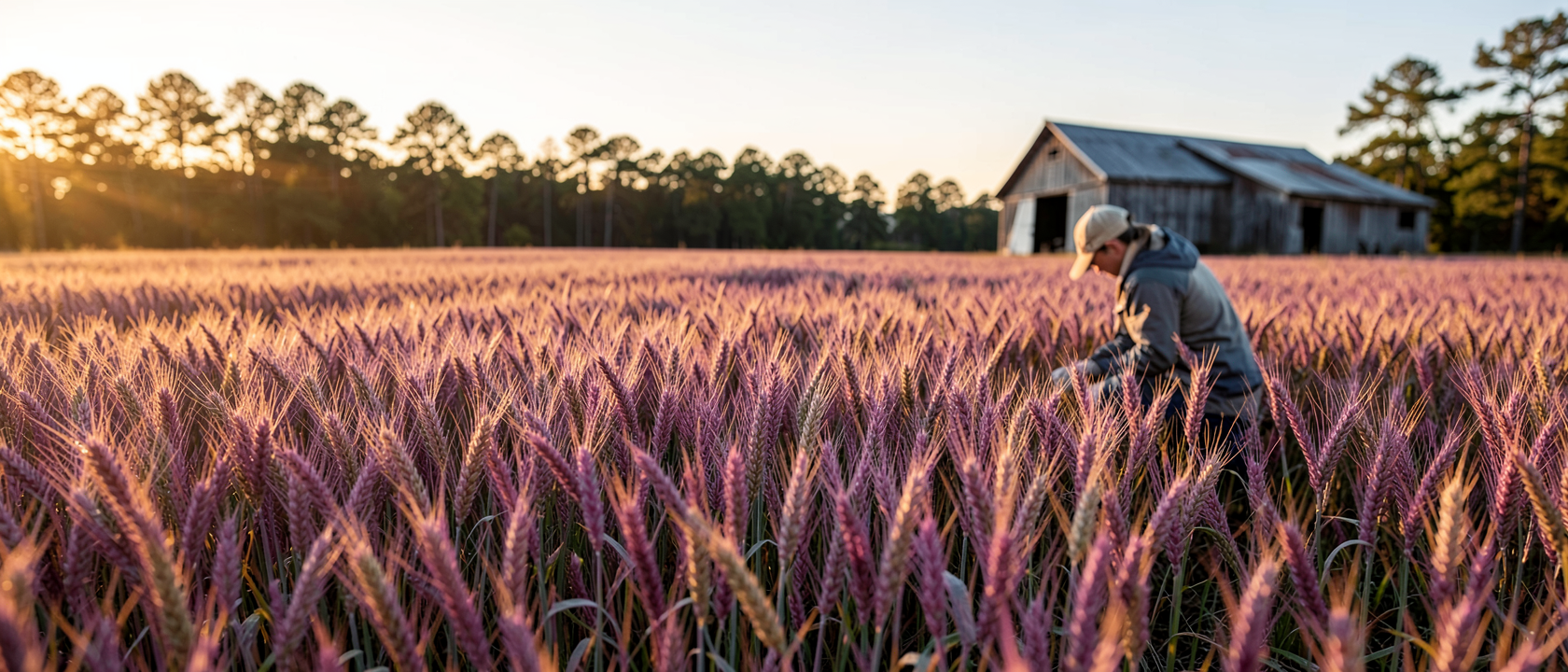
Virginia Piedmont, Before the Revolution
Grain historians once dated purple straw wheat’s appearance to around 1822. Research by food historian David Shields, chair of the Carolina Gold Rice Foundation, traced its presence in the Virginia Piedmont to at least the 1730s, decades before the American Revolution.
What made the grain worth tracking became clear only after the war. Through the nineteenth century, a wave of pests and plant disease moved through wheat fields along the Atlantic seaboard, and most older American wheat varieties could not withstand it. Purple straw could: its stalks, tinted pale lavender and standing close to five feet (1.5 meters) tall, kept producing grain where other wheat had failed.
One Grain, Several Names
By the early nineteenth century, purple straw had spread widely enough through the South to pick up more than one name. At Mount Vernon, George Washington’s Virginia estate, the wheat was already growing while Washington was alive, and farm manager James Anderson later cultivated it there as “red straw.” Elsewhere, growers knew it as “Alabama bluestem.” Both names come from a single modern account and haven’t been confirmed elsewhere.
Purple straw was low in gluten, a poor choice for yeasted loaves but a good one for biscuits, pie crust, pancakes, quick breads, and whiskey. One commercial seed supplier lists its protein content at around 11 percent, a figure not checked against any peer-reviewed study.
The Cold It Needed
Purple straw’s resistance to pests and disease came paired with a far less forgiving requirement: like many wheats, it needs a stretch of cold, called vernalization, before producing grain. Without enough chilling, the plant can grow tall and healthy while forming no usable grain, tying it to a specific climate window.
Competition, not disease, finally displaced it. Purple straw had been grown continuously in the South since the Colonial period, the only heirloom wheat variety to manage that run, stretching from the eighteenth century into the last quarter of the twentieth. Modern hybrid wheats, bred for disease resistance, larger grain, and the yields petroleum-based fertilizer made possible, pushed it off most Southern farms during the 1970s. By then it was no longer a working crop, only a memory on scattered farms. That decline went largely unremarked for decades: it was not until 2016 that Slow Food’s Ark of Taste, a registry of foods at risk of disappearing, added purple straw to its list, noting it had not been grown commercially in decades and survived only in scattered rural pockets.
The Search Begins
The recovery effort had already started by the time that listing appeared. In 2015, Shields and Glenn Roberts, president of heirloom grain company Anson Mills and, with Shields, of the Carolina Gold Rice Foundation, set out to find whatever purple straw seed still existed. The search led to the U.S. National Plant Germplasm System facility in Idaho, which held seed in long-term storage, and to the Sustainable Seed Company in Chico, California, an organic supplier stocking close to 2,000 heirloom varieties, which had already tracked down purple straw stock of its own.
Some of the recovered seed went to Clemson University in South Carolina. Late in 2015, research specialist Brian Ward planted less than half a pound (0.2 kg) at the university’s Coastal Research and Education Center in Charleston, with 500 backup plants kept in a greenhouse in case the field crop failed. By May 2016, the planting had produced about 145 pounds (65.8 kg) of grain, the first purple straw harvest most involved had seen in decades.
Three Years of Work, Undone
Not all the recovered seed went to research stations. Per Atlas Obscura’s reporting, Roberts gave three tablespoons of it to chef Scott Peacock, who planted about two teaspoons near Marion, Alabama. Three years of careful growing produced eight cups of grain, a small but real harvest, then pesticide drift from a neighboring farm’s crop-dusting killed the plants before Peacock could build on it. A second attempt, in a backyard plot, fared worse: the stalks headed out, but the heads held no grain at all.
Breeding and Milling, Separately
At Clemson, plant breeder and geneticist Richard Boyles took the recovered purple straw and began testing it against a threat the eighteenth-century wheat never faced: it has little resistance to leaf rust, a modern fungal disease, despite having stood up to the diseases that wiped out other American wheat in the 1800s. Boyles has been crossbreeding it with rust-resistant cultivars to keep purple straw’s qualities without its modern vulnerability.
A separate effort focuses on putting the grain back into use rather than redesigning it. Atlas Obscura reports that Barton Springs Mill, in Texas, has begun growing purple straw at larger scale and milling it into flour sold in limited batches, one effort trying to make the wheat survive a disease it never met before, the other trying to get the flour onto a shelf.
Mount Vernon, 2021
Purple straw had grown at Mount Vernon while Washington was alive, and, per Atlas Obscura, under James Anderson’s management afterward. In 2021, a small plot of it went back into the ground there, planted by Justin Cherry, the estate’s resident baker at Half Crown Bakehouse, working with Glenn Roberts and Mount Vernon’s horticultural staff. It was possibly the first time purple straw had grown at Mount Vernon in roughly two hundred years, a demonstration planting rather than a working field, meant to put the wheat back on ground it had once belonged to.
What the Record Doesn’t Confirm
Several points in this story rest on a single account. The exact year purple straw became the dominant wheat of the South isn’t recorded; the earliest confirmed date for its presence in Virginia is the 1730s, and its later spread is described only in general terms. The years Barton Springs Mill began growing and milling purple straw aren’t fixed in the available record, and the details of Peacock’s Alabama plantings and the Mount Vernon arrangements come from Atlas Obscura’s reporting without independent corroboration elsewhere.
Much of what is known about purple straw’s reach in the eighteenth and nineteenth centuries comes from Shields’ research and Roberts’ seed-tracing work, carried out and reported by the people doing the recovery itself, rather than confirmed in an independent paper trail from the period. That doesn’t make the story false; it makes it a case where the record and the revival are, for now, the same people’s work.