One Hundred and Fifty Feet of Strategic Problem
The Eastern white pine (Pinus strobus) grew across a broad corridor from what is now Maine south to northern New Jersey, and it grew large. Mature specimens reached 150 ft (c. 46 m). What mattered to a ship carpenter was the trunk: straight-grained, relatively light, resistant to rot, and often free of the knots that made other timber unworkable at sea. A single-stick mast required exactly this kind of wood. By the early seventeenth century, Britain and its rivals had stripped their own forests and exhausted much of the Baltic supply. New England’s white pines were what remained.
The Haudenosaunee Confederacy, the alliance of Mohawk, Oneida, Onondaga, Cayuga, and Seneca nations, founded under the Great Law of Peace by tradition around 1190, with the Tuscarora joining in the 1700s, held the white pine as the Tree of Peace. According to oral tradition, it was beneath a pine on Onondaga land, in what is now central New York, that the original five nations laid down their weapons and joined their confederacy. That understanding did not shape either settler or Crown policy toward the wood.
The settlers grasped the tree’s scarcity early. In 1659, residents of New London passed a local ordinance restricting the felling of pines. No royal directive prompted it. The colonists had noticed the depletion themselves and moved to manage it on their own terms.
The King’s Mark
The Crown’s formal claim came in 1691. The Charter of the Province of Massachusetts Bay, signed October 7 under King William III and Queen Mary II, reserved for the Crown every white pine over 24 inches (c. 61 cm) in diameter on ungranted land. The penalty for cutting one without a royal license: £100 per tree.
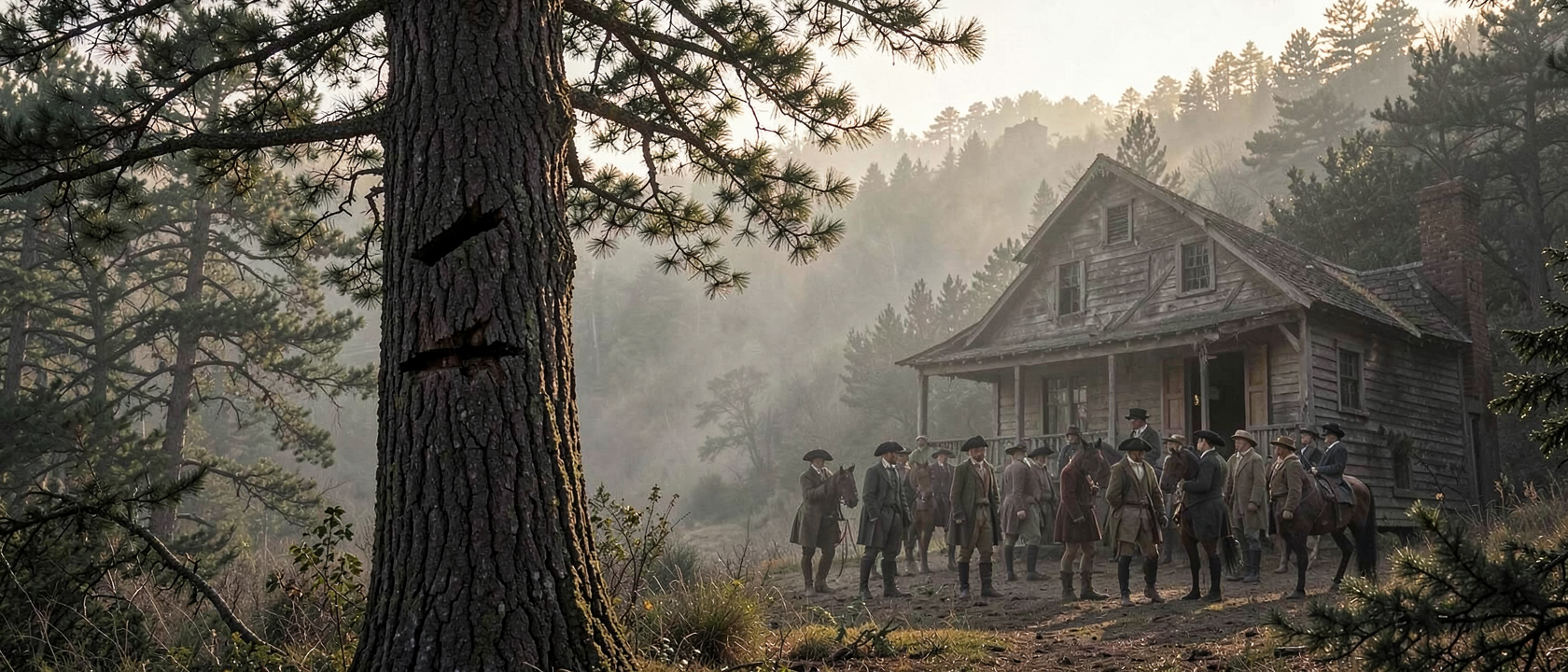
Parliament followed with three successive White Pine Acts, in 1711, 1722, and 1729. The 1711 act applied restrictions across all of New England plus New York and New Jersey. The 1722 act lowered the protected diameter to 12 inches in New Hampshire. The 1729 act closed remaining loopholes, prohibiting unlicensed cutting within township bounds as well as on ungranted land. The Crown created the office of Surveyor General of His Majesty’s Woods in America, whose deputies marked reserved trees with three axe-cuts in the shape of a broad arrow. Once marked, the tree belonged to the king.
Defiance as Standard Practice
In 1734, Crown deputies lodging in Exeter, New Hampshire, were beaten and driven out of town. Colonel David Dunbar, the deputy surveyor, retaliated by seizing logs and destroying equipment at a local sawmill; workers at a neighboring mill responded by firing on his crew, forcing him to retreat. In 1753, a deputy surveyor inspecting a sawmill in Connecticut was thrown bodily into a mill pond. Connecticut’s governor, Roger Walcott, declined to pursue prosecution. None of these incidents produced a single documented conviction. The pattern is not one of petty theft caught and punished, it is organized, collective defiance absorbing each enforcement attempt and continuing.
Between 1763 and 1765, deputies Elijah Lyman and Eleazar Burt marked 363 logs and standing trees near Northampton, Massachusetts, as Crown property. Of those, 326 were quietly redirected to local sawmills; only 37 reached port, an evasion rate of roughly 90 percent, accomplished without violence and without a single prosecution. In October 1765, a mob attacked both deputies, beating them and holding them through the night. When the matter reached the courts, some of those responsible were fined as little as £2, against a statutory maximum of £100. The gap between those two figures speaks clearly enough about how seriously the Crown’s courts chose to enforce the Crown’s law.
The Governor Who Sold the Law
In 1741, Benning Wentworth was appointed royal governor of New Hampshire and subsequently acquired the position of Surveyor General of the King’s Woods as well, placing in one man the roles of governor, chief enforcement officer, and member of a family commercially entangled in the timber trade the law was meant to control. His brother, Mark Wentworth, sold mast wood to the Royal Navy. Benning Wentworth consolidated his hold over the colonial legislature through strategic land grants that determined who could sit in the assembly. He served longer than any other royal governor in the American colonies, leaving office in 1766 or 1767, sources differ by one year. He died on October 14, 1770. During his tenure, White Pine Act enforcement in New Hampshire extended only as far as he chose; the law’s failure there was partly built into the appointment itself.
Once for Each Warrant
By April 1772, the governorship had passed to Sir John Wentworth, Benning’s nephew, who proved less willing to look away. When sawmill operators along the Piscataquog River Valley in Weare, New Hampshire, refused to pay fines for pine law violations, Wentworth sent Sheriff Benjamin Whiting of Hillsborough County and his deputy, John Quigley, to execute arrest warrants against mill operator Ebenezer Mudgett.
On the morning of April 14, 1772, a group of colonists, accounts range from roughly twenty to approximately forty, assembled at Quimby’s Inn in South Weare with their faces blackened with soot. They attacked the sheriff and his deputy, slashed the saddles of their horses, and smashed windows. Eight participants were identified and tried before the Superior Court in September 1772. Each was fined 20 shillings. The statutory penalty for cutting a single protected pine was £100.
On December 16, 1773, participants in the Boston Tea Party would blacken their faces before boarding ships in Boston Harbor.
What They Carried at Lexington
On April 19, 1775, colonial militias assembled at Lexington, Massachusetts, under flags bearing the pine tree. Eight Americans were killed that morning; ten were wounded. A pine tree flag was also flown at the Battle of Bunker Hill, and the image passed into state seals and symbols as an emblem of independence.
Its origins were not difficult to trace: a mill pond in Connecticut, deputies beaten and held through the night in Northampton, a sheriff confronted to the count of his own warrants in Weare. Those episodes did not make the Revolution inevitable. But they made organized resistance a practiced habit, and the pine tree a symbol with weight behind it before anyone formally assigned it one. That erosion happened tree by tree, mill yard by mill yard, over the better part of a century, and left behind a population practiced at the work of saying no.