
In late June 1918, HMHS Llandovery Castle was most of the way through her crossing from Halifax, Nova Scotia, to Liverpool when a German torpedo struck her hull. What the submarine crew did over the next two hours became the key piece of evidence behind the Allies’ first attempt, three years later, to try German officers for wartime conduct in open court. Both the trial and the ship behind it faded from memory soon afterward. What survived was a single legal argument, picked up again during a far larger war.
Two Hours on the Water
HMHS Llandovery Castle began life in 1914 as the liner RMS Llandovery Castle, built in Glasgow for the Union-Castle Line. By 1918 she was one of five Canadian hospital ships carrying wounded soldiers across the Atlantic, marked and protected under the laws of war. On her return leg from Halifax, a torpedo from the German submarine U-86 struck her hull. She sank in roughly ten minutes, too fast for most aboard to do anything but reach the water or a lifeboat.
U-86 did not withdraw. By the official report on the sinking, the submarine spent more than two hours among the wreckage, running down lifeboats and firing on survivors in the water, its deck gun alone loosing an estimated twenty rounds. Only one boat, Lifeboat No. 4, stayed afloat long enough to be picked up by a British destroyer, carrying twenty-four survivors.
An Unprecedented Demand
After the armistice of November 1918, Britain and France pushed for something with no real precedent: trial of enemy officers in a formal court, rather than cash reparations or seized territory. The demand went into the Treaty of Versailles, signed in June 1919. Article 227 arraigned former Kaiser Wilhelm II before a special Allied tribunal, Article 228 let Allied governments try accused war criminals before their own military courts, and Article 230 required Germany to hand over the needed documents and witnesses.
Early Allied planning floated lists as high as 20,000 names before they were trimmed down. Once the treaty was ratified in January 1920, the Allies formally requested roughly 890 men for extradition. Germany refused outright, arguing that handing over men widely seen at home as having done their duty would likely bring down the government. Berlin offered instead to try the accused at Leipzig, and the Allies, lacking any real means to compel otherwise, accepted.
The Leipzig Compromise
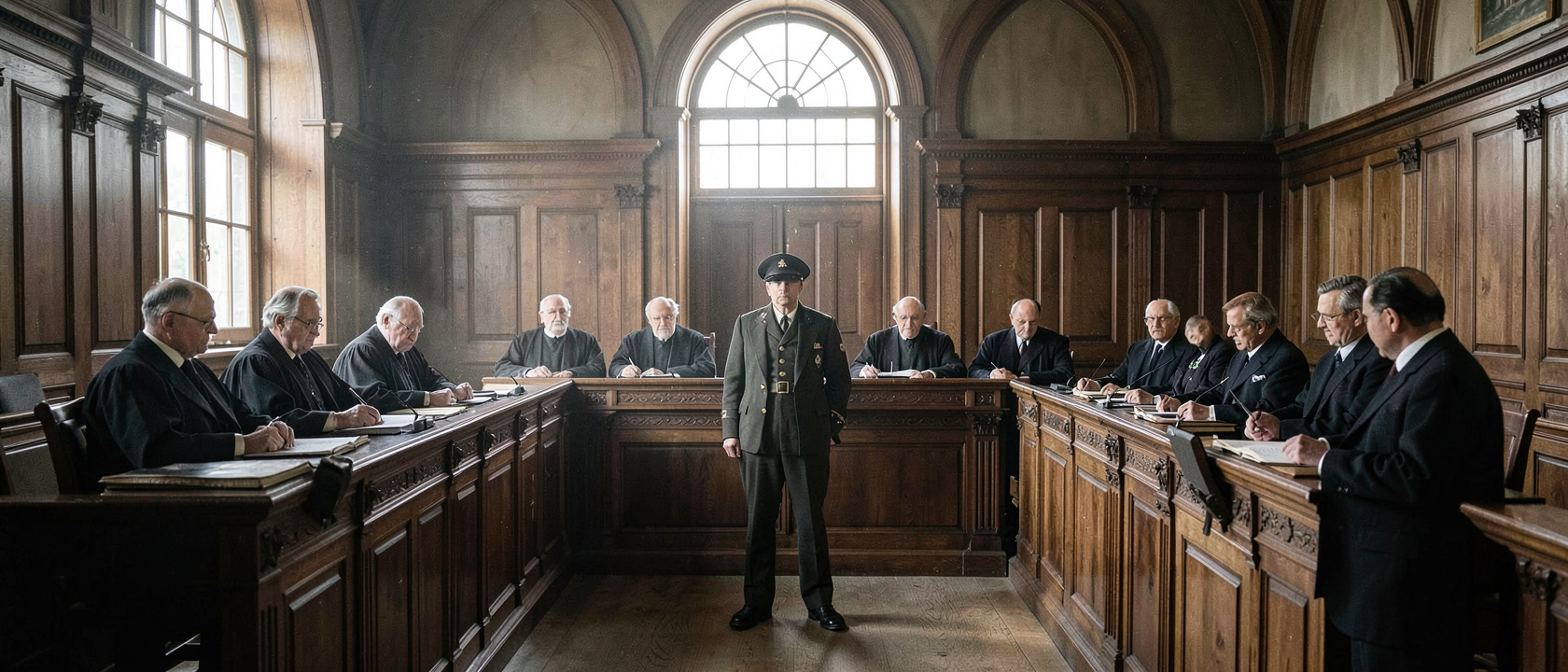
The first cases, against Lottmann, Niegel, and Sangerhausen, were heard in January 1921. The main session opened May 23 before a panel of seven judges in the Reichsgericht’s Criminal Senate and ran until July 16. By one count the court tried seventeen Germans in twelve proceedings across 1921 and 1922; another tally narrows it to twelve men, six of them convicted, on British, French, Belgian, and German charges.
The Llandovery Castle case showed why the arrangement satisfied almost no one. U-86’s commander, Helmut Brümmer-Patzig, who gave the order to fire on the lifeboats, had already left Germany and was reportedly living in Danzig (today Gdańsk, Poland), beyond the court’s reach. He was never tried. The court instead heard the case against two of his subordinates, First Lieutenants Ludwig Dithmar and John Boldt, charged over their failure to act when their commander opened fire on the lifeboats, a narrower charge than the killings themselves. Both were convicted and sentenced to four years in prison, in a verdict handed down in July 1921.
France and the other Allied governments called the results a farce and pulled their observers from the courtroom. Roughly 800 further war-crimes cases that reached the Reichsgericht afterward were discontinued, usually for lack of evidence. By January 1922, a commission of Allied jurists concluded unanimously that continuing at Leipzig was pointless and urged that Germany hand the accused to Allied trial instead. No extraditions followed.
The Twenty-Five-Year Ledger
Of everyone aboard HMHS Llandovery Castle, only twenty-four came back alive, all from the single lifeboat that got clear; every other boat was destroyed during the two hours U-86 spent among the wreckage. The Leipzig case against Dithmar and Boldt was the only legal reckoning that sinking ever received: four years apiece for two junior officers, while the man who gave the order was never brought before a judge.
The wider failure at Leipzig cost more than this one case. It set aside, for a generation, the idea that an international court could hold soldiers individually accountable for how they fought a war. It took a second global war and roughly twenty-five years before the Allies tried again, at Nuremberg and Tokyo in the mid-1940s. Even then, Leipzig’s record was not entirely wasted. Prosecutors preparing the new trials studied the Llandovery Castle verdict: a Soviet prosecutor cited it at the Kharkov trial against Nazi defendants, American jurist Telford Taylor drew on its reasoning about superior orders, and the United Nations War Crimes Commission noted it had been relied on again in the Peleus case. The legal reasoning outlived the court that produced it, though the deterrence the Allies wanted since 1919 never followed.
The Archival Gaps
Parts of this record stay incomplete. The number of people aboard HMHS Llandovery Castle before the attack is not settled in the surviving accounts behind this story, only the count of twenty-four who lived. The name of the ship’s master does not appear in those accounts either, nor does a full explanation of why only one lifeboat made it clear of the wreckage.
The Leipzig verdict carries its own loose ends. Sources disagree on whether the Dithmar and Boldt sentence was announced on July 12, 16, or 21, 1921, and a single, unconfirmed account claims the Reichsgericht later reversed the convictions on appeal. Commander Brümmer-Patzig, who gave the order that killed the survivors, was never cross-examined in any courtroom. The surviving record does not say when he left Germany, only that by the time of the trial he could not be reached.