
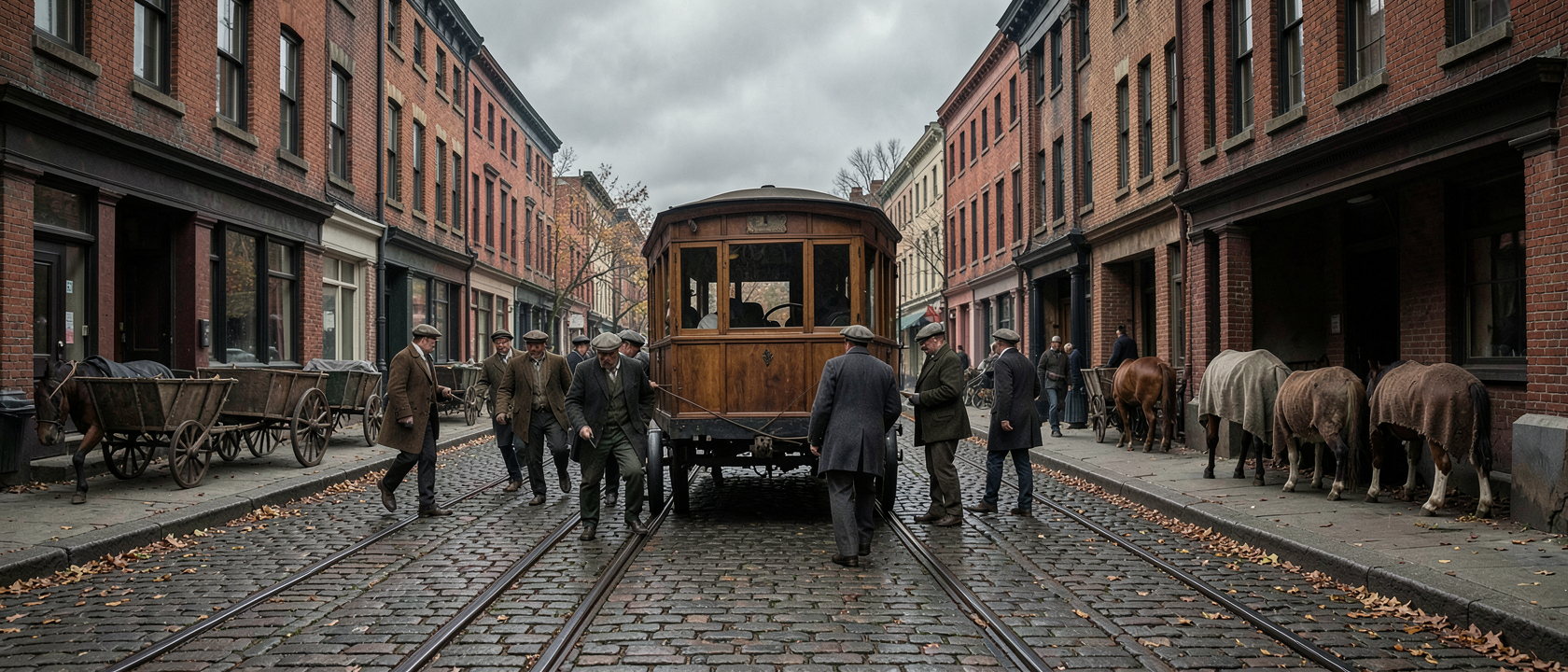
The Men on the Drag-Ropes
On the evening of November 9, 1872, a fire broke out in the basement of a warehouse on Summer Street in Boston, Massachusetts. Some accounts describe the building as a hoop-skirt factory, others simply as a commercial warehouse. Either way, Chief Engineer John Damrell’s department could not answer the alarm with its usual horse teams. Of the city’s 80 fire horses, only 3 had escaped the respiratory illness then moving through the Northeast; the rest stood in their stalls running fevers, coughing, with swollen throats.
Boston had seen the shortage coming. In the days before the fire, the department had rigged manual drag-ropes onto its steam pumpers and temporarily hired 500 men to stand by in case the engines needed hauling by hand. That night the arrangement was put to use. Firemen and the hired crews took up the ropes and dragged the pumpers themselves over the cobblestones. By 8 p.m. all 21 of the city’s fire engines had reached the scene, but the flames had already had an hour’s head start.
The Engine with Four Legs
By 1870, New York City‘s population was approaching one million, and the city moved on horses nearly as much as it moved on steam. Streetcar and stage companies alone kept some 14,000 horses in harness, out of a total city horse population near 38,000. Railroads and steamships carried freight between cities, but every one of those journeys ended the same way: a horse pulling the last stretch, from the rail depot to the factory floor or from the dock to the store shelf.
Horses already took up a disproportionate share of attention from the American Society for the Prevention of Cruelty to Animals, or ASPCA. Even before the autumn of 1872, more than half of the 1,533 cases the Society had brought to court involved drivers forcing sick or injured horses to keep working. Henry Bergh, its president, had spent years contesting the practice of overloading horse-drawn streetcars. The whole arrangement depended on the horses staying well.
The Gridlock of Autumn
The disease, an aggressive strain of equine influenza that would be remembered as the Great Epizootic (an epizootic being an epidemic among animals), is generally traced to Toronto in the summer of 1872, though sources differ on the exact month. From there it moved into New England and Michigan before reaching New York City that fall. On October 25, the New York Times ran the headline “The Horse Plague,” reporting 15,000 horses in the city unfit for use, up from 7,000 just a day before. By October 26, with roughly a quarter of the city’s horses sick, streetcar companies were losing more than $2,000 a day. Within weeks the illness had moved west to Chicago and south to Cincinnati, Norfolk, and Charleston.
Cities tried oxen as a substitute for sick horses, but the animals could not get traction on paved streets. Clerks and longshoremen ended up hauling delivery wagons by hand instead. Some streetcar companies, trying to keep their cars running, kept putting visibly sick horses back into harness. On November 2, Bergh wrote to the president of one streetcar line objecting to the practice, continuing a fight the ASPCA had been waging in the courts for years. Fire departments were hit hardest: in New York only 2 of the roughly 144 to 150 fire horses stayed healthy, and in Boston the ratio was almost the same, 3 out of 80.
Sixty-Four Acres and the Mechanical Shift
In Boston, the fire spread to a three-block radius by 10 p.m. and a five-block radius by midnight. It was brought under control the following day, with some sources giving November 10 and others November 11, after crews blasted gaps through whole blocks with gunpowder to create a firebreak. By then it had destroyed 776 buildings across 64 acres of the city’s commercial core.
In New York, the toll on horses was counted with more precision than almost anywhere else. The city’s assistant sanitary inspector put the epizootic’s death toll at about 1,400 horses, or 3.7 percent of the city’s 38,000, a figure close to the 1,412 the city’s Bureau of Sanitary Inspection later recorded. For weeks, streetcar lines and delivery routes ran at a fraction of their normal pace. City officials and transit operators drew a plain lesson from it: an animal that could fall sick overnight was an unreliable foundation for a transportation system, and the ASPCA’s long court fight over streetcar horses ended in 1873 with a ruling that stripped the Society of routine inspection powers while leaving it free to arrest drivers caught in the act.
The Unknown Vector
Nobody in 1872 could say exactly what was spreading. Germ theory had not yet taken hold in veterinary practice, so physicians blamed atmospheric poisons or vapors carried from Canada, and administered treatments like bloodletting or toxic doses of arsenic when rest alone was required. Modern virology traces equine influenza to two related viruses, equine 1 (H7N7) and equine 2 (H3N8). Outbreaks from around 1930 onward have been matched to specific strains of those viruses, one of them now believed extinct, but the agent behind the 1872 epidemic itself was never isolated.
No government body, local or federal, ever compiled a unified count of animal deaths. Estimates of mortality among sick horses run from 1 to 10 percent depending on the region, even though nearly every horse exposed to the virus fell ill. Across Canada and the United States, no comprehensive tally of animal deaths or economic losses was ever compiled, leaving the continent-wide total unrecorded.