
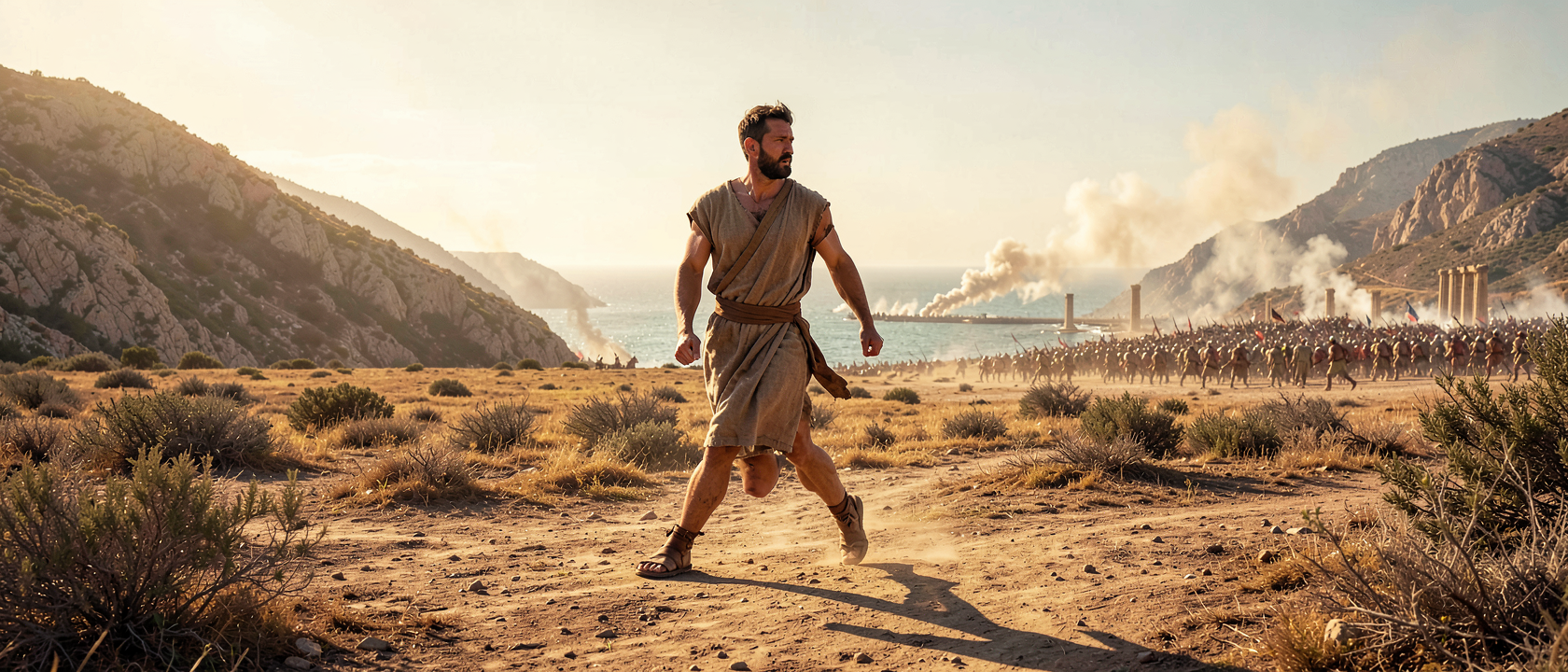
Millions of runners now cover 26 miles and 385 yards (42.195 km) each year, repeating what they understand to be an act of ancient Greek sacrifice: a messenger who ran himself to death announcing a battle won. The earliest and most reliable account of that battle, written by a historian with access to men who had fought in it, says nothing about any such run.
A Plain Near Marathon, 490 BCE
In September 490 BCE, a Persian invasion force under King Darius I landed on the plain near Marathon, in northeastern Attica. The Athenian commander Miltiades led roughly 10,000 hoplites, reinforced by 1,000 men from Plataea, against a Persian army ancient and modern sources size very differently: Britannica puts it at 15,000, other estimates run past 20,000. Darius’s field commanders were Datis and Artaphernes; the Athenian polemarch, Callimachus, died in the fighting. Miltiades thinned his center and strengthened both wings, drawing the stronger Persian center forward while the Greek flanks closed around it. Some modern historians doubt hoplites in full armor could have charged the whole breadth of the plain, and suggest they marched until in range of Persian archers before breaking into a run.
Herodotus, writing within living memory of the battle, put Athenian losses at 192 dead against 6,400 Persians, figures historians today treat with caution; some modern estimates put Persian dead closer to 1,000 or 2,000. Herodotus also records the runner most people associate with the word marathon, but places him before the battle, not after. He sends Pheidippides from Athens to Sparta, roughly 150 miles (240 km), to beg for military help, and has him arrive in about two days. On the road, Pheidippides meets the god Pan, who complains that Athens neglects him, and the Athenians respond by founding an annual ritual race in his honor. There is no death in this story, no run from Marathon to Athens, and no victory proclaimed.
The Silence in Herodotus
For a legend that would eventually define an Olympic event, its absence from the oldest surviving source is the whole problem. Herodotus never mentions a messenger running from Marathon to Athens, never has him collapse, and never gives him a famous last word.
The story appears for the first time more than five centuries after the battle. Writing in the 1st century CE, the essayist Plutarch names the dying messenger Thersippus or Eucles. A century later, the satirist Lucian of Samosata gives him yet another name, Philippides, and has him gasp out news of the victory before dropping dead. The ancient sources cannot agree on who the man was, what he was doing, or whether he died at all. There was never one original version to rediscover, only several, invented across several centuries and later merged into one.
A Legend Greece Could Use
In the 1870s, German archaeologist Ernst Curtius excavated ancient Olympia, uncovering the old stadium, baths, dining halls, altars, and a temple of Zeus. The dig returned the ancient Games to European attention at a moment when the modern Greek state was eager to connect itself to that classical inheritance.
In 1879, the English poet Robert Browning published “Pheidippides,” a poem that fused Herodotus’s genuine account of the run to Sparta with Plutarch and Lucian’s separate story of the dying messenger. No ancient writer had ever told that combined scene. Browning gave his runner a final line, “Rejoice, we conquer,” before dropping him dead in the Athenian assembly. That poem, not any ancient text, is the direct literary source for the race run today.
A Race With No Ancient Model
Baron Pierre de Coubertin began pushing to revive the Olympic Games in 1892 and founded the International Olympic Committee two years later. For the first modern Games, held in Athens in 1896, his associate, the French philologist Michel Bréal, proposed a new event built on Browning’s version of the legend: a run from Marathon to the Olympic stadium in Athens. The ancient Games at Olympia, held roughly every four years from as early as the 8th century BCE into the 4th century CE, had included boxing, discus, and footraces, but nothing longer than about 3 miles (4.8 km). The marathon had no ancient sporting precedent at all; it was built from a literary story about one man, not from any race Greeks had actually run.
On April 10, 1896, 17 athletes from five nations, Greece, Hungary, Australia, France, and the United States, lined up at Marathon for a run of about 25 miles (40 km) into Athens; Britannica’s figure of as many as 25 entrants differs from the official count of 17. Spyridon Louis, born in 1873 in Marousi, near Marathon, and remembered as a Greek water-carrier though his exact background is disputed, crossed the line in 2 hours, 58 minutes, and 50 seconds, more than seven minutes ahead of runner-up Charilaos Vasilakos. Gyula Kellner of Hungary finished third. The crowd treated Louis’s win as a restoration of ancient glory, in a stadium full of a nation hungry for exactly that, on an event that had existed for a single afternoon.
The Winner and the Woman Who Wasn’t Allowed to Run
Louis’s prize was a silver vase donated by Bréal and presented by the Crown Prince of Greece. Later retellings add free coffee and shaves for life, a marriage proposal, even a Hollywood film: claims repeated often enough to feel like fact, though none appear in any verified record.
Left out of the record entirely was Melpomene, a Greek woman who, by some accounts, ran the same 1896 course unofficially alongside the men. If she did, no result could credit her, because women were barred from Olympic marathon competition until 1984, a gap of 88 years between Louis’s medal and the first official women’s Olympic marathon, held at the Los Angeles Games.
Millions Run a Death No Historian Recorded
The distance now treated as sacred wasn’t settled in Greece. The 1896 course measured about 25 miles (40 km), and early Olympic marathons after it used slightly different routes each time. At the 1908 London Games, organizers laid a course between Windsor Castle and the Olympic Stadium that came to 26 miles and 385 yards (42.195 km). That figure stuck because of where an English castle happened to sit relative to a stadium; the distance wasn’t made official across the sport until 1921.
One year after Louis crossed the line in Athens, Boston held its first marathon, in 1897, and has run one every year since.