
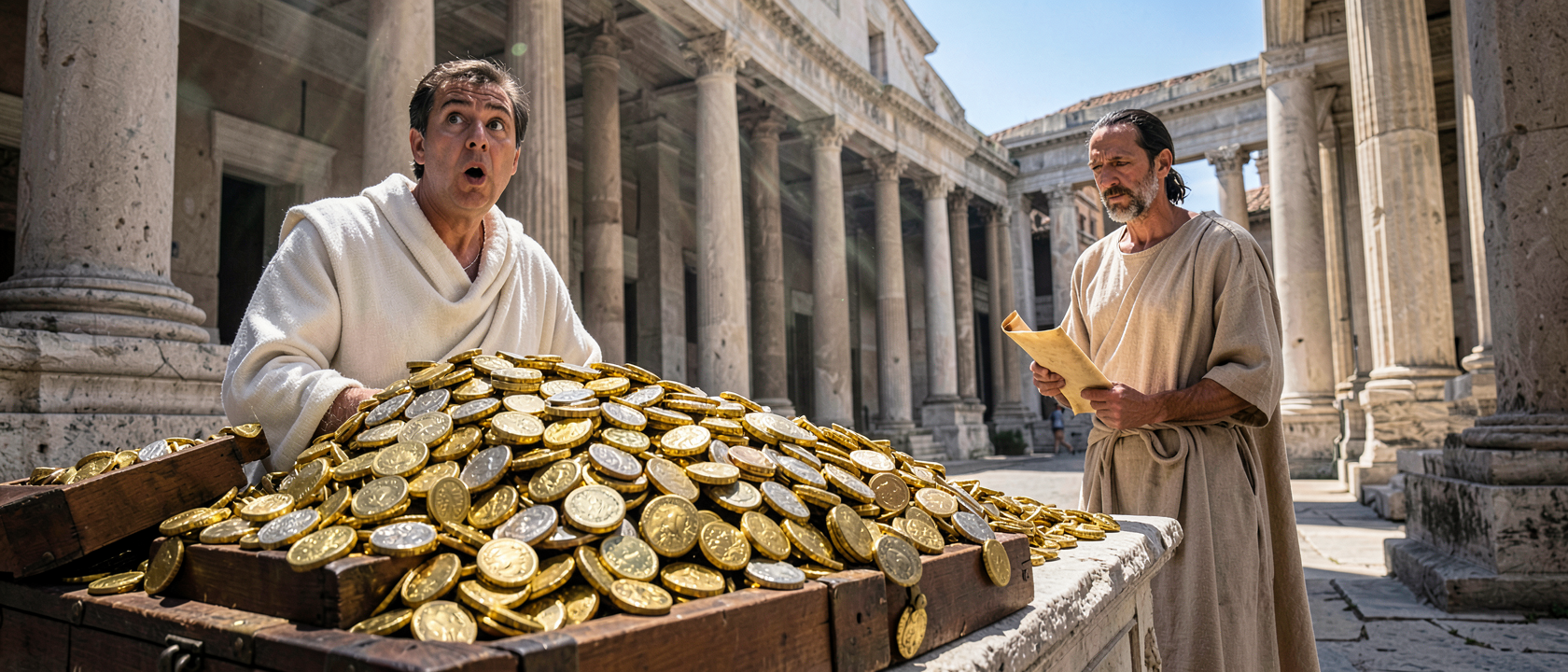
In Rome, sometime in the late second century BC, a senior statesman named Marcus Aemilius Scaurus stood at an auction block and placed a bid of 700,000 sesterces for a single enslaved man. It was, so far as the ancient record shows, the highest price ever paid for anyone born into Roman slavery, a figure that stood unmatched for more than two centuries. The man on the block had no military record and no foreign pedigree to explain the number. His name was Daphnis, and the price was for his command of language.
A bid that size invites easy guesses. People picture brute labor sold for a fortune, an exotic import bought as a trophy, or a young beauty kept for display. None of that fits here. Daphnis was a household-born slave trained as a linguist, skilled enough in Greek and Latin letters that Rome’s wealthiest men competed to own him. Within a few decades, even Julius Caesar would spend so heavily chasing scholars of the same kind that he ordered the real figures left out of his own ledgers.
Seven Hundred Thousand Sesterces
The sale falls somewhere in the window of roughly 115 to 100 BC, tied loosely to the political career of Marcus Scaurus. Ancient and modern sources generally identify him with the Marcus Aemilius Scaurus who held the consulship in 115 BC, though Pliny’s own text gives no exact year for the purchase, only the man’s rank. Pliny the Elder recorded the deal in his Natural History, written in the first century AD, and named the seller as Attius of Pisaurum, a town on the Adriatic coast of Italy (modern Pesaro). Pliny describes the buyer only as the “Head of the state,” marking Scaurus as one of the most senior men in Roman public life.
Daphnis himself was what the Romans called a verna, a slave born inside a household rather than captured in war or shipped in from a foreign market. He had no battlefield story to raise his value. What he had was learning: Pliny calls him a skilled linguist, trained to a level in Greek and Latin that made him, on paper, worth more than any other enslaved person Rome had ever recorded a price for.
The Price of Learning
Most enslaved Romans never came near that kind of money. Field hands and ordinary household servants typically changed hands for a few hundred to a few thousand sesterces, prices set by age, health, and plain usefulness. Daphnis’s price did not belong on that scale at all. It belonged to a separate market, one built around education rather than muscle.
By the late Republic, Rome’s senatorial elite ran on written and spoken Greek nearly as much as on Latin. Letters, oratory, law, and diplomacy all depended on men who could read, translate, and argue at a high level, and keeping that skill inside one’s own household carried real weight. A grammarian of Daphnis’s standing was less a servant than a standing asset, the kind of purchase a competitive aristocrat could point to as proof of his own household’s intellectual reach.
The Making of a Scholar
Daphnis’s mother was enslaved at Pisaurum, and the seller recorded in Pliny’s text, Attius of Pisaurum, shares a name with the Accii, a family whose most famous member was the tragic poet Lucius Accius (also spelled Attius in some ancient texts). Accius had been born at Pisaurum in 170 BC, the son of a freedman probably from Rome, and went on to write some fifty tragedies, of which about 700 lines survive, along with verse treatises on literary history and a work on farming. He lived long enough that Cicero, born in 106 BC, later recalled discussing literature with him, and is thought to have died around 86 BC.
Whether Daphnis trained directly under Accius or simply grew up within the family’s wider circle at Pisaurum is not something the surviving sources settle. What they do agree on is the return on that education: Daphnis was sold not once but twice at the same extraordinary price, 700,000 sesterces each time, a figure no other recorded sale of an enslaved person in Rome ever matched.
Above the Wealthy Baseline
Set against Rome’s property classes, Scaurus paid an amount rivaling an entire elite fortune for one man’s fluency in two languages. It was wealth sufficient to underwrite an entire aristocratic household, handed over in a single transaction.
The habit did not end with Scaurus. Decades later, Julius Caesar competed so hard in the same market for refined, highly educated slaves that the prices embarrassed even him. Suetonius wrote that Caesar spent such large sums on these purchases that he ordered his own secretaries to leave the real figures out of his household account books, rather than let the true numbers stand on record.
The Gaps in the Record
Not everything about the sale survives. Pliny never gives an exact year, fixing it only loosely within Scaurus’s career, and no ancient source confirms whether Daphnis ever worked under Lucius Accius in person or only within the family’s broader network. A 2022 reconstruction by the classicist Harriet Flower, published in the journal Classical Philology, places his active years closer to the 80s BC, later than the date usually tied to Scaurus’s consulship in 115 BC. The two datings do not agree, and the ancient evidence alone cannot settle which is right.
The accounts that preserved the price say nothing about whether Daphnis was ever freed. Flower’s research argues that he eventually was, taking the name Quintus Lutatius Daphnis once manumitted, a name that points to a member of the Lutatius family as the one who freed him. Pliny and Suetonius, the two writers who kept the price itself on record for later generations, never mention that part of his life at all.