
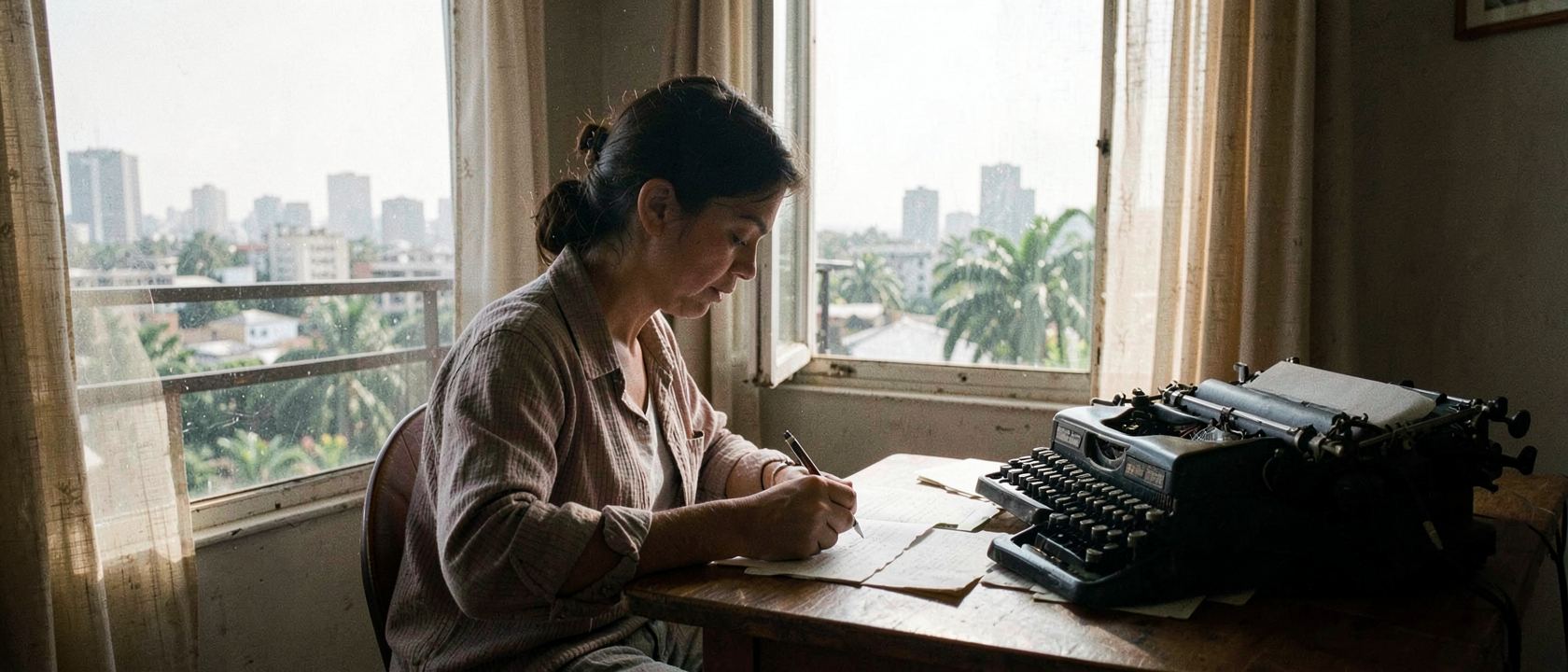
On January 8, 1981, in a rented apartment in Caracas, Venezuela, Isabel Allende sat down to write to a man she could not go see. Her grandfather was dying in Santiago, Chile, close to ninety-nine years old, and the exile that Chile’s military government had forced on her made a visit impossible. The letter she began that night did not stay a letter for long.
January 8, 1981
Allende later said she wrote the first pages at her late grandmother’s seance table, working at night after her days were taken up with other things. The pages kept coming. What she meant as a few lines of comfort for a dying man grew, over the months that followed, into a manuscript that ran to roughly five hundred pages by the time she judged it finished, sometime in 1982.
For a long stretch she did not call it a book. It was simply the letter to her grandfather, a record of family voices she was afraid would go quiet with him.
The Cost of September 11, 1973
The reason she was writing from Caracas instead of Santiago reached back almost eight years. On September 11, 1973, the Chilean armed forces overthrew President Salvador Allende, her father’s first cousin, and his government fell. Within days the poet Pablo Neruda was dead. In the violence that followed, the folk singer Víctor Jara was tortured and killed by soldiers.
Isabel Allende stayed in Chile for a time after the coup before leaving for Venezuela in 1975, once she had spoken out publicly against General Augusto Pinochet’s junta, the military council then running the country. Exile, once it began, was not something she could end simply by wanting to go home.
The Trueba Dynasty on Paper
By 1982 the letter had become a four-generation novel, The House of the Spirits (La Casa de los Espíritus), built around a family called Trueba. At its center stands the patriarch Esteban Trueba, master of an estate named Las Tres Marías that stands in for the large landholdings Salvador Allende’s government had tried to break up through agrarian reform. Trueba builds schools and welfare for the people who work his land, and in the same pages he abuses them and fathers children he refuses to claim.
Several of the book’s characters map onto real people from the period. The poet who dies soon after a coup in the story draws on Neruda; the folk singer Pedro Tercero García draws on Jara; a political figure known only as the Candidate draws on Salvador Allende himself. Several Spanish-language publishers turned down the five-hundred-page manuscript before it finally reached print in 1982, in Barcelona by one account and in Buenos Aires by another.
The Toll of the Purges
The novel’s success changed nothing about what had already happened in Chile. Neruda and Jara were both gone within weeks of the coup. Thousands of Allende’s compatriots were scattered into exile alongside her, unable to go home while the junta held power, some of them for years longer than she was.
The book’s closing chapters carry that history straight into the Trueba family. Esteban Trueba’s granddaughter, Alba, is tortured and raped in custody by Esteban García, the patriarch’s own illegitimate grandson, who has risen through the security forces the dictatorship built. The branch of the family Trueba abandoned turns on the branch that kept his name and his land, a design Allende used to show how resentment nursed across generations could turn into state violence.
Recognition for the book followed steadily. Chile named it novel of the year in 1983, it won the Grand Prix d’Évasion in France in 1984, and it was a finalist for the National Book Award for Fiction in the United States in 1985.
The Debate Over Document and Fable
Critics have argued for decades over whether the novel’s magic sharpens its politics or dulls them. Clara, the clairvoyant matriarch who moves salt shakers and speaks with the dead, carries the clearest dose of magical realism through the book. The critic Christopher Hitchens read that supernatural layer as a vehicle carrying a hard class critique of Chilean society into living rooms that might never have opened a conventional political history.
Other readers, including Chilean literary scholars, have argued close to the opposite: that dressing the precise cruelty of a police state in fable let the people responsible for it off more easily than a plain account would have. Allende herself described leaving the country unnamed in the novel as deliberate, a way to show that what happened in Chile could happen in any society split by the same kind of inequality.
In 2003, in her memoir My Invented Country, she went further, writing that the land reform Salvador Allende’s government had pushed through had carried serious costs of its own, a judgment she applied to the same history her first novel had already tried to hold.