
Off the Road
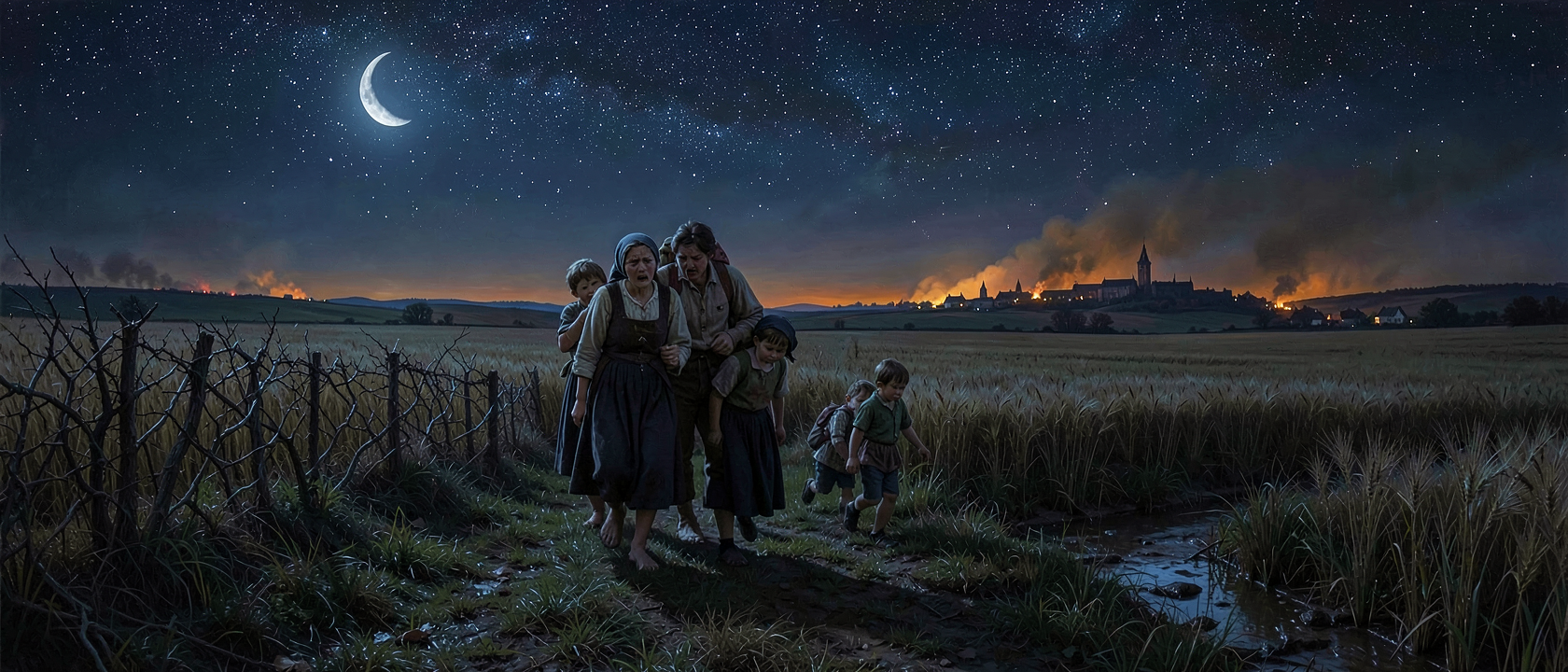
On the evening of June 22, 1635, Hans Heberle left Neenstetten. He was a shoemaker and small farmer, born in the village in the spring of 1597, and he had lived through seventeen years of war already. He took his wife and their three young children and walked south toward Ulm, but he did not take the road. Imperial troops were quartered close enough that the direct route carried real risk: soldiers demanded food and lodging by force, plundered what they chose, and civilian travelers on roads had little recourse. So Heberle led his family through fields, hedgerows, and ditches instead, across roughly 12 miles (20 kilometers) of rough ground, overnight, in the dark.
He recorded it himself. That is why we know the date, the route, and the reason.
The Shape of the Danger
The Thirty Years’ War had been grinding through Central Europe since 1618, when the future Holy Roman Emperor Ferdinand II moved to impose Roman Catholic absolutism on Bohemia and the Protestant nobles there revolted. By June 1635, the conflict had run seventeen years without resolution. The armies moving through Swabia at this point were not passing through; they quartered in villages, consumed what the local population had stored, and took the rest. For a family on a road at night, the calculation was straightforward: the road was faster and easier, but it led through places where soldiers sat. Open country was physically punishing, especially with small children, but it reduced the chance of a direct encounter.
There was no safe option. There was a worse one and a less-worse one.
Arrival and Waiting
The Heberle family arrived at Ulm in the early hours of June 23, 1635. Ulm was a Free Imperial City (“Freie Reichsstadt Ulm”), a city that held its charter directly from the Holy Roman Emperor rather than from any territorial lord, and one that had been Protestant since 1530. In periods of military danger, its walls made it a refuge for civilians from the surrounding countryside, and thousands had converged on it during this same stretch of fighting. Heberle’s family joined them.
They stayed for more than a month. In early August 1635, the authorities judged conditions safe enough for refugees to return to their home villages, and the Heberles went back to Neenstetten. What the family ate during those weeks, where they slept, and what conditions inside the crowded city were like for them specifically: none of that is specified in the known record.
The Thirty-Times Man
The June 1635 crossing was Heberle’s fifth such flight. He would go on to record close to 30 in total across the span of the war; scholarship drawing on Peter Wilson’s work on the period puts the figure at 28 flights to Ulm alone, with additional escapes to other towns or into the woods. Whether “close to 30” is Heberle’s own tally or a figure derived by later historians is not resolved in the available scholarship.
He recorded all of it in a document he called the Zeytregister, a German word meaning roughly “time register” or chronicle. He had begun writing in 1618, prompted by a comet he observed in November of that year, which he took as an omen of great events. He compiled the record from direct observation, from conversations with travelers passing through, and from reading broadsheets. He kept writing until 1672. The intended audience was his own household, not any public readership.
Heberle could read and write, which was not standard for a bonded craftsman in 17th-century Swabia; his schooling had been unusual for his social class. The Zeytregister ran to 184 pages and was first published in 1975, when Gerd Zillhardt edited and released it through the Ulm City Archive as volume 13 of Forschungen zur Geschichte der Stadt Ulm. Before that, it had survived in manuscript for three centuries.
What It Cost, at Two Scales
For the Heberle family, the bill accumulated across years. Close to 30 flights on foot, each one carrying the same calculation about roads and soldiers. During the war, Heberle and his wife lost seven children. He lived to approximately 80, dying in 1677, twenty-nine years after the Peace of Westphalia ended the conflict in October 1648.
For Europe, the Thirty Years’ War’s mortality is estimated at around five million dead, the figure used in the scholarship that draws most directly on Heberle’s account. Historians working from different methodologies put the range considerably wider: the generally accepted band runs from around 4.5 million to 8 million, and some estimates reach higher. The majority of deaths came not from combat but from famine and disease. In the German territories, population decline is estimated at around 30 percent on average; in Brandenburg, losses reached an estimated 50 percent; in some areas, close to two-thirds of the population did not survive the war period.
Those two scales sit alongside each other in the record without any single document connecting them. Heberle did not write about statistics; he wrote about what happened to him and the people around him, which is precisely the category of evidence that is otherwise almost entirely absent for this conflict.
The Edges of the Record
Several things about the Zeytregister remain uncertain. Whether Heberle shared it beyond his household, read portions of it aloud, or kept it entirely private is not established. The full date range of his writing is known only at the broad level: begun in 1618, extending to 1672. Whether he composed it continuously across those decades or assembled parts of it retrospectively is not specified in the available scholarship.
What is clear is that the document exists, that it covers the duration of the war at the level of a working craftsman’s direct experience, and that it represents a category of evidence that survived almost nowhere else. Most civilian experience of the Thirty Years’ War is recoverable only through aggregate mortality figures, administrative records, or passing mentions in military sources. Heberle sat down and wrote what happened to him, repeatedly, across fifty-four years. The Zeytregister is what that looks like: 184 pages of flights, losses, and returns, written by a man who had no reason to expect anyone beyond his own family would ever read them.