
A Union of Crowns, a Century of Friction
The Kalmar Union was assembled in June 1397 at Kalmar, its premise straightforward: one monarch would rule Denmark, Norway, and Sweden together. The political architect was Queen Margaret I of Denmark; the first king crowned under the arrangement was Erik of Pomerania, on June 17, 1397.
The union held across the following century but did not sit evenly on all three kingdoms. After 1448, Sweden rebelled repeatedly against what it understood as unionist centralization, led mainly by the Sture family, regent-governors who ruled Sweden in practice while formally acknowledging the shared crown.
The last of that line was Sten Sture the Younger, regent from around 1512. Christian II of Denmark, born July 1, 1481, king of Denmark and Norway since July 22, 1513, launched his invasion of Sweden in 1519 with papal backing, allied with Archbishop Gustav Trolle of Uppsala, the pro-unionist cleric whom Sture had deposed and imprisoned in 1517. Sture was mortally wounded at the Battle of Bogesund on January 19, 1520, and died on the ice of Lake Mälaren on February 3. The resistance lost its organizing center, and in September 1520 Stockholm fell.
The Coronation and the Promise
Before Stockholm surrendered, Christian had offered amnesty and favorable terms to his opponents. Swedish nobles, church officials, and city administrators accepted him as king and agreed to attend the post-coronation celebrations.
On November 4, 1520, Archbishop Trolle anointed Christian II as king of Sweden at Stockholm. The guests gathered at Tre Kronor Castle included, in many cases, exactly those who had spent the previous decade organizing resistance against Danish authority. A formal royal pardon drew them into the city and held them there, openly identified and unarmed.
The legal mechanism set against them worked through a different category of law entirely. Trolle had compiled a list of opponents who had wronged him, those who had ordered demolition of his fortress at Almarestäket, those who had imprisoned him. Under canon law, heresy was a religious matter, not a political one. A royal pardon covering political offenses did not extend to heresy. The charge converted the political purge into a religious-judicial proceeding, leaving the amnesty’s protections technically intact and practically voided.
Nightfall, November 8
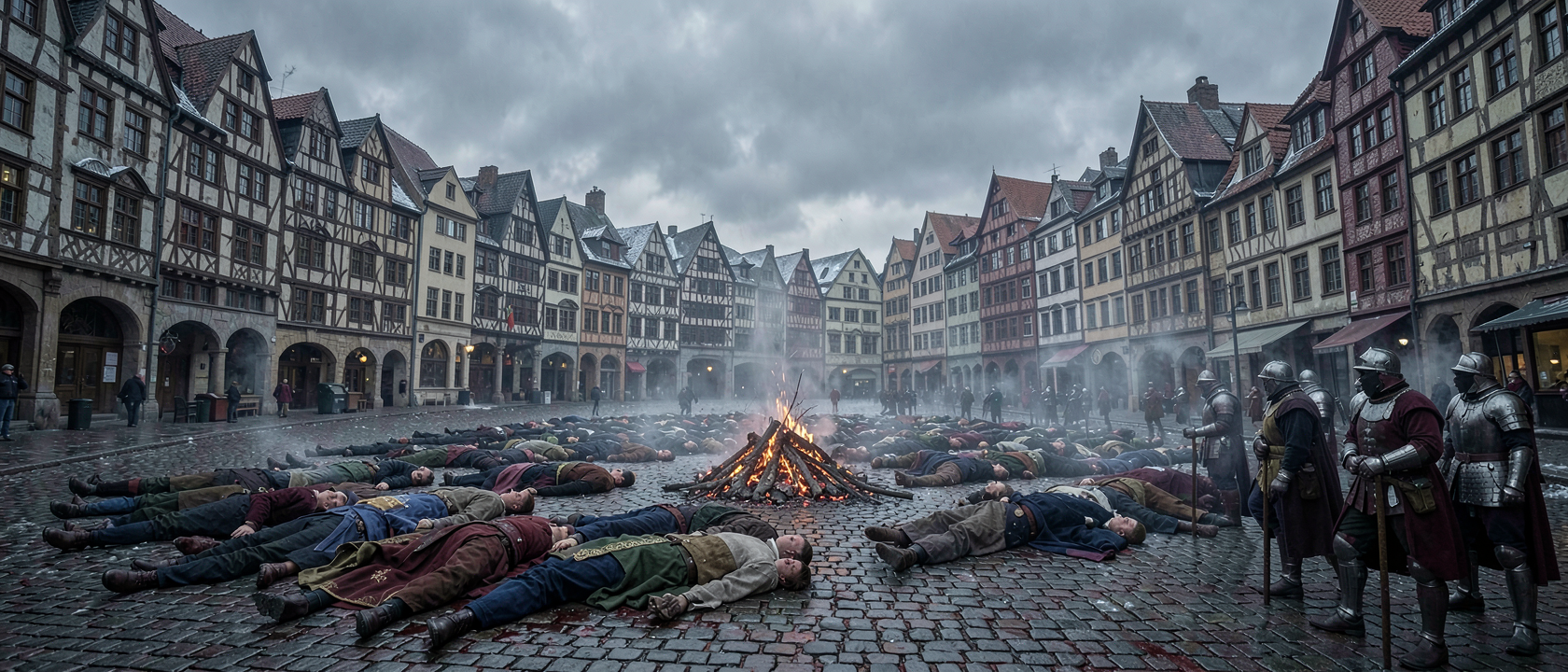
After dark on November 8, 1520, organized forces arrested the guests at Tre Kronor Castle: members of the Swedish council of state, senior churchmen, among them Bishop Vincent of Skara and Bishop Matthias of Strängnäs, city administrators, knights, nobles, and ordinary residents. The scope and timing point to advance preparation.
The prisoners were charged with heresy, tried, and executed at Stortorget, the main square of Gamla Stan. The exact span of the killings is disputed: Britannica records November 8 and 9; other sources extend to November 10; Wikipedia gives November 7 through 9. Both hanging and beheading were used; afterward, the bodies were broken apart and burned.
The punishment reached even the already dead. The corpse of Sten Sture the Younger was exhumed and burned at Stortorget, condemned posthumously as a heretic. The priest Olaus Petri, who witnessed the killings, recorded that a man named Lasse Hass was sentenced to death for weeping at what he saw. The executions subsequently spread to other parts of Sweden and into Finland.
What We Can and Cannot Count
The death toll is genuinely disputed. Britannica records more than 80; the figure 82 appears in several accounts, including those of The Local. The Swedish History Museum puts the total at nearly 100. The eyewitness account attributed to Olaus Magnus, a Swedish canon and chronicler whose handwritten record was later found in a copy of Gesta Danorum, held at the Royal Library of Sweden, states over 120 persons. The variation almost certainly reflects differing decisions about whether provincial executions elsewhere in Sweden and Finland are included.
Two distinct Swedish clerics witnessed these events and are sometimes confused. Olaus Magnus, born in October 1490, left the handwritten account confirmed by the Royal Library. Olaus Petri, born January 6, 1493, in Örebro, was the priest who attended the coronation and separately recorded what he observed.
The Bill
Breaking apart and burning the victims’ remains denied the dead a Christian burial and extinguished the property and inheritance claims that heirs might otherwise have brought forward. The intent was erasure, of the bodies, of the bloodlines, of the legal standing that survivors might use to seek redress.
The political damage to Christian II became apparent within months. Surviving Swedish nobility and clergy, most with kin among the dead, had no remaining basis for trusting a Danish royal guarantee, the amnesty itself had been the instrument of the killing.
Gustav Eriksson Vasa, whose father Erik Johansson Vasa had been executed in the Bloodbath, raised a rebellion in 1521, rallying the province of Dalarna with backing from Lübeck and the Hanseatic League. Christian II, meanwhile, was deposed as king of Denmark and Norway in 1523 and replaced by his uncle, Frederick I. On June 6, 1523, the Swedish council at Strängnäs elected Gustav Vasa as king, formally ending the Kalmar Union after 126 years. June 6 is now recognized as Sweden’s National Day.
Gustav I centralized royal authority, separated Sweden from the Roman Catholic Church, and established hereditary succession in 1544. By his death on September 29, 1560, the crown held an estimated 60 percent of Swedish soil. Historians have noted, without resolving it neatly, that the Bloodbath had eliminated much of the high nobility that might otherwise have checked his consolidation of power. The House of Vasa continued to reign until 1818.
Christian II acquired the name Kristian Tyrann in Sweden. Assessments in Denmark have been more mixed, some historians pointing to his reforming inclinations while acknowledging his reputation was partly shaped by Gustav Vasa’s political messaging. On the events of November 1520 themselves, the sources do not disagree about what happened, only about how many people it took to carry it out.