
What the King Carried
In the autumn of 1216, King John of England kept his treasury close. A civil war had been grinding for over a year, Prince Louis of France held London and much of the south and east, and no fixed location was safe. The wealth traveled with him.
What that wealth amounted to was substantial even by royal standards. John carried two complete sets of royal regalia: crowns, swords of state, scepters, and formal garments of kingship. One set had belonged to his grandmother, Empress Matilda, and included a German crown of notable quality. Beyond the regalia sat gold and silver plate, rings, jeweled crosses, reliquaries, and coin. John had written to seventeen senior clergy on June 24, 1215, demanding the return of items in their custody; by late July, the recovered inventory ran to 143 cups, 14 goblets, 52 rings, 2 gold crosses, and dozens of other objects. The Bishop of Norwich had given John a clasp set with emeralds and rubies; Pope Innocent III had sent four rings approximately eleven years before the end of John’s reign.
On May 28, 1215, the Knights Templar returned Empress Matilda’s regalia to John. Around a year later, in mid-1216, the Knights Hospitaller delivered the remaining set. By autumn the treasury was the financial and symbolic core of John’s authority, and he could not afford to leave any of it behind.
The Road He Was Forced to Take
Prince Louis landed in England in May 1216 at the invitation of the rebel barons and within weeks held London. John’s response was a relentless circuit through the midlands and east, but the royal baggage train could not keep pace with a mounted force. John himself could cover 40 to 50 miles on a good day; the wagons and packhorses could not match that and traveled separately.
By October 1216, John had reached King’s Lynn, on the southern edge of the tidal estuary then known as the Wellstream, the broad coastal inlet now called the Wash. The baggage train was routed across the estuary while John traveled ahead. At low tide, a sand path crossed roughly 4.5 miles between Walpole Cross Keys on the western bank and Long Sutton on the eastern side, a crossing that was a standard feature of medieval road travel in the region. The problem, in October 1216, was the tide.
Nine Days in October
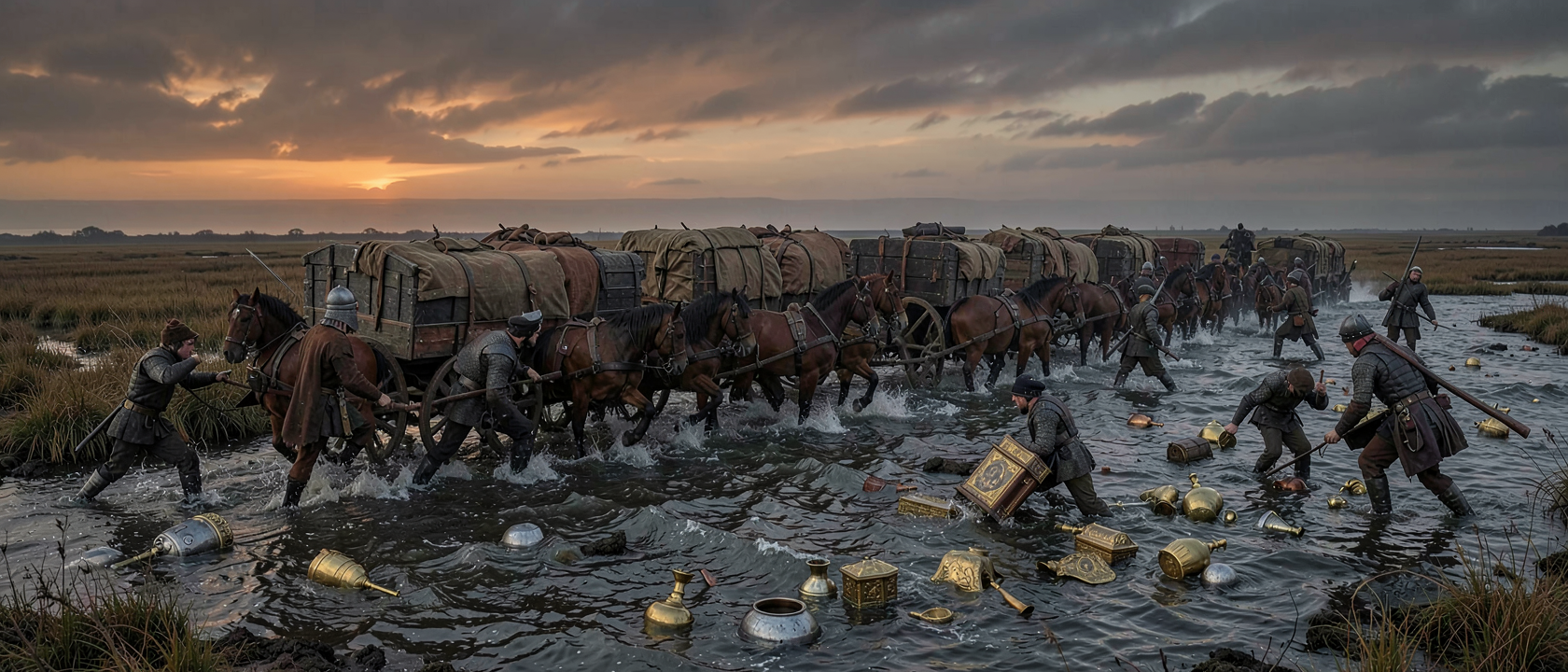
John arrived in King’s Lynn on October 9, 1216. The baggage train, traveling separately, was caught by the incoming tide while crossing the Wellstream. Contemporary records confirm that wagons, packhorses, and treasure were lost to the tidal sands. No eyewitness account lists what went under, and the precise volume of the loss was never recorded.
John was already ill. He moved north through Lincolnshire after the disaster, reaching Newark Castle in Nottinghamshire, where he died during the night of October 18 to 19, 1216, most scholars place the death in the early hours of October 19. He was 49 years old. The chronicles give dysentery as the cause. The loss of the treasure and the death of the king are separated by nine days.
Two Coronations
Henry III was nine years old when his father died. He was crowned at St. Peter’s Abbey in Gloucester on October 28, 1216, with the country still at war and no safe route to Westminster, using a golden circlet in place of a crown. Whether this was because at least one of John’s crowns had been lost in the Wellstream, or simply because transporting regalia through hostile territory was too dangerous, the sources do not settle.
On May 17, 1220, Henry was crowned a second time at Westminster Abbey using regalia items that correspond in the records to pieces from John’s treasury, including a crown, sword, and scepter. Historian David Carpenter has noted the correspondence with John’s known inventory. Some of what John carried reached his son safely. At least one crown and several other items disappear entirely from the documentary record after October 1216. The two coronations together define the problem precisely: some things survived, some did not, and the line between them has never been drawn with certainty.
What the Chroniclers Argued Over
Roger of Wendover, a monk at St. Albans Abbey, built a narrative in which John’s final illness was caused or worsened by grief and shock at the loss of the treasure. Ralph of Coggeshall’s account breaks that chain: he indicates John had already contracted dysentery while in King’s Lynn, before the baggage train was lost. The two accounts do not simply differ in emphasis; they produce different chains of cause and effect. Wendover’s version spread more widely and fed a tradition of dramatic interpretation. Subsequent historians have dismantled it without replacing it with a cleaner story, because no eyewitness account of the crossing survives and the medical details of John’s final days are too sparse to support certainty. Within years of the king’s death, the narrative was already contested.
Eight Centuries of Looking
In 1906, historian W.H. St. John Hope proposed a specific crossing route for the baggage train; by 1913, engineers and hydrographers had raised serious doubts, and World War I interrupted further work. In 1972, G.F. Tagg used resistivity surveying to identify a probable crossing path roughly 3 miles long, running somewhat south of Hope’s line, redirecting the search without resolving it.
A dig at Tydd St. Giles in 2016, around the 800th anniversary of the loss, recovered only minor artifacts. In March 2024, planned construction of a solar farm near Walpole Marsh prompted a larger excavation led by the West Norfolk and King’s Lynn Archaeological Society, at a site approximately 5 miles (8 km) from the current coastline, a measure of how radically the landscape has changed since the 13th century. No gold, jewels, or regalia came out of the ground. More than a century of survey and excavation has narrowed, but not closed, the area of probability. The baggage train’s contents, whatever they amounted to in October 1216, remain where the tide put them.