
The Clear Morning
November 1, 1755 was All Saints’ Day, one of the major feast days on the Catholic calendar, and Lisbon’s churches were full that morning. Many households had lit candles for Mass. An English merchant living in the city later wrote that nothing in the sky or the air gave any warning of what was coming: the morning was ordinary, calm, and clear.
Lisbon was one of the great port capitals of Europe, built on trade with Portugal’s overseas colonies, densely built, and crowded close to its harbor. Nothing about the start of the holiday suggested any of it was in danger.
What Was in Reach
Lisbon sat inside an active seismic zone running along the Atlantic side of Portugal and Spain, tied to a fault system known today as the Azores-Gibraltar Transform Fault. This was already the third major earthquake to strike the city, after quakes in 1356 and 1531. Southern Portugal lay within reach of a strong shock, and so did southern Spain and the Moroccan coast, all sitting along the same stretch of ocean floor.
The Shaking
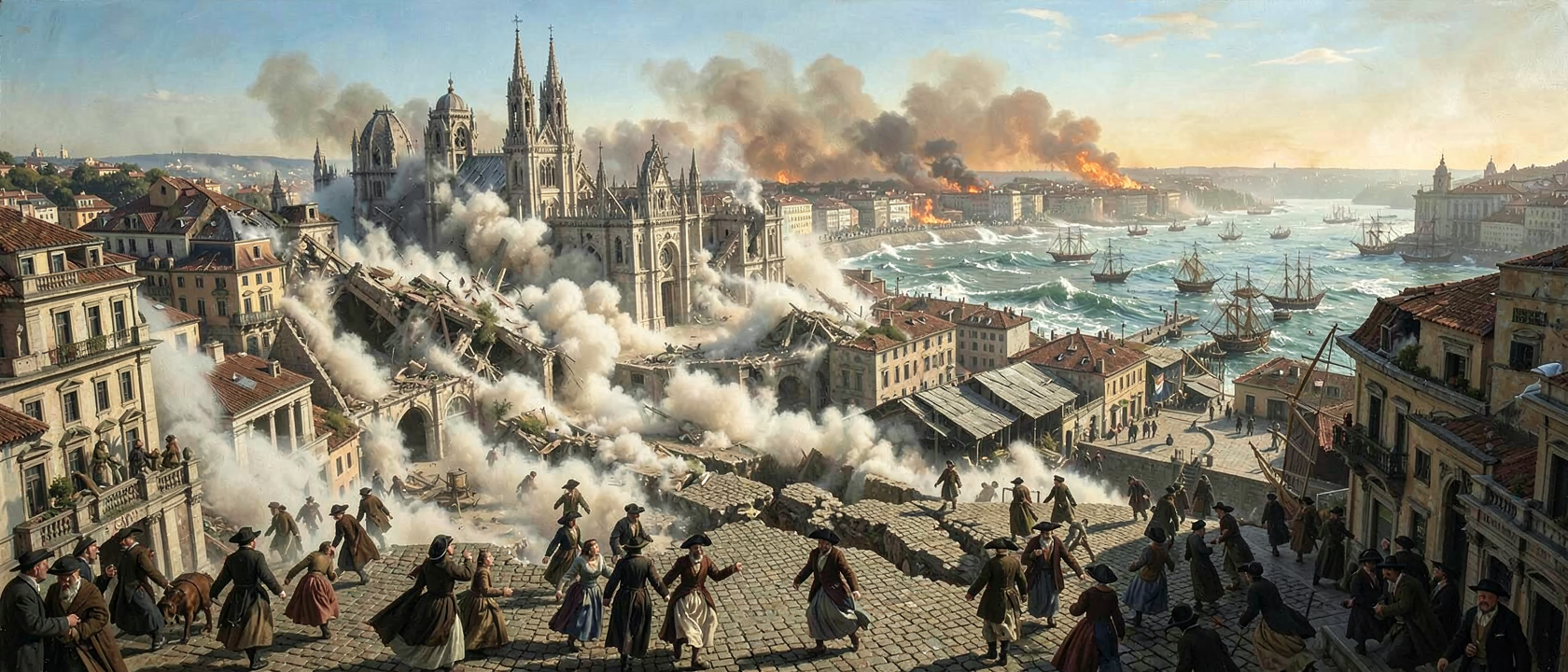
The ground under Lisbon began to move at around 9:40 in the morning, according to most modern reconstructions; the primary eyewitness account puts it closer to 9:30. Three separate tremors struck over roughly ten minutes. Modern estimates place the magnitude somewhere between 7.7 and 9.0, a spread wide enough that researchers still argue over it, since no instrument existed in 1755 to measure it directly. What is not in dispute is the intensity on the ground: shaking strong enough to register at level XI, Extreme, one step short of the top of the scale used to gauge historic earthquakes. Churches packed for the holiday came down on the people inside them. An estimated 12,000 dwellings collapsed along with major public buildings across the city.
The Wave
People fleeing the collapsing buildings ran for open ground: the riverbank and the waterfront, away from anything that could fall on them. About forty minutes after the main shock, a tsunami came in off the water, reported at around 20 feet (6 m) in the harbor area. Many who had escaped the earthquake by reaching the water found no safety there either.
The Fire
Fires broke out among the wreckage soon after, possibly fed by candles lit for the holiday and by untended kitchen fires, though no source states exactly how they began. What the record does give is duration: more than a week by the earliest account, with other reconstructions putting it closer to five or six days. Whichever figure is right, the fire outlasted the quake and the wave by days, working through buildings the shaking had left standing.
Felt Across an Ocean
The tsunami did not stop at the Portuguese coast. It reached southern Great Britain and Ireland. Accounts from the period describe its effects as far as the Caribbean, including Barbados and Antigua, and the earliest surviving record places its reach at Newfoundland as well, though that particular claim is harder to confirm independently. A wave generated off the coast of Portugal was measurable on the far side of the Atlantic.
What the Record Doesn’t Say
What the sources will not give is a number. There is no single confirmed death toll for Lisbon in 1755, and no agreed figure for what the disaster cost in money or property. Estimates that circulate elsewhere run from as low as roughly 12,000 dead to figures well above 100,000, depending on which historian’s method is used; no one number commands agreement. What is not in dispute is the description of a city and a stretch of coastline left in ruin. Wherever a precise casualty figure gets repeated as settled fact, it should be read as an estimate, because that is all any of them are.
God or Nature
The earthquake became an argument almost as fast as it became a ruin. It fed directly into one of the defining debates of the Enlightenment: whether a disaster on this scale was divine punishment or simply the mechanical behavior of a natural world indifferent to who stood on top of it. The question reached into theodicy, the old theological effort to explain how a just God allows suffering, and it was not settled in 1755. The record here does not say which thinkers carried the argument forward in the years after, or how Lisbon itself was eventually rebuilt. What it leaves behind is the ruin, and the question the ruin forced open.