
The Pastry Shop, December 1828
In December 1828, a riot swept through the Parian, a market for luxury goods in the Zócalo, Mexico City’s central square. Soldiers sent to put it down wrecked the shop of a French pastry maker, sometimes named as Monsieur Remontel, and his damage claim came to 1,000 pesos. (Some accounts instead trace Remontel’s claim to a separate 1832 looting in Tacubaya, then a town outside Mexico City, for which he sought 60,000 pesos on a shop worth less than a tenth of that; historians disagree on which incident gave the war its name.) France’s government held a longer list of unpaid claims from its citizens in Mexico that year. The pastry shop was simply the detail that stuck.
A Hero Already Fallen
By 1838, the man who would turn this dispute into his own comeback had already lived one full political life. In 1829, General Antonio López de Santa Anna defeated a Spanish army at Tampico, and the victory made him a national hero. An unsuccessful presidency followed, and in 1836, during the Texas Revolution, he was defeated and captured at San Jacinto, then forced to accept terms Mexicans found humiliating. By 1838 he was out of power, living at his hacienda, Manga de Clavo, near Xalapa. One observer described him then as “gentlemanly and melancholy-looking,” passing his days like a philosopher in dignified retirement, fond of gambling and cockfights and, critics said, still fond of the national treasury.
The Bill Multiplies
Through the early 1830s, French diplomats pressed Mexico City over the unpaid claims of its citizens. In spring 1838, King Louis-Philippe’s government backed the claims with a fleet that reached Veracruz that February. Within months, France’s prime minister, Louis-Mathieu Molé, was demanding 600,000 pesos in compensation, six hundred times the 1,000-peso claim from the Parian shop. Mexico did not pay, and a naval blockade choked Gulf trade for months. On November 27, 1838, French ships opened fire on the fortress of San Juan de Ulúa and the city of Veracruz behind it. Mexico’s president, Anastasio Bustamante, declared war on France three days later.
Fog, Grapeshot, a Dying Man’s Dispatch
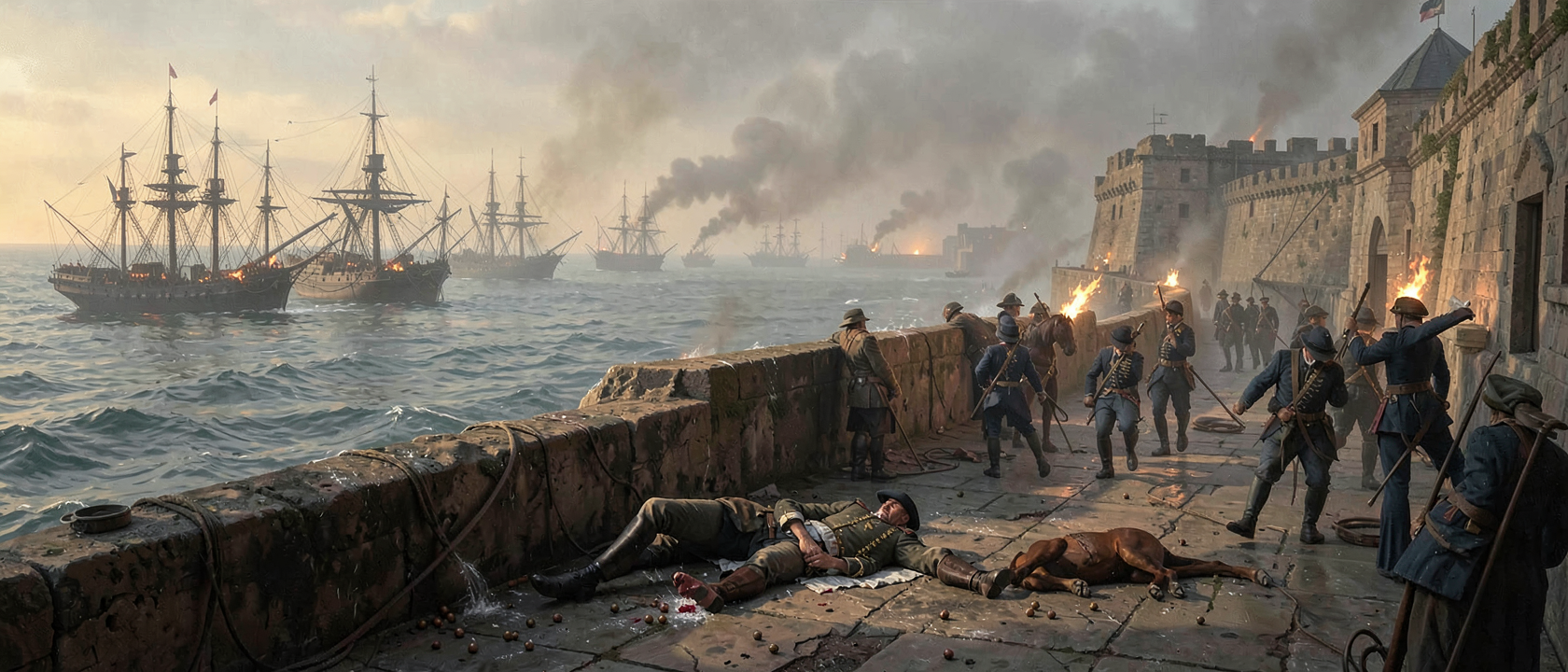
Santa Anna came out of retirement to help direct the city’s defense. On December 5, 1838, about 3,000 French troops under Rear Admiral Charles Baudin entered Veracruz under cover of a thick dawn fog. In the fighting, a cannon loaded with grapeshot fired near him, killing his horse and shattering his left leg, which surgeons soon amputated. That same afternoon, he dictated a dispatch as though he expected to die of the wound, writing that he had probably offered his country its last victory, asking forgiveness for his political mistakes, and asking to be remembered as a “good Mexican.” He did not die.
What the Record Won’t Settle
What that wound actually accomplished is where the sources split. Santa Anna’s own account held that he drove the French back to their ships that morning. Other reports say the French were already withdrawing on their own schedule, having spiked the fortress’s guns and taken what they came for, so that his stand changed nothing about their departure. Contemporary Mexican accounts favored the first version and credited him with repelling an invasion; later historians lean toward the second. The record does not settle which telling of that morning is right. It simply preserves both.
A Leg Rides Him Back to the Palace
Whichever version was true, it mattered less than what came next. Santa Anna was carried back to Mexico City a wounded man, and public sympathy did what his military record alone could not: within months, popular acclaim swept him back into the presidency. The war that had nearly killed him ended on March 9, 1839, when two treaties, mediated by British diplomats, settled the dispute. Mexico agreed to pay France its full 600,000 pesos, and French forces withdrew that same day. The country that had spent the better part of a year under blockade now had to raise the money to pay for it, at the very moment its most visibly damaged general was being rewarded with power.
The Bill, Itemized
Add it up. Mexico paid France 600,000 pesos in full. One horse died and one general lost a leg. Gulf trade sat under blockade for the better part of a year, and the fighting at Veracruz produced roughly 121 French and 224 Mexican casualties by one tally. Santa Anna’s restored presidency, built largely on the strength of that wound, lasted only until July 1839. The war is remembered as trivial only because of how it started. What it took to settle it was not trivial at all.
A State Funeral for a Leg
In 1842, with Santa Anna again in power, his amputated leg was exhumed. It had been kept since the amputation, preserved in a glass case. Mexico City gave it a full state funeral, with military honors, in a public cemetery, and a speaker eulogized it as the mutilated remains of an “illustrious caudillo of Independence and Liberty,” using the era’s term for a political-military strongman, while Santa Anna looked on. A country that never gave some of its own dead soldiers a proper burial gave one, with music and speeches, to a leg.