
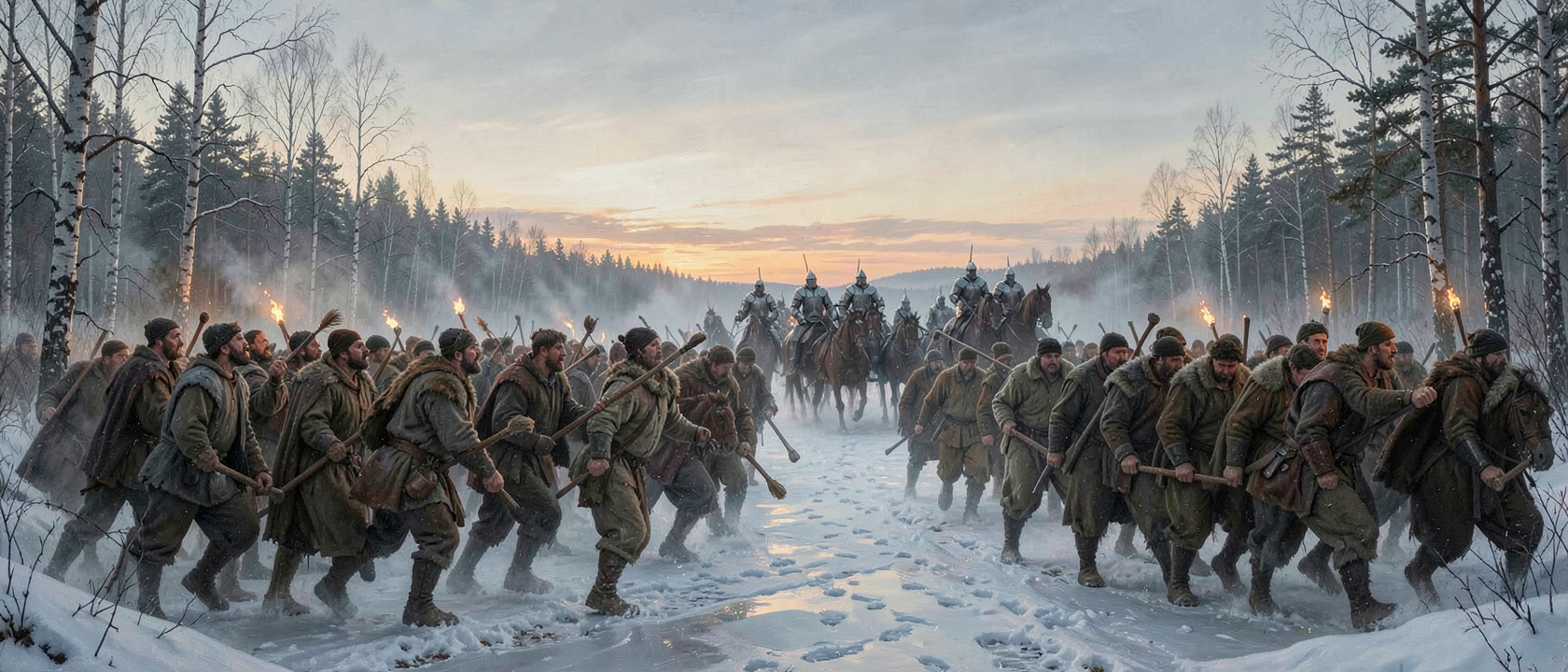
Kyrö, November 25, 1596
On the night of November 25, 1596, peasants in Kyrö, a district of South Ostrobothnia in the Finnish provinces of the Kingdom of Sweden, set fire to the manor houses of the local gentry. They wrecked outbuildings, tore down fences, and in at least one recorded episode broke the ice on a river to drown soldiers belonging to Klaus Fleming, the Swedish crown’s marshal in Finland, as they tried to cross.
The anger had been building for years. Sweden was fighting a long war, and the tax burden fell hardest on Finnish peasants, who were also required to feed and house soldiers under their own roofs, a burden known as billeting. Those soldiers were permitted to help themselves to stored food and fodder, sometimes for years at a stretch, war or no war.
Weeks earlier, a peasant delegation had carried these complaints to a man outside Fleming’s chain of command: Duke Charles, the king’s uncle and rival. Charles reportedly told them there were more than enough of them to shake off the soldiers, even armed with nothing sharper than fence posts and clubs. That line, preserved in only one surviving account, gave the uprising its name: the Cudgel War, Nuijasota in Finnish.
By the fires of Kyrö, it was still peasants doing the burning and the drowning. The man who had put the idea in their heads had not picked up a weapon himself.
A Crown in Dispute
Behind the fires sat a quarrel inside the Swedish royal house. Sigismund III held the throne of Sweden and Poland, but his uncle, Duke Charles, later to reign as Charles IX, had never accepted a lesser role and wanted the crown for himself. Their rivalry ran through Swedish politics from the early 1590s and was still unsettled that autumn.
Klaus Fleming stood on Sigismund’s side. As the king’s marshal in Finland, based at Åbo Castle in Turku, he was the man enforcing the taxes and billeting peasants hated, and he was also Charles’s main obstacle to power in the Finnish provinces. When the delegation came to Charles with their grievances, he had every reason to encourage them: weakening Fleming meant weakening the king’s grip on Finland.
None of this means peasant anger was invented for the occasion. The taxes were real, the plundering was real, and so was the hunger after years of hard harvests. But the fire Charles helped strike was one he could use, and he used it. The larger fight between Sigismund and Charles would run on for years after the last peasant laid down his club; that story is only sketched here.
Terror and the March That Never Landed
Through December 1596, the revolt spread across the Finnish countryside, and it turned from scattered outbreaks into a deliberate campaign against the gentry as a class. Rebels rigged manor houses to collapse on anyone who returned to them and left severed cattle heads propped in windows, a warning to families still living nearby.
The peasants who carried the revolt did not think small. Their declared aim was to march south to Åbo Castle in Turku, Fleming’s own headquarters, and take it apart, by their own account, with bare hands and teeth.
That march never landed. Fleming commanded professional men-at-arms, armored and armed in ways most rebels were not, and through the winter his forces fought down the peasant bands one by one. The uprising’s military strength broke at the Battle of Santavuori on February 24, 1597. The boast about tearing the castle apart stayed a boast. Fleming would remember it anyway.
The Reprisal
What followed Santavuori was not a peace settlement. It was an organized punishment, carried out under Fleming’s direction.
According to one surviving contemporary-derived account, not corroborated elsewhere, an estimated 400 peasants who had already surrendered their weapons were killed at Padasjoki. The same account describes captured rebels bound in groups of twelve and forced beneath the ice of frozen waterways to drown, an echo of how some of Fleming’s own soldiers had died in the ice near Kyrö months before. That account also has one group of prisoners made to try to break apart a brick fireplace with their teeth, a direct answer to the earlier boast about tearing down Åbo Castle.
Historians estimate that around 3,000 peasants died in the Cudgel War, out of a Finnish population of roughly 200,000 at the time, a figure built from surviving records rather than any contemporary census. Some gentry families had already lost their homes to fire and looting in the uprising’s early weeks, and an unknown but real number of Fleming’s soldiers died in the fighting before Santavuori. No source gives a precise count for either group. The peasants bore almost all of it.
What the Record Doesn’t Say
The accounts that survive were shaped almost entirely by the side that won, and that leaves gaps worth naming plainly. No source gives an exact breakdown of how many nobles lost their homes or how many of Fleming’s soldiers died before Santavuori. The estimate of roughly 3,000 peasant dead is itself a historian’s reconstruction; other counts, drawn from different records, land closer to 2,550. The wider struggle between Sigismund and Charles is only touched on here, not told in full, and it did not end with Fleming.
Fleming died on April 13, 1597, weeks after crushing the revolt, while preparing to defend Åbo Castle against the invasion he expected from Charles. The throne fight he had died still fighting for was years from settled, and Charles’s own rise came later, as part of a story this piece does not tell.
What is left to us of the Cudgel War is a set of numbers with the edges filed off: about 3,000 dead, out of roughly 200,000 Finns, counted by historians long after the fact rather than by anyone who was there to keep a ledger. Knowing that the number is an estimate, not a tally, is not a hole in this story. It is the part of the story that tells you how much of it we can actually stand behind.