
In 1961, Charles de Gaulle awarded the Legion of Honor, France’s highest civilian distinction, to Maurice Papon, the head of the Paris police. That same year, officers under his command killed dozens of Algerian demonstrators, by some estimates far more. Papon did not stand trial for his role in the Holocaust until 1998, at age 88, more than fifty years after he had signed deportation orders in Bordeaux.
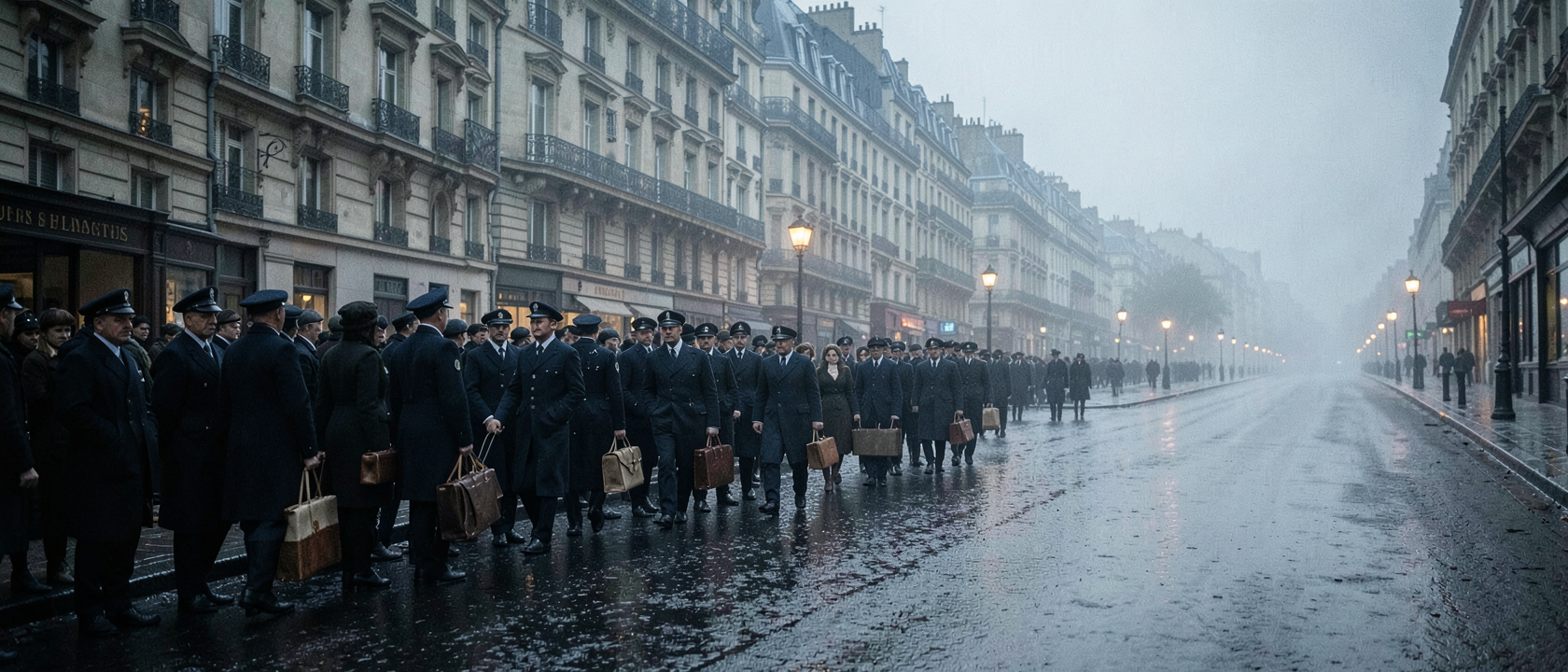
Behind that gap sits an institution most people never think about: the Paris Police Prefecture. During the German occupation, this ordinary French bureaucracy, not German security forces, carried out most of the arrests of Jews in wartime Paris.
An Institution Built for Order
Napoleon founded the Paris Police Prefecture in 1800 on the Île de la Cité. Built around filing systems and a fixed chain of command, it kept functioning through every change of government for a century and a half, earning a reputation as one of France’s most efficient state institutions.
A Country Split in Two
From July 1940, France was divided: a German military occupation covered the north, including Paris, while a nominally independent government under Marshal Philippe Pétain governed the south from the town of Vichy. By autumn 1940, without any German order, Vichy’s own administration had begun interning foreign and refugee Jews in camps in the unoccupied zone. Occupation and collaboration were not the same thing; French officials were sorting Jewish residents years before deportation trains began running.
A Shortage of Hands
By 1941 and 1942, German security forces in Paris were thin on the ground; across the whole occupied zone, the Gestapo’s presence numbered only in the low hundreds. Rounding up tens of thousands of people took more manpower than the Germans had to spare. Vichy’s police, obedient to state authority and already familiar with the city’s Jewish residents through internment records, offered a ready substitute. Historian Laurent Joly, whose research underpins this account, found that most of these officers were not committed antisemites; what they had was a professional habit of following orders.
The Roundups
Of the 74,150 Jews deported from occupied France between 1942 and 1944, roughly 38,500, slightly more than half, were deported from the Seine prefecture, the region covering Paris and its close suburbs, and most were arrested by ordinary Paris policemen rather than German units. The signature event came on July 16 and 17, 1942, when Paris police carried out the Vel d’Hiv roundup almost entirely on their own. Enforcement was not uniform: officers in the outer districts, the banlieues, generally pursued arrests more aggressively than those in central Paris, and there are documented cases of individual officers warning Jewish acquaintances before a raid reached their door.
The Last Illusion Ends
In November 1942, after the Allied invasion of North Africa, Germany and Italy occupied the southern zone Vichy had governed since 1940. Whatever independence Vichy had kept on paper was gone, and coordination of deportations tightened across the whole country. What ended that month was any pretense that Vichy had ever acted at arm’s length from Berlin.
What Survived
An estimated quarter of the Jewish population counted in France in 1940 and 1941 died in the Holocaust, a devastating toll, yet still lower, by the same estimates, than the roughly three-quarters killed in the Netherlands or the roughly ninety percent killed in Poland. Only Denmark’s Jewish community survived at a markedly higher rate, largely through evacuation to Sweden. By the Liberation of Paris in 1944, an estimated 50,000 Jews were still living in the city, a gap the uneven enforcement and the isolated warnings help explain, without excusing the machinery that killed the quarter who did not survive.
Business Resumes
After the Liberation in 1944, French authorities dismissed openly collaborationist officers, but many others returned to policing within a few years, their wartime conduct left unexamined and their careers picking up where they had left off. Maurice Papon was one of them. As the Vichy official responsible for Jewish affairs in Bordeaux between 1942 and 1944, he had signed deportation orders himself, yet he avoided prosecution and went back to work inside the French state.
The Massacre and the Medal
By 1958, Papon had become Paris police prefect, a post he held until 1967. On October 17, 1961, during the Algerian War, police under his command attacked a demonstration of roughly 30,000 Algerians protesting a curfew; more than 12,000 people were arrested that night. How many died is disputed: the French government acknowledged 40 deaths only in 1998, after 37 years of denial, while other historians put the toll as high as 200 to 300. The dead were killed by beatings and by officers who threw demonstrators into the Seine. That same year, de Gaulle awarded Papon the Legion of Honor.
The Verdict, Decades Later
Papon’s trial for crimes against humanity opened in October 1997 and ran for more than six months, one of the longest trials in French history. In April 1998, at age 88, he was convicted for deporting more than 1,600 Jews, including 130 children, by one widely cited count, from Bordeaux to the camp at Drancy and onward to Auschwitz between 1942 and 1944, and was sentenced to ten years in prison. In October 1999 he fled to Switzerland rather than begin the sentence; Swiss authorities sent him back to France, and he was released early after roughly four years.
What the Record Doesn’t Settle
The death toll from October 17, 1961, remains disputed because French authorities suppressed and, in places, destroyed records at the time; estimates run from an official count of 40 to historians’ figures of 200 to 300. The archive is just as thin on which officers were dismissed after 1944 and which slipped back into the ranks unnoticed. What the surviving paperwork does not show is intention: it records that an officer made an arrest, or chose to warn someone instead. It does not record why. That is the question every reader carries out of an archive like this one, because the paperwork never says which official you would have been.