A Steamer Called Confucius
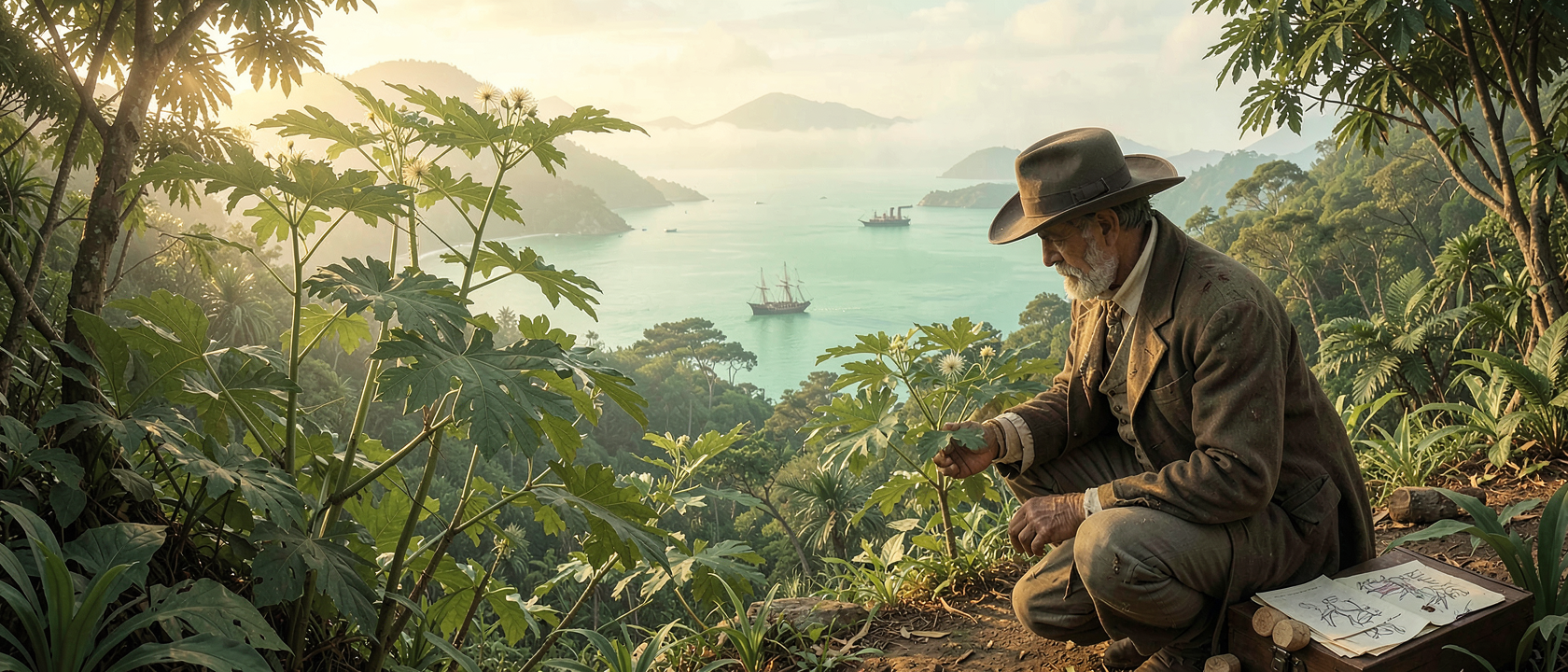
At some point between 1853 and 1856, on his third expedition to the Far East, the Scottish botanist Robert Fortune boarded an American steamer named Confucius off the coast of Fujian Province. Fortune, born in 1812, had already made his name five years earlier by taking tea plants and trained tea workers out of China and into India on behalf of the British East India Company, an exploit that left him with a reputation as the man who stole China’s tea secrets.
The Confucius was not carrying him for his own purposes. The Chinese government had chartered the ship to move money to Formosa (present-day Taiwan). Fortune had simply arranged passage on it. Whatever came next would happen because a cargo of money needed to cross the water, not because a botanist wanted to.
The Flower Nobody Could Name
By the 1850s, British drawing rooms had a fondness for artificial flowers made from something sold as “rice paper.” The name was misleading: no rice went into it. The material was pith, sliced into thin sheets with a fine, ivory-like finish, cut from the stem of a plant that Western science had barely met. In China itself the raw sheets were cheap, bundled a hundred to a bundle and sold, by one surviving museum record, for as little as a penny and a quarter, meant mostly for flower-making.
In 1852, a year before Fortune sailed, the British botanist William Jackson Hooker had already given the plant its first scientific description, naming it *Aralia papyrifera* (now classified as *Tetrapanax papyrifer*), based on dried specimens and pith samples that reached him through consular contacts in China. That was a name built from paperwork, not from a plant seen growing by a Western traveler. For a botanist already known for going where other Westerners did not, that gap still looked like unfinished business.
A Closed Island
Formosa in the 1850s answered to Qing dynasty China, and Qing policy kept it closed to routine foreign contact. There were no treaty ports there, no standing arrangement letting Western merchants or naturalists come ashore, and no legal channel for a traveler to simply visit. A foreigner’s footprint on the island was not tourism. It was an irregularity that officials on both sides would have had to explain.
That closure is exactly what made the Confucius useful to Fortune, though not by design. A ship on Chinese government business had a reason to be there. He, on his own, did not.
One Day Ashore
Riding along on the money run gave Fortune a single day on Formosan ground. The surviving account gives no date within the 1853-56 window, no name for the place where he landed, and no description of what he did once he was there. What remains is the bare fact of it: a Scottish plant collector already notorious for slipping in and out of closed Chinese territory spent one day on an island where Westerners were not supposed to set foot at all.
The Bill: A Day, Not a Discovery
Nobody died over this, and no fortune changed hands. What it cost was smaller and easier to miss: one day, borrowed from a money-run schedule that had nowhere to be but Formosa and back, spent on the very question that had made the detour worth taking, and answered by nothing that survives in the record.
Whether Fortune found the pith plant, saw it growing, or came away with nothing but a day ashore and a return passage, the account does not say. For a story that opens with theft and closed borders, this is the flat ending: a landing, and no confirmed discovery attached to it.
What the Record Won’t Say
Set beside what is known, the gaps deserve their own accounting. There is no confirmed date for the landing inside the 1853-56 span. There is no explanation of why a Chinese government’s money errand and a British botanist’s itinerary happened to line up at all. There is no record of where on Formosa Fortune went, how far he traveled inland, or what, if anything, he collected.
This thinness is not unusual for Fortune’s career. Much of it survives in travel narratives written for a British readership rather than in logs kept for later historians. A day that left almost no trace beyond the fact of its occurrence is, for this expedition, closer to the rule than the exception.
The Island Opens, Later
Formosa did not open to Western trade until after the Treaty of Tientsin (Tianjin) in 1858, at least two years after Fortune’s third expedition had ended. That treaty brought treaty ports, regular foreign shipping, and consular officials with a legal right to be there: the ordinary machinery that made a Western visit to the island unremarkable within a few years.
Set against that later normalcy, Fortune’s day stands out for what it lacked. No port, no permission, no return visit. He got onto Formosa once, aboard someone else’s ship, on someone else’s errand, and then the door that had briefly opened for a money run closed again behind him.