
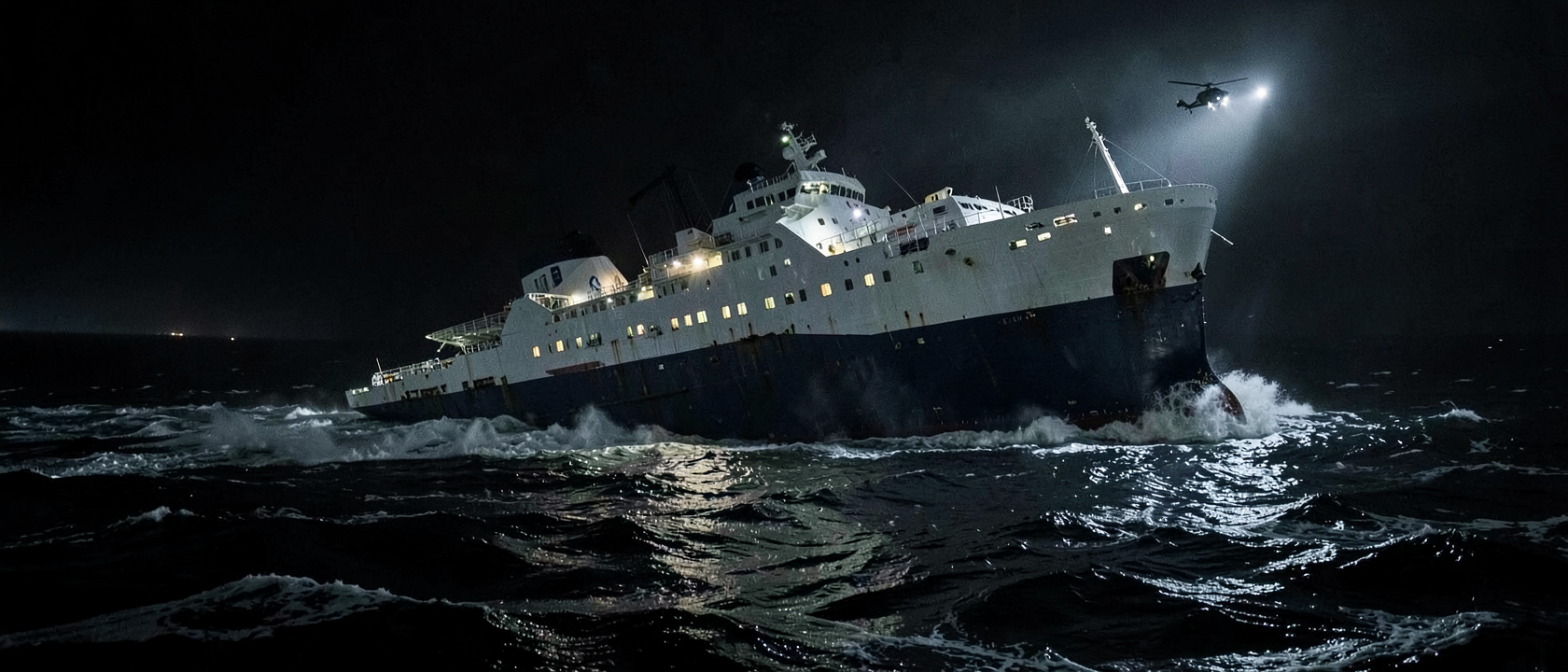
One car ferry. Three acts of violence, fourteen years apart. Two murders under one name, then a sinking that killed 852 people under another.
A Ferry Called Sally
On June 29, 1980, a new ferry entered service for the Finnish company Rederi Ab Sally, running between Turku and Stockholm via Mariehamn in the Åland Islands. She was the Viking Sally, the largest ship then on the route. Her early years were ordinary: a grounding in 1984, propeller trouble in 1985, a stern rebuild that same year.
Floating and Anonymous
A big overnight ferry held hundreds of strangers for a single crossing, in cabins and public rooms, on water that belonged to no single country’s police. Whoever caused trouble could be off the gangway in another port before anyone official knew. Privacy, crowding, and unclear jurisdiction made such a ship hard to police.
July 10, 1986
On the morning of July 10, 1986, near the end of a crossing from Turku to Stockholm, Finnish businessman Antti Eljaala went into his cabin with fellow passenger Reijo Hammar and an associate. Hammar robbed him of the cash in his wallet, and Eljaala did not survive it; accounts disagree on whether he was stabbed and strangled or struck with an axe. Hammar left the ship before the body was found and was caught in Stockholm weeks later. What became of the associate in the cabin isn’t part of the record available here.
Hammar was pardoned by President Tarja Halonen in December 2004, and in 2011, as Andreas Hammar, was convicted again, this time of attempted manslaughter.
July 27, 1987
On the evening of July 27, 1987, West German students Klaus Schelkle and Bettina Taxis boarded the same ferry in Stockholm, touring the Nordic countries with a friend, Thomas Schmid, and slept on the open heliport deck. They were found badly beaten in the early hours that followed (some accounts place it a day later, on July 29). A Boy Scout on board, meaning to give first aid, found them and saw at once the injuries went far beyond that.
Schelkle died after the ferry reached Turku; Taxis survived with no memory of the attack. Police reportedly interviewed more than a thousand people. No one was ever charged.
From Sally to Estonia
Ownership of the ship changed repeatedly in the years that followed. In October 1987, Rederi Ab Sally was sold to Effoa, which also controlled rival Silja Line. Over the next several years the ship changed hands and names more than once; the exact sequence isn’t fully documented. By the early 1990s she belonged to Estline, running between Tallinn and Stockholm, a route that existed as ordinary commercial traffic only because Estonia had regained independence in 1991. Estline repainted her and gave her a new name: Estonia.
The Night of September 27-28, 1994
On the evening of September 27, 1994, the Estonia left Tallinn for Stockholm into a storm. How rough the sea was depends on the account: some put the waves at about 20 feet (6 meters), others closer to 10 to 13 feet (3 to 4 meters), with winds near 31 to 37 mph (50 to 60 km/h), a normal Baltic autumn storm.
Shortly before 1 a.m. on September 28, the ship began listing heavily to starboard. A 1997 joint investigation by Estonia, Sweden, and Finland found the cause: the bow visor, the hinged panel that lifted for vehicle loading, had locks too weak for the wave pressure that night. Once it tore off, water poured onto the car deck and the ship lost stability fast. Investigators also found the crew had been sailing faster than conditions allowed, and misread the list once it began. She capsized and sank within about an hour, between roughly 12:50 and 1:50 a.m. Of 989 people aboard, 137 survived.
What It Cost
In 1994: 852 dead, 137 survivors, out of 989 aboard, an estimated 501 of them Swedish. In 1986: one man robbed and killed in his cabin. In 1987: one man beaten to death, one woman left alive with no memory of it. The Estonia lies on the Baltic seabed; in 1995 the three countries agreed to treat the wreck as a grave and leave it undisturbed. The sinking also led to the 1996 Stockholm Agreement and later safety rules that phased out bow visors in favor of solid bow doors.
A Hero Under Suspicion
The Boy Scout who found Schelkle and Taxis was hailed at the time as exactly that: a hero. His name was Thomas Nielsen, later known as Herman Himle. For decades the case went nowhere.
Years afterward, a tip that began inside a Danish prison brought Finnish investigators back to him, and by some reports he gave an informal confession under questioning. That word, allegedly, matters here: no lawyer was present, and what he is said to have told police was never tested the way a formal, counseled statement would be.
Acquitted, Not Cleared
Nielsen stood trial in Turku in 2021, more than three decades after Schelkle’s death, and was acquitted. The reasoning was procedural: because his alleged confession had been given without a lawyer present, it could not be used as evidence. According to some reports, a Turku court upheld that exclusion in August 2022, though this detail comes from a single source and has not been independently confirmed. Whether the case will reach Finland’s Supreme Court remains unresolved.
The Curse and the Coincidence
Nielsen’s guilt in Schelkle’s death was never established in court. His alleged confession is disputed because of how it was taken, and no one else has ever been charged; the case stands open.
Writers who have studied the ship’s history, among them journalist Miika Viljakainen, separate the pattern from the cause. A murder in 1986, an unsolved killing in 1987, and a sinking in 1994 sharing one hull make a striking sequence to tell. They don’t make a single explanation. Coincidence and causation aren’t the same thing, even aboard the same ship.
Eljaala’s death had a motive: robbery. Schelkle’s still has none proven in court. The Estonia’s 852 dead came down to a steel visor that failed in a storm, and a crew that pushed her harder than the sea allowed.