The Lot on Fremont Street
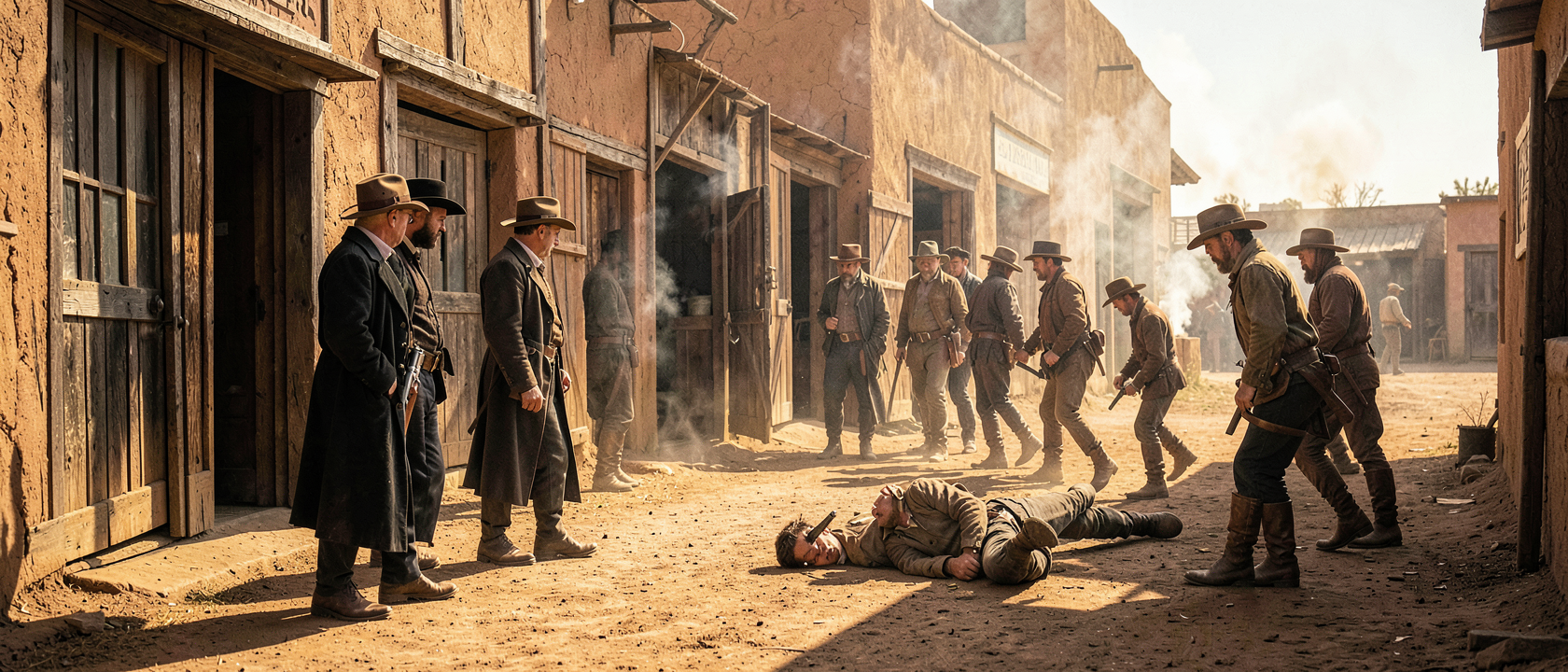
On the afternoon of October 26, 1881, in Tombstone, Arizona Territory, three men died within thirty seconds. The shooting did not happen inside the O.K. Corral itself. It happened in a narrow vacant lot on Fremont Street, next to C.S. Fly’s photography studio, close to the corral’s rear entrance. That distinction gets lost every time someone repeats the fight’s name, but it is where the story has to start.
By one account the time was close to three o’clock. On one side of the lot stood Virgil Earp, Tombstone’s town marshal and a deputy U.S. marshal, together with his brothers Wyatt and Morgan Earp and John “Doc” Holliday, a gambler and occasional dentist known equally for cards and a pistol. Facing them were Ike Clanton and his younger brother Billy, along with brothers Tom and Frank McLaury. A fifth man, Billy Claiborne, stood with them as well. Virgil’s badge mattered from the first second: whatever happened next, one side could claim it was the law doing its job.
Two Versions of Order
Tombstone in 1881 was one of the richest mining towns in the Southwest, built fast after silver was found nearby in 1877. Fast money brought a town council anxious to look civilized. According to town records cited in later accounts, the council had passed an ordinance on April 19, 1881, requiring anyone carrying a pistol, rifle, bowie knife, or dirk to check the weapon at a livery stable or saloon soon after entering town. That ordinance is the pretext historians point to for the confrontation on Fremont Street: Virgil Earp trying to enforce it against men who made their living outside town rules.
The Clantons and McLaurys belonged to a loose ranching and rustling network the newspapers called “the Cowboys,” men more used to open range than city ordinances. What exactly had set the Earps and the Cowboys against each other before that October afternoon is not settled here, and it should not be papered over: the sources point to a running dispute over cattle, politics, and control of the town, but no single clean origin story survives. What is clear is that by October 26, two different ideas of who got to carry a gun in Tombstone were about to meet in the same lot.
Thirty Seconds
The shooting itself did not last long. Around thirty shots were fired in roughly thirty seconds. When it stopped, Billy Clanton, Tom McLaury, and Frank McLaury were dead or dying. Billy Clanton was eighteen. Virgil Earp, Morgan Earp, and Doc Holliday were wounded. Ike Clanton and Billy Claiborne came through unharmed.
The Tombstone Epitaph normally logged local shootings in a standing column it called “Death’s Doings,” a few lines and move on. This time it broke the pattern and ran a headline of its own, reported as: “Three Men Hurled Into Eternity in the Duration of a Moment.” A newspaper that dealt in gunfire every week had decided this particular thirty seconds was worth treating differently.
A Funeral Watched by Thousands
Days later, about 300 people walked in the funeral procession for the dead men, and a crowd estimated at 2,000 lined the route to watch them pass. Tombstone was not a large town, and turnout on that scale suggests a good part of the population was not convinced the killings had been lawful, whatever Virgil Earp’s badge said about it.
Ike Clanton pressed the point formally, filing murder charges against the Earps and Holliday. A preliminary hearing ran from October 30, 1881, to March 19, 1882, and at the end of it the four men were found to have acted within the law. The legal question closed there, but the feud did not. On December 28, 1881, Virgil Earp was ambushed and maimed. On March 18, 1882, a gunman firing through the glass door of a saloon killed Morgan Earp. The bill for those thirty seconds on Fremont Street kept coming due for months after a court had already called the shooting lawful.
Wyatt Earp Meets the Movies
Wyatt Earp outlived everyone else who had stood in that lot. He died in 1929, by which time he had spent years circulating in early Hollywood, where a gunfighter from a mining town was a novelty worth knowing. By 1915 he was mixing with figures like Charlie Chaplin and a young John Wayne, then still working as a stuntman and extra.
That same year, on the set of director Allan Dwan’s Douglas Fairbanks picture The Half-Breed, released in 1916, an old-timer showed up and ended up, barely visible, in a crowd scene. Dwan, recalling it later in his own writing, described only a visitor to the set. Popular accounts have long identified that visitor as Wyatt Earp, though researcher Jeff Morey has argued the man was more likely the rancher and lawman Texas John Slaughter. Which of the two Dwan actually filmed is still argued over. What is not in dispute is that Earp, by then, was a fixture around film sets, on hand to trade his own account of Tombstone with the people who would eventually put it on screen.
The Legend Locks In
The event that made Wyatt Earp famous had a stronger afterlife on film than it ever had in print. The Tombstone Epitaph’s headline in 1881 reached readers of one territorial newspaper. In 1957, seventy-six years after the shooting and roughly a generation after Earp’s death, a Hollywood film built the shootout back into a story for a national audience. It is that film, more than any 1881 account, that fixed “Gunfight at the O.K. Corral” as the name everyone remembers, wrong location included.
None of that reaches the screen without the groundwork Earp laid decades earlier, sitting on movie sets with Chaplin, Wayne, and Dwan and letting himself become part of the material. The lot behind the corral had emptied in half a minute in 1881. It took most of a century, and one long-lived witness willing to talk, to fill theater seats with the same story instead.