
The Weigh-In
On the morning of March 24, 1962, Bennie “Kid” Paret and Emile Griffith stepped onto the scale at Madison Square Garden ahead of that night’s welterweight title fight. Paret had already told reporters what he thought of his opponent. “I hate that kind of guy,” he said. “A fighter’s got to look and talk and act like a man.”
At the scale he went further. Paret touched Griffith on the buttocks and whispered into his ear, “maricón, maricón,” Spanish slang carrying roughly the weight of the English slur for a gay man. Griffith had to be pulled back before he could get at Paret. Reporters in the room mostly left the moment out of their stories, or softened it into a phrase like “anti-man.” Neither fighter had thrown a punch yet.
The Rubber Match
Griffith and Paret were not strangers outside the ring. Both men lived in the same Bronx neighborhood and ran into each other often, and gossip about Griffith’s sexuality had been circulating for months before that morning’s weigh-in. This was their third meeting, and each of the first two had left something unsettled.
On April 1, 1961, Griffith knocked Paret out in the thirteenth round at the Miami Beach Convention Center in Florida, before a reported crowd of 4,618, ending Paret’s first defense of the welterweight title. Five months later, on September 30, 1961, Paret took the title back at Madison Square Garden by split decision, a verdict that drew both cheers and boos from ringside. In between, on December 9, 1961, Paret took a heavier beating still, stopped in the tenth round of a fifteen-round middleweight bout against Gene Fullmer in Las Vegas. Accounts differ on how much time he had to recover before facing Griffith again, ten weeks by one telling, closer to three months by another. Either way, the third fight arrived billed as a decider for the title, and as something more personal than that.
Nine Seconds
An estimated 7,500 to 8,000 people filled Madison Square Garden that night, with a national television audience watching on ABC. The fight swung both ways for eleven rounds. In the sixth, Paret nearly finished Griffith with a combination, and Griffith was saved only by the bell.
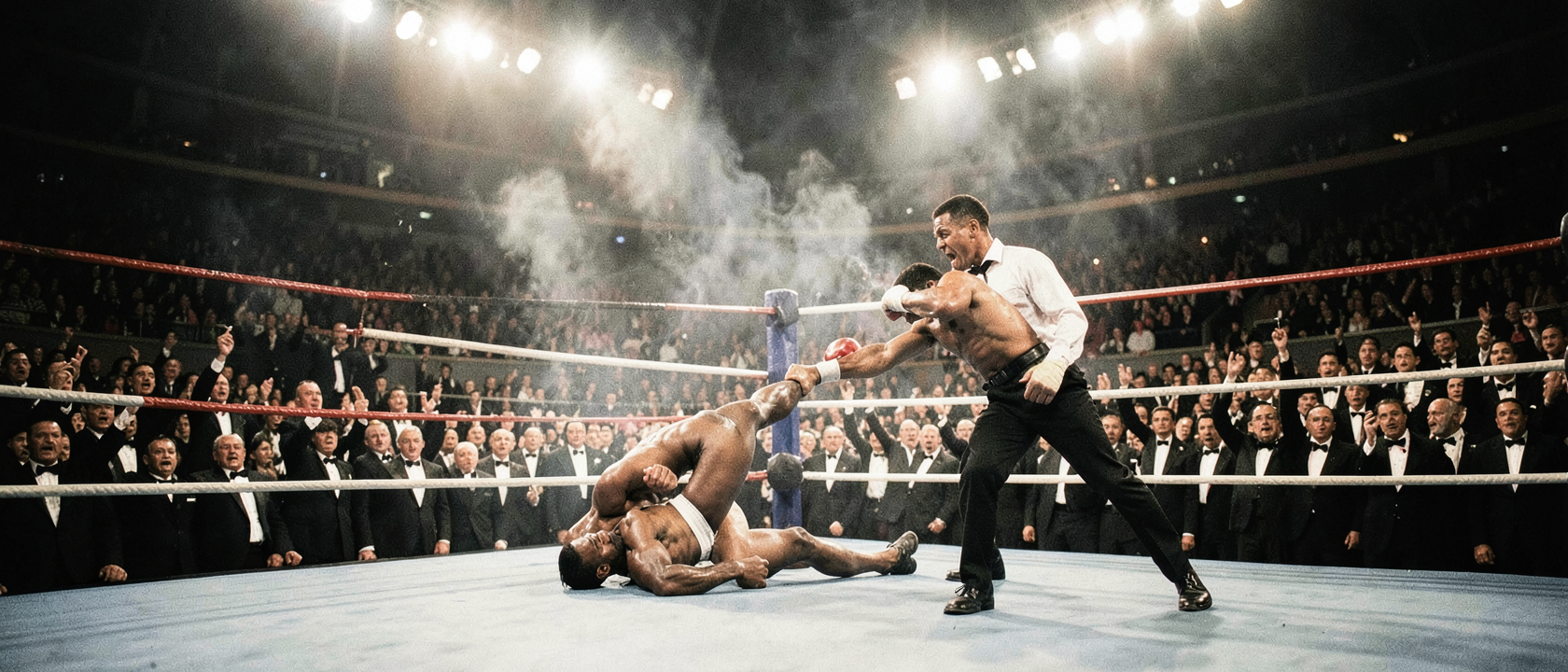
In the twelfth, two right hands from Griffith rocked Paret back into a corner. Griffith kept throwing right uppercuts, over and over, until Paret’s head was swaying against the ropes and his legs had stopped holding him up. Historian Christina D. Abreu puts the final barrage at an estimated 20 to 26 punches landed in about nine seconds. Paret slid down the ropes, foaming at the mouth. Referee Ruby Goldstein finally pulled Griffith away. By then it was too late.
Ten Days
Paret never woke up. He underwent emergency surgery the next day to relieve pressure on his brain and remained in a coma for ten days before he died, on April 3, 1962, at 25. The cause of death was recorded as pneumonia.
New York Governor Nelson Rockefeller said the beating, seen live by millions on television, left him “deeply concerned and disturbed.” The state athletic commission reviewed film of the fight and interviewed witnesses, then cleared Goldstein of negligence. Within about a week, at least one ABC affiliate announced it would no longer broadcast boxing. Other stations followed over the months that came after.
The Disputed Word
What Paret actually said has never been pinned down. The Spanish-language paper La Prensa reported that he told Griffith he was not a man and called him a homosexual outright, while other outlets reported the slur “maricón” instead. Which version is accurate, or whether he said both, has never been settled.
Media scholar Leger Grindon has argued that the fight over the exact words misses something more basic: boxing is a sport built to produce knockouts, and the twelfth round did what the sport is designed to do, with or without an insult behind it. Goldstein himself, cleared of blame, put it more bluntly after the commission’s ruling: “No one is to blame. It’s the type of sport it is. Death is a tragedy that occasionally will happen.”
Griffith’s Long Fight
Griffith kept fighting. He won the light middleweight title later in 1962 and became middleweight champion in 1966 by beating Dick Tiger at the Garden. He finished his career, which ran from 1958 to 1977, with a record of 85 wins, 24 losses and 2 draws, 23 of them by knockout, and entered the Boxing Hall of Fame in 1990.
He carried Paret’s death with him the whole time. In a 2008 autobiography he wrote that he had been bisexual since his teens, after years of telling interviewers only that he loved men and women both and did not care for any of the labels people wanted to put on it. According to one account, he was beaten and hospitalized in 1992 after leaving a gay bar in New York City, though that report has not been independently confirmed elsewhere. He died in his sleep in July 2013, at 75, in obituaries that still led with the fight from 1962.
Mailer’s Sentence and the Sociologists After Him
Norman Mailer covered the fight for Esquire in 1963, and his account, which mentioned the gossip already circulating about Griffith’s sexuality before the bout, helped fix it in American memory as something more than a sports result. Decades later, sociologist Eric Anderson pointed to the Griffith-Paret fight as a case study in how insults about sexuality could be used to enforce a narrow idea of manhood inside a violent sport, an argument made long after the two men had left the ring for good.
The taunt that started it and the sport that finished it are still argued over separately. What is not in dispute is what each man paid: Paret with his life at 25, Griffith with decades spent explaining, and living down, nine seconds that took less time to happen than it takes to describe them.