
“Strike My Name”: Prague, 1948
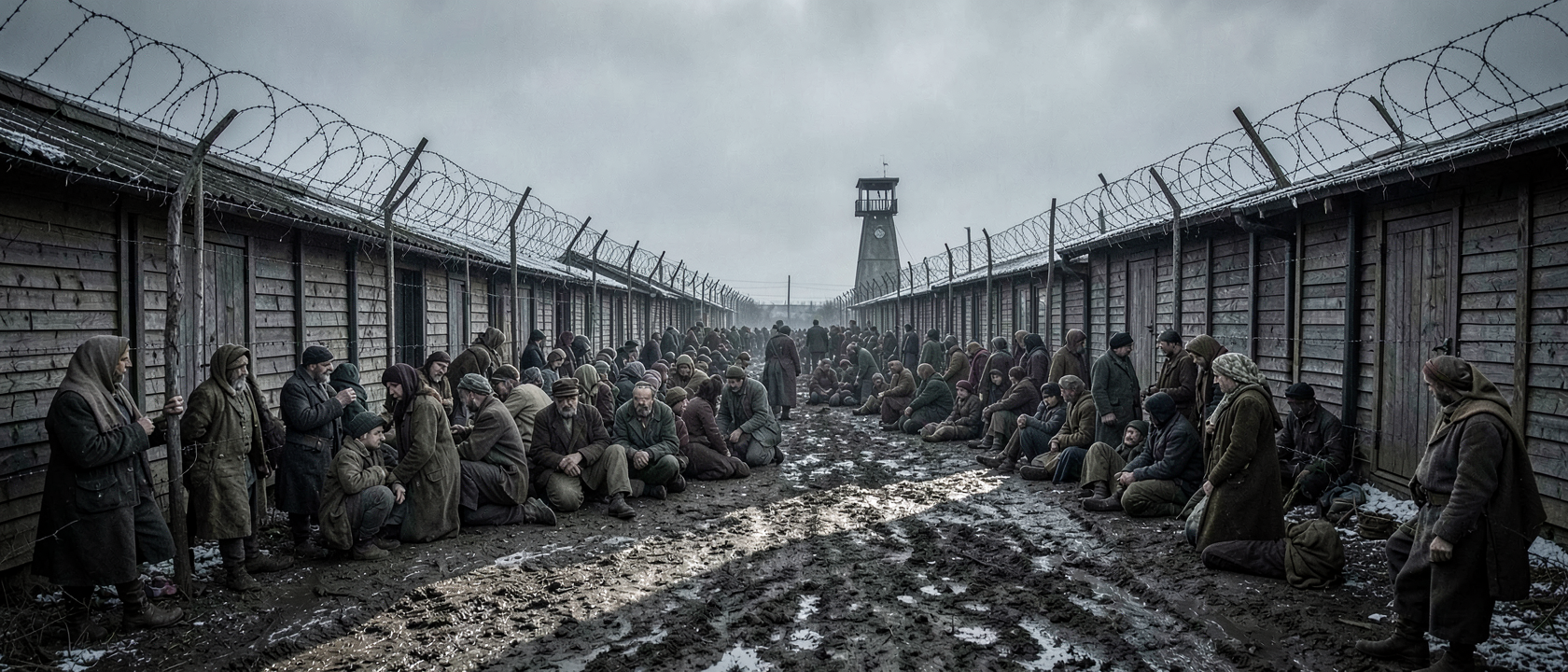
In 1948, a Czech man named Václav R. wrote to authorities in Prague asking to have his name struck from the “Gypsy register.” Three years earlier, in May 1945, he had been freed from Terezín, the concentration camp northwest of Prague where the Nazis sent him in 1944. Czechoslovakia’s government now called itself anti-fascist, yet it kept a list sorting people by the same racial category the Nazis used to mark “pure” or “mixed blood.” Whether Václav R. considered himself Roma is unknown; his petition only shows a state built on Nazism’s ruin still keeping a version of that ledger. No answer survives. What survives is the question the rest of this story has to answer.
Before the Swastika: A Continent Already Counting
That register had ancestors. In the late 1700s, Habsburg emperor Joseph II treated Roma across his lands as a problem to be solved through forced assimilation or expulsion. In 1893, Austrian criminologist Hans Gross published a handbook describing “Gypsies” as inherently criminal by nature; it ran through six editions and wide translation. France created a legal category of “nomads” in 1912, requiring registration and restricting travel. Around World War I, Roma were interned in camps in Alsace and Austria-Hungary, and states began issuing identity cards with fingerprints and photographs for itinerant Gypsies. In 1927, the new Czechoslovak Republic passed its own law regulating people “living like Gypsies.” None of this was Nazi. All of it was waiting to be used.
From Ledger to Law: 1933-1938
Within months of taking power in 1933, Germany’s new government passed the Law for the Prevention of Offspring with Hereditary Diseases, singling out “Gypsies” for sterilization on racial grounds; an estimated 400,000 people were sterilized under this law nationwide, Roma among them. The 1935 Nuremberg Laws stripped “Gypsies,” alongside Jews, of German citizenship and banned marriage to Germans. A Gypsy camp went up at Marzahn on Berlin’s edge ahead of the 1936 Olympics. In 1938, Heinrich Himmler ordered every “Gypsy” in the Reich registered as “pure” or “mixed blood,” a task given to Robert Ritter, a biologist running the Research Institute for Racial Hygiene. That year Germany annexed Austria; in 1939 it occupied the Czech lands. In both, local authorities moved fast toward harsher measures.
Deportation and the Camp Built to Kill: 1939-1943
Weeks after the invasion of Poland in September 1939, Berlin’s Reich Security Main Office ordered 30,000 “Gypsies” deported east into the occupied Generalgouvernement. The invasions of Yugoslavia in April 1941 and the Soviet Union that June pushed policy from restriction toward killing. That autumn, roughly 5,000 Roma deported from Austria were sealed into an isolated section of the Łódź ghetto; survivors of a typhus outbreak there were later gassed in mobile vans at Chełmno. Construction of a Gypsy camp, the Zigeunerlager, at Auschwitz-Birkenau had begun in 1941; its first transport arrived February 26, 1943, while barracks were still going up. On December 16, 1942, Himmler ordered the roughly 10,000 Roma remaining in Germany deported there too. Unlike most of Auschwitz, this camp held families together, a detail that mattered for how it ended.
Shot, Not Registered: The Balkans and Transnistria
Not every killing left a camp record. In occupied Yugoslavia, the Wehrmacht shot Roma alongside Jews and resistance suspects from 1941 on. In Croatia, the Ustaša regime ordered, in May 1942, all Roma deported to its Jasenovac camp; estimates of the dead there range from about 16,000 to 26,000, a figure researchers still call undercounted. In Romania, Marshal Ion Antonescu’s government deported 25,000 Roma to Transnistria, between the Bug and Dnieper rivers, where roughly half died of starvation and disease. None of it passed through a registry the way Auschwitz did, one reason the final toll can only ever be an estimate.
August 2, 1944: The Zigeunerlager Is Liquidated
In mid-May 1944, an SS unit moved to empty the Auschwitz Gypsy camp. Forewarned, the Roma inside armed themselves with iron bars, pipes and shovels and refused to leave; the SS withdrew and called off the operation. Romani activists later marked the date as a day of resistance, though it rests on survivor testimony rather than confirmed camp records. The reprieve did not last: on the night of August 2 to 3, 1944, prisoners were barred from their barracks, loaded onto trucks despite renewed resistance, and gassed. Camp records once put that night’s toll at 2,897; newer research from Auschwitz-Birkenau’s own historians puts it at 4,200 to 4,300. In all, close to 21,000 of the roughly 23,000 Roma held at the camp died there.
After the Gate Opened: What Survivors Carried
Survivors left camps like Terezín and Auschwitz with sterilization scars, injuries from forced labor, and no family left to return to. In liberated France, people classified as “nomads” under the 1912 law faced further danger: violent reprisals, including killings, from communities accusing them of wartime collaboration. Czechoslovakia reintroduced a Gypsy register in 1947, the direct predecessor of the list Václav R. asked to leave a year later. Across much of postwar Europe, Roma stayed filed under headings like “asocial” rather than recognized as genocide victims, a classification that kept them out of compensation for decades. Formal recognition came only in stages: the European Parliament designated August 2 as European Roma Holocaust Memorial Day in 2015.
What Historians Still Argue About
Historians disagree on how to name what happened. Anthropologist Michael Stewart calls it an “invisible genocide,” pointing to the absence of any single central extermination order like the one used against Jews. Historian Anton Weiss-Wendt argues Nazi planning for the “Gypsy Question” and the “Jewish Question” was closer in scope and brutality than that framing suggests. Both agree the death toll cannot be fixed. The commonly cited estimate of up to 500,000, from the United States Holocaust Memorial Museum, rests on missing prewar census data, killings that generated no camp record at all, and gaps in what paperwork survived the war. That uncertainty is not sloppy history. It is what a genocide carried out partly by clerks and partly by men with rifles and no list leaves behind.