Euston Station, August 20, 1868
At 7:30 in the morning on August 20, 1868, the Irish Mail pulled out of Euston station in London, bound for Holyhead on the coast of Wales, where its passengers would cross by ferry to Dublin. The London and North Western Railway had run this service daily since 1860. Its cargo was mixed: mail, sorted as the train moved in a traveling post office car, and people, many of them among the wealthiest in the country, heading back to their estates in Ireland. Among those aboard that morning were Lord Farnham of County Cavan (Henry Maxwell) and his wife, Lady Farnham; the Duchess of Abercorn, wife of Ireland’s lord lieutenant, returning to Dublin with five of her children after a summer in London; and Viscount Castlerosse of Killarney. Pulling the train was a locomotive named Prince of Wales, of the “Lady of the Lake” class, numbered 291. Behind it ran a chief guard’s van, the traveling post office, a luggage van, four passenger carriages, and a second guard’s van at the rear.
A Name, Not a Number
The Irish Mail carried a name rather than a number, and it was said at the time to be the only train in Britain given that distinction. Some tellings go further and call it the only named train in the world, a claim this record cannot confirm. By reputation it was also the fastest train in the kingdom, said to run at about 60 miles per hour (97 km/h), a figure resting on a single account and best read as an estimate rather than a measurement. That speed came fixed to a schedule. The Irish Mail left Euston at a set hour and had to reach Holyhead in time to meet the mail boat, carrying a postal contract that left no room for delay.
The Fork at Chester
The train made its scheduled stop at Chester, a major junction, where four more passenger carriages were coupled on at the front, ahead of the four that had traveled up from London. Some passengers had spent the night at the Queen Railway Hotel next to the station and reached the platform through a private tunnel built to link the two. Coming out of it, most people turned left, toward the newly added carriages. A few turned right, back toward the original ones, to rejoin friends who had traveled with them from London. Choosing which way to walk took a few seconds.
The Bill
Ahead on the line, a pick-up goods train of 42 wagons had left Abergele at 12:15 p.m., meant to wait in a siding at Llandulas, three miles (4.8 km) up the track, while the Irish Mail went by. Setting up the siding meant loose shunting, letting wagons roll free to be sorted by hand, and in the confusion a brake van and six wagons came loose. Two of the six carried paraffin, an estimated 1,700 to 1,800 gallons (about 7,730 to 8,183 liters) packed in 50 wooden barrels. None of the six wagons had its own brake set; only the brake van held them, and the shunting had jarred that brake loose as well. The wagons rolled back down the grade toward Abergele, picking up speed to about 15 miles per hour (24 km/h).
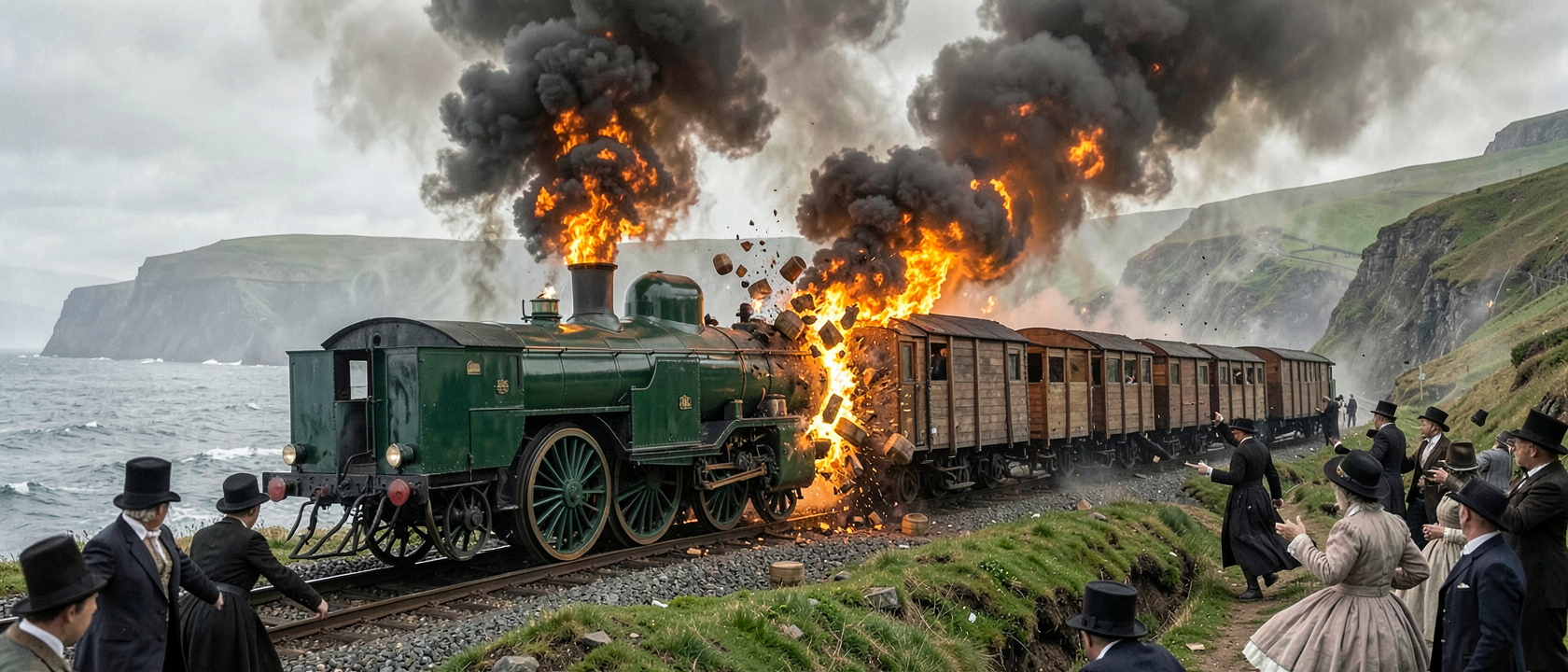
Arthur Thompson, driving the Prince of Wales, saw them about 1¾ miles (2.8 km) outside Abergele, some 200 yards (183 m) ahead. He first took them for wagons on the other line, then realized they were on his own track. He shut off steam and his fireman threw the brake. Neither made a difference. Running at up to 30 miles per hour (48 km/h), the Irish Mail struck the runaway wagons head-on. The paraffin barrels burst open on impact and caught fire. The locomotive, its tender, and the leading guard’s van derailed and ran on for about 30 yards (27 m) before overturning, and fire spread quickly through the carriages behind them.
Thirty-three people died, at the time the highest toll of any railway accident recorded in Britain. Fire and smoke made rescue impossible, and some of the dead could be identified afterward only by what they had carried. Thompson’s fireman, Joseph Holmes, died in the wreck. Thompson jumped clear, badly hurt, and died of his injuries at home two months later, on October 15, 1868; the inquiry that followed did not blame him. Lord and Lady Farnham were among the dead. The Duchess of Abercorn and her five children survived, and one account of that day holds they were among those who had turned right at Chester.
The dead were buried together on August 25 in a single grave 60 feet (18.3 m) long at Abergele churchyard, in a funeral the railway company paid for. Their memorial still reads, “In the midst of life, we are in death.” An inquiry for the Board of Trade, led by Colonel Frederick Henry Rich, found the immediate cause was a brakesman’s failure to set the individual wagon brakes before the shunting began, made worse by the loss of the brake van’s own brake in the same operation. The inquest blamed the two brakesmen on the goods train and the stationmaster who had supervised them; the brakesmen were charged with manslaughter and later acquitted, and the railway company was heavily criticized for its shunting procedures.
What the Record Doesn’t Say
Even with all this, some things stay unsettled. Some tellings put the Chester stop at 11:30 that morning, a time that sits awkwardly beside a 7:30 departure from Euston and doesn’t fully square with other accounts of the train running only about five minutes late by the time it reached Abergele; the exact clock that day isn’t something the record fixes with confidence. The paraffin cargo appears as 1,700 gallons in one account and 1,800 in another, so the real figure sits somewhere between them. And the record credits the choice at Chester with mattering a great deal without fully explaining why: no source gives a total count of everyone aboard that day, or how many turned left against how many turned right, or how that split lined up with the thirty-three who died, beyond what’s recorded of the Farnhams and the Abercorns.
Twenty-one years later, in June 1889, the same failure repeated itself: unbraked wagons rolling down a grade into a passenger train, this time at Armagh in Ireland.