
A Homecoming That Didn’t Finish
The East Indiaman Götheborg left Sweden in March 1743 and reached Canton (present-day Guangzhou), China, in early June 1744. By September 1745 she was on the final leg home, thirty months out, carrying tea, silk, spices, and porcelain for the Swedish East India Company. At least 35 men had already died of disease and poor diet on that crossing.
On September 12, 1745, with about 3,000 feet (900 m) left to her berth in Gothenburg harbor, Götheborg struck a submerged rock in the Göta älv river, recorded in different sources as the Hunnebådan or the Knipla Börö. The impact lifted her bow roughly 4.5 feet (1.4 m) out of the water, and within minutes the hold had taken on 5 feet (1.5 m) of water. No storm, no enemy: just bad luck within sight of harbor. The official cause was never settled.
No one drowned, though about a third of the cargo was recovered later; the rest, said to be worth a sum equal to Sweden’s public purse, went down with the hull. What else went down was a set of shipbuilding skills Sweden would not need again for generations.
Two Years on the Riverbed, Two Centuries Later
The wreck lay in the Göta älv for 239 years before anyone went looking for it in earnest. On December 9, 1984, a dive team began a systematic excavation, with a diver named Joakim Severinson among them.
Over roughly two years, the team recovered an estimated 8 tons of porcelain shards, now on display at the Maritime Museum in Gothenburg, along with a layer of green tea about 2 feet (0.6 m) thick, still identifiable after more than two centuries underwater.
The porcelain made headlines and the tea made historians pause, but the real consequence was Severinson himself. A diver who had spent years inside the timbers of an eighteenth-century hull was about to become the man Sweden turned to when it decided to build another one.
The Last Time Anyone Built a Ship This Big
The idea of a replica had circulated since the wreck was identified in 1984. In 1993, the Swedish East Indiaman Company (Svenska Ostindiska Companiet AB) formed to run the project, and on June 11, 1995, the keel was laid at the disused Eriksberg shipyard on the Göta älv. By then, the original Götheborg had been in the water since 1738 and at the bottom of the river since 1745–250 years of shipbuilding practice for a hull this size had gone largely unused in Sweden.
That made the job something other than a restoration. Nothing survived to restore from; the original had broken apart on a rock and been picked over by divers a century and a half later. The team worked instead from general knowledge of eighteenth-century shipbuilding and from what the excavation had taught them, not from plans specific to this hull.
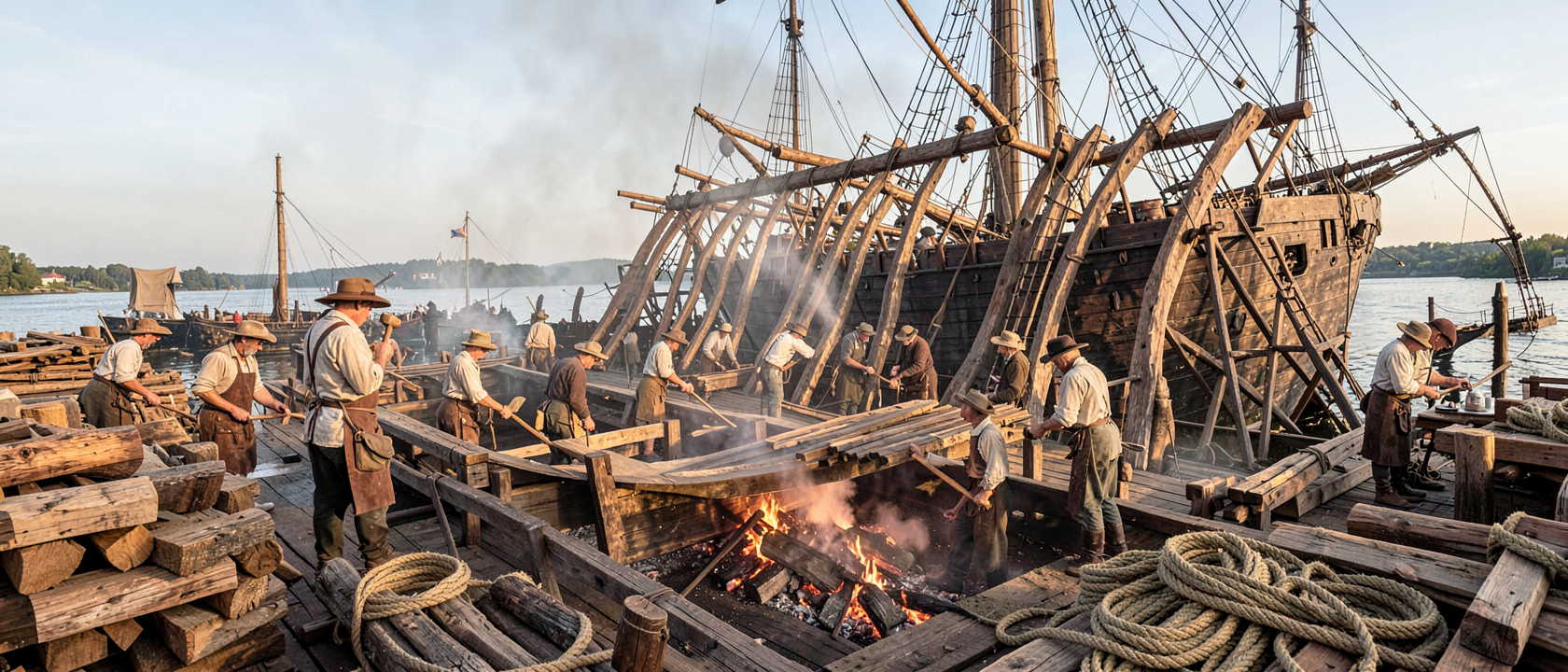
Four crafts had to be relearned almost from scratch: bending oak planks with steam, heat-treating iron mast rings, hand-sewing linen sails, and tarring hemp rope. Steam boxes let builders soften wood fibers and bend planks into a curved hull, roughly doubling construction speed over the older method of heating planks against an open fire, a technique already forgotten in Sweden by 1995.
The Steam Box
Under Severinson, now the project’s master shipwright, the steaming followed a fixed rule: about one hour in the box for every inch of a plank’s thickness. A 4-inch (10 cm) plank needed four hours of steam, produced with an electric heating unit standing in for the open-flame boilers of the 1700s.
Then the clock ran the other way. Workers had 15 to 20 minutes, less in cold weather, to pull the plank out and clamp it into the hull’s curve with mechanical clamps roughly 3 feet (0.9 m) long and 65 pounds (29 kg) apiece, before it cooled and stiffened. A crew of eight could manage only one or two planks a day.
At that pace, steaming and bending alone ran for more than two years, about a fifth of the eleven-year build. Severinson later said the ship took many hundreds of planks, though he could not give an exact figure. It was slow, repetitive work, and it filled years of the project: an hour of steam, twenty minutes to get it right, then back to the box.
Launch Day and What It Bought
The hull went into the water on June 6, 2003. Queen Silvia of Sweden christened the finished ship on September 3, 2004. After sea trials in May 2005, the new Götheborg entered service on April 18, 2005, ten to eleven years after the keel was laid, depending on which end date you use, at a reported cost of about $40 million, funded jointly by the Swedish government, the City of Gothenburg, and local companies.
She measures 190 feet 3 inches (58 m) overall, with a beam of 36 feet 1 inch (11 m), about 21,140 square feet (1,964 m²) of sail, and a top speed near 11 knots (about 20 km/h). A crew of 80, 20 professionals and 60 volunteers, sails her.
On October 2, 2005, she left Gothenburg on her first long expedition, tracing much of the old company’s route through South America, South Africa, and Australia to China, and back via the Suez Canal by June 2007. Baltic and Scandinavian tours followed, and by one count she had logged nine expeditions since launch. In 2021, organizers announced another: a departure planned for April 2022 to retrace much of the 1745 route back toward Shanghai, with stops including Lisbon, Djibouti, and Hong Kong. Whether the full circuit was completed isn’t confirmed in the record consulted here.
The Gaps in the Record
Some parts of this story were never pinned down, and the honest move is to leave them that way. No final plank count survives, nor any tally of the oak trees felled to supply them. It also isn’t clear whether any timber from the original wreck went into the new hull, or whether the ship was built entirely from fresh wood.
Wendy Van Duivenvoorde, a marine archaeologist at Flinders University in Australia and author of a study on Dutch East India Company shipbuilding, has called the rebuild one of the more historically faithful ship reconstructions in modern shipbuilding, a professional judgment, not a settled consensus. She has also pointed to the plainer cost underneath projects like this one: centuries-old oak trees, decades in the growing, cut down to build ships that a single collision could open up in minutes.