
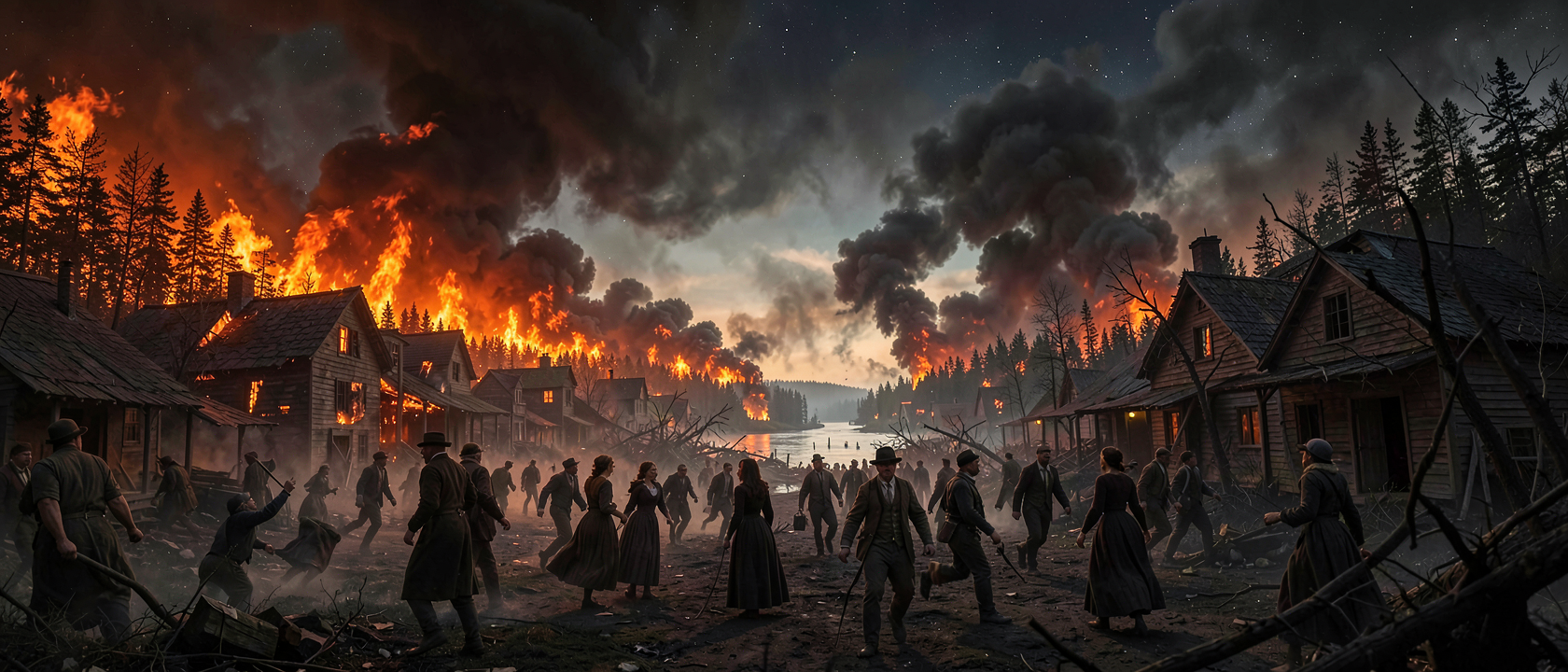
On the night of October 8, 1871, people in Chicago blamed a cow. According to a story that took hold almost as fast as the fire itself, a cow owned by Mrs. Kate O’Leary kicked over a lantern in a barn on DeKoven Street and started a blaze that killed about 300 people and burned just over 3 square miles (8 square kilometers) of the city. The same night, a few hundred miles to the north, a firestorm tore through Wisconsin and Michigan. Historians still argue over exactly how much ground it covered and how many people it killed, but the estimates run into the thousands of square miles and well over a thousand lives. It remains, by that count, the deadliest wildfire in American history. Almost nobody remembers its name: Peshtigo.
A Summer of Drought
The disaster in Wisconsin started with weather, not fire. The summer and autumn of 1871 had been unusually dry across a wide stretch of the country, from the Rocky Mountains to the Allegheny range, and large fires were already burning in several places. In the weeks before October 8, the woods around Peshtigo, a lumber town of about 2,000 people on the Peshtigo River, were smoldering too. Loggers had cleared the surrounding forest for years and left behind piles of slash, dry branches and stumps that caught easily. Residents took the danger seriously enough to set wooden barrels of water, called hogsheads, at intervals around town in case a fire got out of hand.
Built Almost Entirely of Fuel
Peshtigo was made of what it produced. Its mills cut lumber for a living, and the town itself was built of wood: frame houses, wooden sidewalks, streets covered in sawdust from the sawmills. The same mill economy had stripped and littered the surrounding woods with debris, so a fire that caught on the outskirts had almost nothing standing between it and the buildings.
The Night the Fires Merged
On the night of October 8, 1871, a shift in the weather turned the region’s scattered small fires into one. The same storm system that drove Chicago’s fire into a citywide blaze pushed hurricane-force winds, later reconstructed by the National Weather Service at around 100 miles per hour (160 km/h), across northeastern Wisconsin. The wind fused the smoldering ground fires into a single firestorm that jumped from treetops to brush to buildings once it reached town. The exact cause was never determined, and historians treat it that way: the conditions made a fire almost inevitable, but no one ever traced a single spark.
Father John Peter Pernin, parish priest of Peshtigo and neighboring Marinette, led parishioners toward the Peshtigo River as the flames closed in. Both of his churches burned to the ground. He and the others stood in the river up to their chins for most of the night, ducking under the surface to escape falling embers and smoke. Pernin came out of the water around 3:30 a.m. on October 9, temporarily blinded by what he had been through. His sight returned, and he spent the hours after helping other survivors.
Peshtigo was remote, and the fire had wrecked the means to report it. The nearest working telegraph was 45 miles away, in Green Bay. Word of the scale of the destruction did not reach the state capital in Madison until roughly two days after the fire had passed through.
What It Cost
Historians treat the Peshtigo death toll as an estimate, not an exact count, because the dead were scattered across farms, logging camps and small settlements as well as the town itself, and because the fire also swept into parts of Michigan the same night. The figures vary by source: some put the toll at just over 1,000, others as high as 2,500, with a commonly cited range of roughly 1,200 to 2,400. The area burned is disputed too, with estimates from around 1,900 square miles to as much as 2,400 square miles (roughly 3,000 to 6,200 square kilometers). Whatever the precise numbers, the toll dwarfed Chicago’s roughly 300 dead the same night. Both of Pernin’s churches were gone, and so was most of the town.
In the aftermath, Pernin recorded that a man caught looting the bodies of the dead was nearly hanged on the spot. Relief did not come from Wisconsin’s governor, Lucius Fairchild: he was in Chicago at the time, delivering aid to that city’s fire victims. It fell to his wife, Frances Bull Fairchild, twenty-four years old by one account, to organize Wisconsin’s own response. She rerouted a train car of food and supplies bound for Chicago to Peshtigo instead, and ran a blanket drive in Madison to send the bedding north.
Written Down Before It Was Forgotten
A record of the disaster was assembled almost at once. Frank Tilton, a journalist from nearby Green Bay, put together a short account before the year was out and sold it to raise money for survivors. It got the story into print while the disaster was still news, but it was not the fullest account.
Father Pernin wrote his own version, published in Montreal in 1874 in both French and English, under the title The Finger of God Is There! (Le doigt de Dieu est là!). It is more personal and more vivid than Tilton’s account, and it remains the central firsthand source for that night. Editors at the Wisconsin Magazine of History later judged that Pernin may have written it partly to raise money for a new church in Marinette, and partly to work through what he had lived through.
Pernin died on October 9, 1909, thirty-eight years to the day after he waded out of the Peshtigo River. The town was rebuilt on the same ground and still stands there. It is now home to the Peshtigo Fire Museum, which keeps the town’s own record of the fire on display.
What the Record Won’t Confirm
Some parts of this story are firmer than others. The tale of Mrs. O’Leary’s cow kicking over a lantern has no solid basis; a reporter later admitted to inventing it, though the story never left circulation. The Peshtigo death toll and the area burned are both working estimates, not a census, because many of the dead lived on farms and in camps that were themselves wiped out, with no one left to say who had been there. And while both fires broke out under the same violent winds on the same night, the link between them is shared weather, not a proven shared cause. What is certain is the imbalance: one fire is famous, and the other, on any of the estimates historians use, killed far more people while staying almost unknown outside Wisconsin.