A Bad Harvest and a Countess’s Order
In the summer of 1524, in the southwestern corner of the Holy Roman Empire, roughly the region of the Black Forest and Upper Swabia, trouble started small. Villagers argued with their lords over tithes owed to the church, over the days of unpaid labor a household owed each year, and over who had the right to fish a stream or gather wood in a forest that belonged, on paper, to somebody else.
These were the ordinary terms of peasant life under serfdom: fixed dues paid in grain or coin, labor owed on demand, and disputes settled in a lord’s own manorial court, where the lord also sat as judge. These disputes were common. 1524 turned out differently.
Twelve Articles and an Army of Farmers
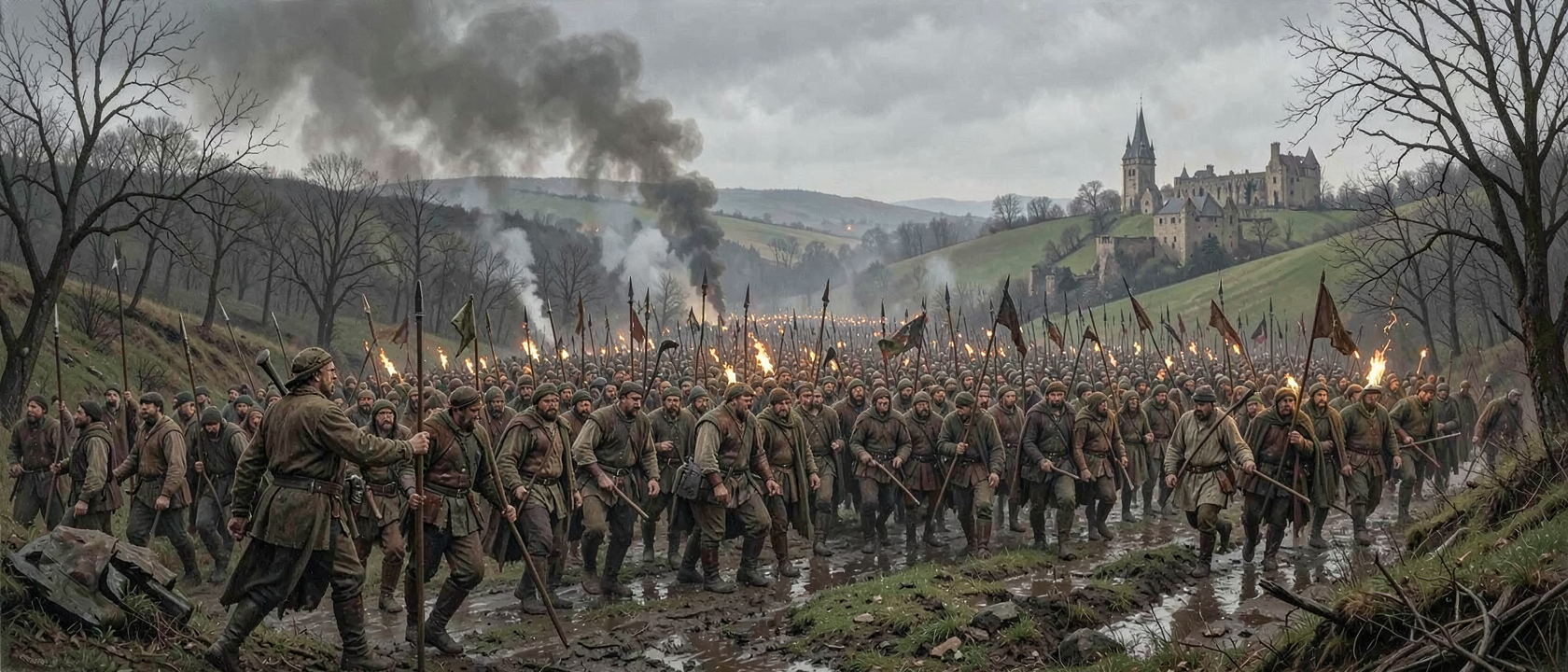
By early 1525, the scattered complaints had turned into an organized movement. Peasant bands, called Haufen, formed across Swabia, Franconia and Thuringia, and at Memmingen a group of them wrote down what they wanted: an end to serfdom, the right of each village to choose its own pastor, and tithes cut to a fair share, every demand argued straight from scripture. These became known as the Twelve Articles, printed, by one estimate, in as many as 25,000 copies.
Historians estimate that well over 100,000 people took up arms, across a stretch of territory running from the Black Forest along the Rhine to Lake Constance, into the Swabian highlands, along the upper Danube, and into Bavaria and Tyrol. That made it the largest popular uprising Europe would see before the French Revolution, more than two and a half centuries later. Peasant bands moved on castles, monasteries and fortified towns, not for what those places held but for what they stood for.
Weinsberg Falls
On April 16, 1525, Easter Day, a peasant band known as the Heller Haufen, the “Bright Band,” forced the surrender of the town and castle of Weinsberg. More than 70 nobles had taken shelter inside, among them Count Ludwig von Helfenstein, governor of Württemberg. The garrison gave up after only brief fighting.
The band’s leader, Jäcklein Rohrbach, had the count and his men run a gauntlet of peasant soldiers anyway. Count Ludwig, 13 other nobles, and their servants, 24 men in total, were stabbed as they ran the line until they died. It was the clearest proof the peasants had that a fortified position could fall to them. For the nobility, it became the defining image of what the rebels were capable of.
The Swabian League Answers
The other side of the war had already begun. On April 4, 1525, at Leipheim, roughly 5,000 peasants faced more than 8,000 professional troops of the Swabian League under Georg, Truchsess von Waldburg. The peasants broke and were cut down in retreat, an estimated 3,000 or more killed, and once the town surrendered, four of their leaders, including Jakob Wehe and Ulrich Schoen, were beheaded. Ten days later, at Wurzach, roughly 7,000 fought on each side; 140 peasants died, and the League’s own losses were not recorded.
The imbalance was structural: cavalry and trained soldiers against villagers carrying pikes and farm tools. It told the same way almost everywhere the two sides met. Around May 20 or 21, 1525 (sources differ by a day), Jäcklein Rohrbach, the man behind Weinsberg, was chained to a stake and burned alive while the nobility marked its victory. By then, across most of Swabia and Franconia, the revolt’s momentum had already broken.
The Last Embers, in Austria
Fighting continued into 1526, but by then it was confined to Austria, after the core of the uprising further north and west had already been put down. It was the closing chapter of the war rather than a second rising, and with it the fighting came to an end.
The Bill
What the war cost is recorded only in round terms: tens of thousands of peasants dead, a figure historians give as an estimate because no one kept a precise count. The reprisals that followed, the beheadings at Leipheim, the burning of Rohrbach, were repeated across the region as princely armies retook rebel territory. The order the Twelve Articles had asked for never arrived. In most of the affected territories, serfdom and feudal dues continued much as before. The outcome had been settled by force, not by which side held the better claim.
Blickle’s Revolution
In 1975, the historian Peter Blickle published Die Revolution von 1525 (translated into English as The Revolution of 1525), arguing that the uprising amounted to what he called a “Revolution of the Common Man” (Revolution des gemeinen Mannes): a reasoned bid to remake the empire’s political order, not a tax revolt that had simply run out of control. For a generation of historians, it became the war’s most influential interpretation.
Others have pushed back. The historian Gerd Schwerhoff, among them, has argued the war looked less like one coherent movement than a loosely connected series of local events, driven as much by circumstance as by program. How uniform the peasants’ actual demands were from one region to the next remains an open question. What is not in dispute is the scale of what more than 100,000 people attempted, and what it was made to cost them.