
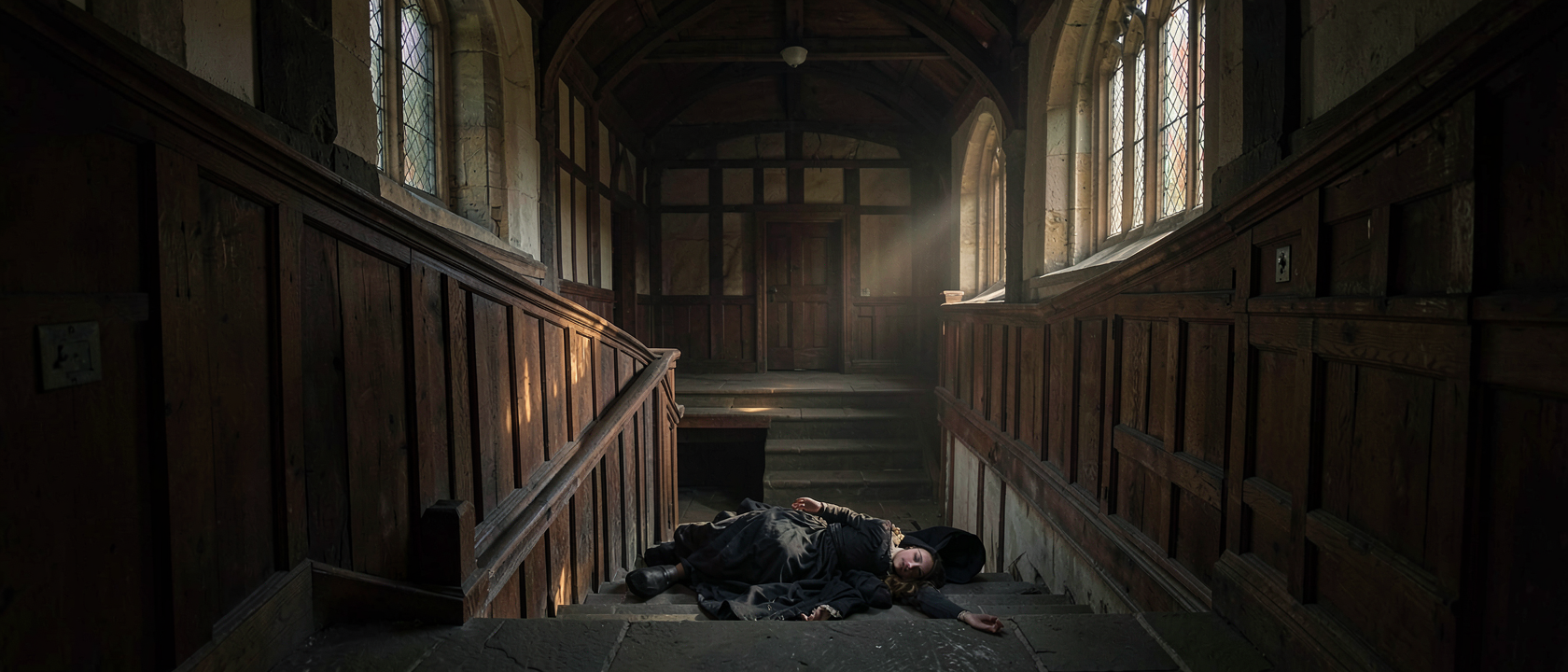
An Empty House
On September 8, 1560, Amy Robsart sent the entire household at Cumnor Place, a manor near Oxford, Oxfordshire, off to Abingdon Fair for the day. The house was leased at the time by Anthony Forster, a member of Parliament for Abingdon who acted as an agent for Amy’s husband, Robert Dudley. By morning it stood empty of servants. Robsart, 28 years old, had been living apart from Dudley, who was away at court, at Windsor.
When the household came home that evening, they found her at the foot of a staircase, dead, her neck broken. The record of the case states she had been alone in a particular room and had fallen down the stairs; there was no sign of a struggle and no other marks on her body. No one witnessed it. Word reached Dudley by way of a servant named Bowes, who rode to Windsor to tell him.
A Man Who Needed Good News
Six months earlier, in March 1560, the Spanish ambassador Alvaro de la Quadra had reported that Dudley told him he expected to be in a “new position” within the year. De Quadra also passed along gossip that Amy might be poisoned. Historians have since read that remark as a man anticipating his wife’s death and clearing his own path to marry the Queen, though that is a later reading, not something anyone could prove at the time.
Dudley was Elizabeth I’s favorite, and talk of a marriage between them had already reached the courts of Europe before Amy Robsart ever died. That is what made her death dangerous to Dudley in particular: no one needed to prove he was guilty, only the suspicion people already carried about him.
The Inquiry and the Verdict
An inquest opened at Cumnor on September 9, 1560, the day after the death, and was adjourned until August 1, 1561, nearly a year later. Dudley’s steward, Thomas Blount, reached Cumnor on September 10 to follow the inquest and carry out his own inquiries, reporting back to Dudley, who stayed at Windsor rather than going himself. Amy was buried on September 22, 1560, at the University Church of St Mary the Virgin in Oxford; the exact site of her grave was never recorded and is now lost.
When the jury finally reported on August 1, 1561 (some later accounts round the date to September, roughly a year after her death), the verdict was accidental death: Robsart had suffered two wounds to the head, called “dyntes” in the record, and broken her neck under the weight of her own fall, dying instantly. Rumor at the time, and some historians since, held that Dudley had done his best to pack and steer the jury that cleared him. In 2008, the historian Steven Gunn found the coroner’s report itself in the National Archives, sitting unnoticed among centuries of routine accident files. Its exact wording, one wound a quarter of a thumb deep, the other two thumbs deep, has split opinion again: the historian Chris Skidmore has argued it points toward violence, while other historians read the same document as consistent with a fall.
What the Verdict Couldn’t Fix
No one else died at Cumnor Place. No estate was seized and no fortune changed hands because of the verdict. On paper, the case closed clean: an inquest, a jury, a ruling of accidental death, filed away and forgotten for centuries.
But the ruling never gave back what the scandal had already cost. The marriage that gossip had predicted for Dudley and Elizabeth never happened. Dudley’s career went on regardless: he was created Earl of Leicester in 1564 and stayed close to the Queen for the rest of his life. The crown, though, was never his to reach for again. That was the real price of September 8, 1560: not a scaffold, not a prison sentence, but a future narrowed for good, on the strength of suspicion rather than proof.
The Staircase Reconsidered
In January 1956, the surgeon Ian Aird published a reassessment of the case in the English Historical Review. He argued against the theory, circulating since the 19th century, that Robsart had thrown herself down the stairs, calling it physically implausible. In its place he proposed something that was neither murder nor suicide: a spontaneous fracture, a spine already weakened by disease and giving way on its own.
Aird pointed to a report from April 1559, more than a year before Robsart’s death, in which the Spanish ambassador of the time, the Count of Feria (a predecessor of de Quadra, not the man himself), had written that Amy suffered from “a malady in one of her breasts.” If that illness was cancer that had spread into her bones, Aird reasoned, it could have caused her spine to fracture on its own. In his own review of fatal cases, bone deposits of that kind turned up in about 50 percent of them, with 6 percent of those reaching the spine.
Aird never proved his theory, any more than the murder or suicide theories were ever proved. Five centuries on, the coroner’s verdict of accidental death remains the only official finding on record, and no rival explanation, murder, suicide, or hidden disease, has ever been established as fact.