
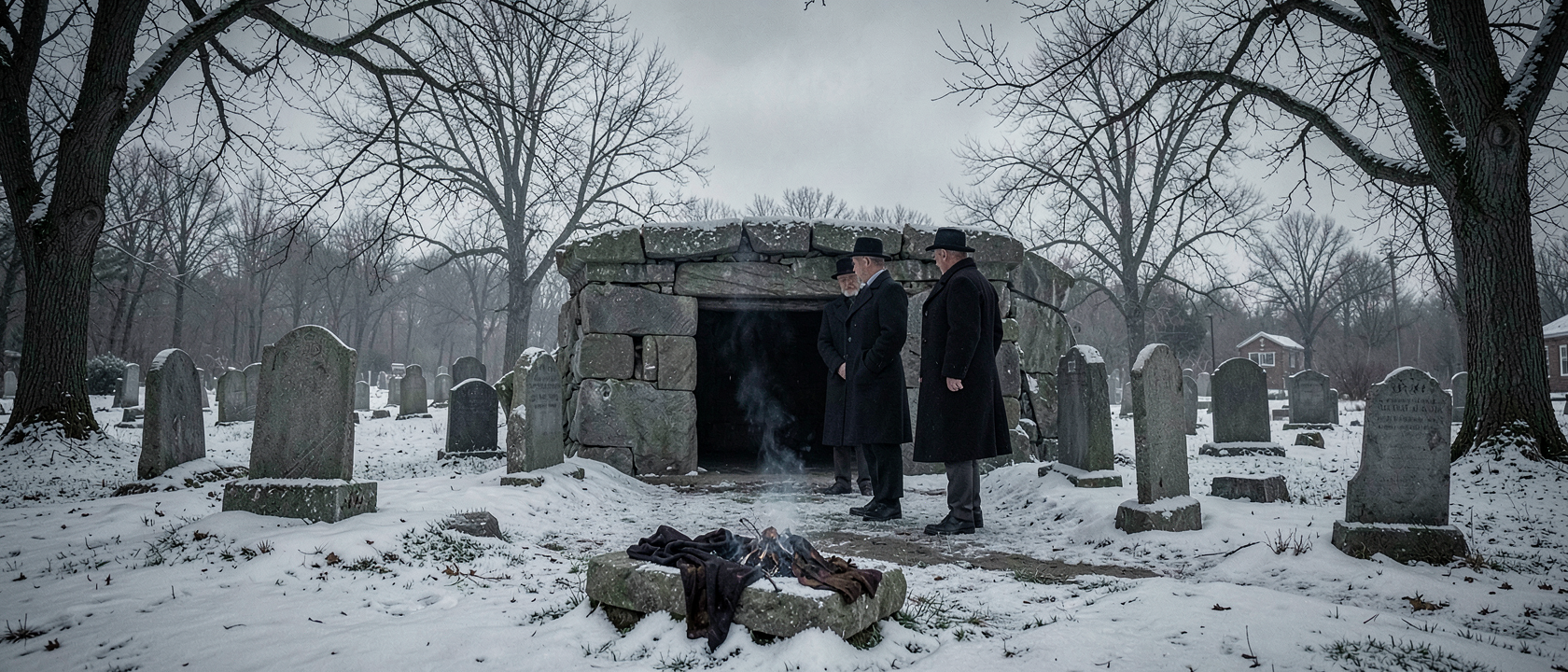
Between the late 1700s and the 1890s, several Rhode Island families facing repeated deaths from the same wasting illness dug up a relative already buried and looked for signs the body was not fully at rest. What they found decided whether a heart came out of the chest and went into a fire.
The Exhumation of Sarah Tillinghast
Sarah Tillinghast died in 1799 near Exeter, Rhode Island, one of four children the family lost to consumption, the era’s name for tuberculosis, in that single year, according to research by folklorist Dr. Michael E. Bell. Earlier retellings put the toll as high as seven; Bell traces it to four: Sarah, twenty-two, and her siblings Ruth, Aunstis, and James. Her father, Stukely Tillinghast (also spelled Stuckley or Stutley), farmed and kept an orchard near the family land. Accounts differ on how many children he and his wife, Honor, had in total, giving either twelve or fourteen.
Bell’s research confirms Sarah’s body was exhumed toward the end of the 18th century. Local tradition holds that Stukely then cut out her heart and burned it, believing this would stop the sickness from taking the rest of his children, though no document from the period describes that part directly, only the exhumation itself is supported by the record. The family lies today in a cemetery on Forest Hills Drive in Exeter that covers just 50 square feet (4.6 square meters) and holds twenty-five burials.
Why a Grave Looked Like a Threat
The pattern repeated across these families. When one relative after another sickened with the same symptoms, blame settled on the first person to die, usually the most recently buried, believed to still hold enough vitality to be drawing strength from the living at night.
Exhumation was the test. A family expected decay; if the body instead looked wrong for how long it had lain in the ground, blood that seemed fresh, hair or nails that appeared to have kept growing, that was read as proof the person had not fully died. Once that proof appeared, only removing and destroying the organs thought to hold the remaining life, usually the heart, sometimes the liver, was believed capable of stopping further deaths in the house. Rhode Island gained a particular reputation for this compared with the rest of New England, and in Exeter the fear had real numbers behind it: the town’s population fell from more than 2,500 residents in 1820 to about 960 by 1890, consumption’s steady work over three generations. Judged from the outside, the ritual looks superstitious. Inside the logic of the time, it was closer to a rescue plan built on a wrong premise, these families were not punishing the dead, they were trying to keep the living alive.
Three Graves, One Ritual
In 1875, a newspaper account described a family gripped by the same fear that would later reach the Browns. Convinced their dead father was pulling the rest of the household toward the grave, a sickly son took part in digging him up and cutting off the head. No names survive beyond the account itself.
In 1889, Nellie Vaughn was buried on her family’s farm in West Greenwich, Rhode Island. At her mother’s request, her body was later exhumed and reburied in the town cemetery, after which she became the target of a vampire accusation of her own, though no record states when or on what grounds. This case rests on a single scholarly account and has not been independently confirmed elsewhere.
The best-documented case followed three years later, only 2.5 miles (4 kilometers) from the Tillinghast burial ground. Mercy Lena Brown died in January 1892 in Exeter at nineteen, the third member of her household lost to consumption in under a decade: her mother, Mary Eliza Brown, had died in 1883, and her sister Mary Olive had followed about six months later. When Mercy’s brother, Edwin, grew seriously ill, neighbors pressed their father, George Brown, to open the family graves and settle whether one of the dead women was to blame. On March 17, 1892, by most accounts, George Brown, a local doctor named Harold Metcalf, and a group of townspeople did exactly that. Mary Eliza and Mary Olive had decomposed as expected. Mercy’s body had not, since it had been held in a cemetery vault through the winter rather than buried in frozen ground, an ordinary cold-weather effect that those present read as something else entirely. Contemporaries described her as too well preserved, with color still in her face and blood said to remain in her heart, claims never verified beyond what those at the scene reported. Dr. Metcalf cut out her heart and liver and burned them on the spot; some accounts add that her lungs were removed as well, though the more careful record lists only the heart and liver. The ashes were mixed with water and medicine and given to Edwin to drink. Two days later, on March 19, 1892, the Providence Journal ran the story on its front page.
The Bill for Mercy Brown
Edwin Brown died a few months after drinking his sister’s ashes. No exact date survives, but the ritual bought his family nothing. His death is generally treated as the last known instance in Rhode Island of a community exhuming, mutilating, and burning a corpse, then feeding the remains to a dying relative, in the belief that it would stop a vampire.
The Browns were not an isolated case. In 1896, anthropologist George R. Stetson published an account of how widespread the practice had become, finding five families in one town who had exhumed relatives, three in another, and two more spread across two neighboring villages, each entry a household that had already buried someone once and then gone back with a shovel.
From the Grave to the Germ
What ended the practice was not a single announcement but a shift in what people understood to be killing them. Tuberculosis, historian Jeanne E. Abrams has written, was the leading cause of death in the United States through the 19th century and into the early 20th. As germ theory took hold and doctors could describe how the disease actually spread, through airborne bacteria rather than a restless corpse, fear had somewhere new to go.
Researchers Donald H. Holly Jr. and Casey E. Cordy, tracing these cases from the Tillinghasts to the Browns, describe what followed: anti-spitting ordinances meant to limit the bacteria’s spread, and a push for better ventilation in homes and workplaces. None of this arrived at once, folk belief and public health measures overlapped for years rather than trading places overnight, but the direction was set. Fear moved from the graveyard to the sickroom, and the response moved from exhumation to policy.
What the Record Doesn’t Say
Parts of this story stay open. No one has recorded the exact date Nellie Vaughn was accused of vampirism, only that it came sometime after her reburial. No full count exists of how many bodies were exhumed across New England; Stetson’s numbers cover only the villages he happened to survey. And no source marks the precise moment tuberculosis was scientifically tied to these deaths, or the exact point when families stopped digging up their dead.
What is left instead is a scattering of graves, a handful of documented names, and a pattern repeated by families who had already lost too much and were trying, with the knowledge they had at the time, to keep from losing more.