A Seat at the Table: Iraq and the League of Nations, 1932
The Vote
On October 3, 1932, the League of Nations Assembly, meeting for its thirteenth annual session in Geneva, voted unanimously to admit the Kingdom of Iraq. It was the first Arab country to join the League, and the only mandated territory ever to leave that status through a collective vote rather than through war or a unilateral British withdrawal. The mandate Britain had run since 1921, known as Mandatory Iraq, ended with that vote.
The scene itself was simple: a delegate took his seat, a flag went up beside the others, and Iraq gained standing in international law as a sovereign state.
The vote removed nothing else. Not one British soldier, aircraft, or adviser left Iraqi soil, because the terms governing all three had already been settled two years earlier, in a treaty Iraq could not undo simply by joining Geneva.
The Fine Print of 1921–1930
The monarchy that entered the League in 1932 had been assembled with British hands in 1921, when British officials installed Faisal I as king. The treaty that made 1932 possible was signed on June 30, 1930, between King George V and King Faisal I, with High Commissioner Francis Humphrys signing for Britain and Prime Minister Nuri al-Said signing for Iraq.
The Anglo-Iraqi Treaty declared that “responsibility for the maintenance of internal order rests with the King of Iraq,” and bound Britain to help only if Iraq were invaded from outside. In return, Britain kept its air bases, the right to move troops through the country, its own officials inside Iraqi ministries, and a military mission attached to the Iraqi army. One document did two jobs at once: it set the timetable for ending the mandate, and it wrote British military presence into Iraqi law for years afterward.
Sovereignty on Paper
A seat at Geneva did not translate into command at home. Iraq’s government could vote alongside Britain and France, but for any real military problem it still depended on British aircraft, British advisers, and a treaty built on the assumption that British forces would remain in the country.
The strain showed quickly. Nuri al-Said, who had signed the 1930 treaty, resigned within weeks of the League vote, and King Faisal turned to Rashid Ali al-Gaylani, a former opponent, to form the next government. A monarchy leaning on outside military backing, and already changing prime ministers within a month of independence, had reason to worry about looking weak, both abroad and at home. The episode points to a lesson the monarchy could hardly avoid, whatever anyone in Baghdad said about it at the time: recognition at Geneva was not the same as control at home, and control would have to be built some other way.
Where the New Army Pointed
That other way was the army. Through the early and mid-1930s, Iraq’s military and its small air force were aimed not at any outside enemy but at Iraqis the state judged unreliable.
Kurdish nationalist rebels in the north were one target. Shia Arab tribes in the mid-Euphrates region were another: uprisings against the Sunni-led government in 1935 and 1936 were put down by force, killing roughly 100 people in 1935 and more than 90 in 1936, with government aircraft shot down and captured rebels executed.
The worst came in August 1933, in and around the village of Simele in the north, when Iraqi forces under General Bakr Sidqi, joined by Arab and Kurdish irregulars, moved against Assyrian communities over five days, August 7 through 11. Death toll estimates are disputed: British figures from the time put it at 300 to 600, Assyrian estimates at 3,000 to 6,000. Not disputed is the displacement. More than 20,000 Assyrians fled to Syria afterward. Yazidi communities in the same northern region were also drawn into the state’s campaigns against groups it treated as internal threats, though the surviving record does not give the same level of detail for what happened to them.
What the Record Doesn’t Say
The gap between 300 and 6,000 deaths at Simele reflects two sources counting the same event by different methods, and no single figure in between should be treated as settled.
The record is thin elsewhere too. There is no complete timeline for the individual campaigns against Kurdish rebels or Shia tribes beyond the broad years in which they took place. And there is no clear account of what Britain’s forces and advisers, still present in Iraq under the 1930 treaty, did or did not do while the violence was underway. What role, if any, that presence played is a question the available sources simply do not answer. Closing that gap would take archival work, not a guess.
The Bill
Structurally, Iraq’s independence in 1932 was closer to a legal formality than a change in who actually held power. British bases, British advisers inside the army, and British treaty rights over troop movement all continued exactly as the 1930 agreement had set them out. The mandate ended on paper years before it ended in practice.
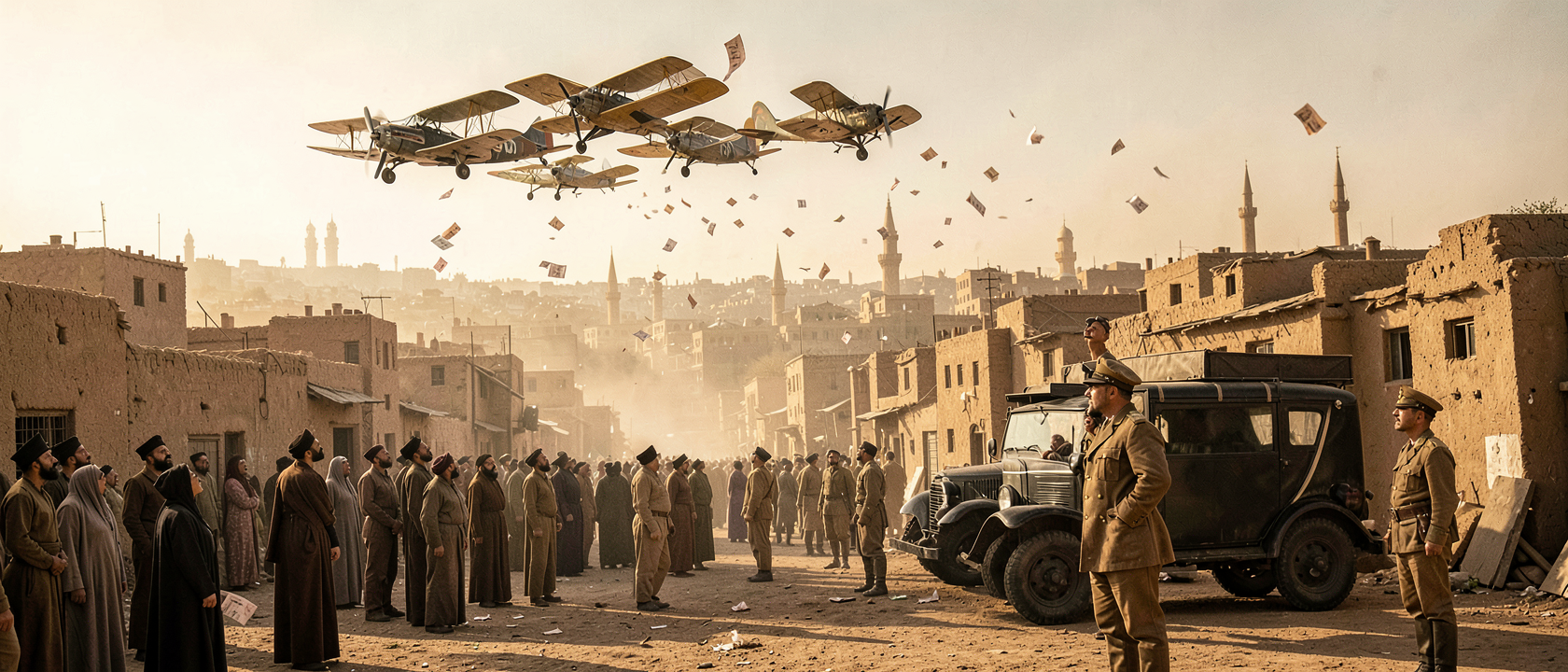
Humanly, the pattern set in these years outlived the men who set it. Bakr Sidqi, who led the campaign at Simele in 1933, went on to lead Iraq’s first modern military coup in October 1936, using aircraft and leaflets dropped over Baghdad to force out one prime minister and install another. Six more coups followed before 1941. Looking back, and this is a judgment made only with hindsight, not one available to anyone in 1932, the habit the monarchy built in its first years of formal independence, meeting internal dissent and minority difference with the army instead of negotiation, did not end with the monarchy. It shaped how the Iraqi state dealt with its own people for decades afterward.