Land Made a Weapon
In 1960, Kenya was still a British colony, one Britain had begun carving out of East Africa in the 1880s, during the scramble that divided the continent among European powers. The territory was formally named Kenya in 1920. By 1960 it held about 64,000 people of European descent, alongside roughly 6 million Black Africans and smaller communities of Asian and Arab descent.
The imbalance was not only demographic. In 1902, colonial administrators passed the Crown Lands Ordinance, reserving the colony’s most fertile farmland, known ever after as the White Highlands, for European settlers alone. Black Africans could not own land there. For nearly six decades, that single ordinance decided who farmed the best soil in Kenya and who did not. By 1960, it had produced two generations of dispossession, and any conversation about the country’s future had to start there.
Seventeen Nations in One Year
Kenya’s transition was not happening in isolation. In 1960 alone, seventeen African states declared independence from their colonial rulers, a wave later remembered as the Year of Africa. Negotiators on both sides had two cautionary examples close at hand. Congo’s own independence, that same year, broke down into civil conflict within months. South Africa, meanwhile, was hardening into apartheid rather than loosening its grip. Against that backdrop, nobody sitting down to write Kenya’s constitution could assume a peaceful outcome was guaranteed.
The Lawyer Building Someone Else’s Nation
Thurgood Marshall arrived in Kenya in January 1960, invited by Kenyan independence leaders. Six years earlier he had argued Brown v. Board of Education before the U.S. Supreme Court and become a symbol of the American civil rights movement. By 1960 a younger generation back home was turning to sit-ins and street protests rather than lawsuits, and Marshall was, by his own account, wondering what role remained for him. Kenya offered an answer: a Black man helping to found a nation, something with no equivalent in his own country.
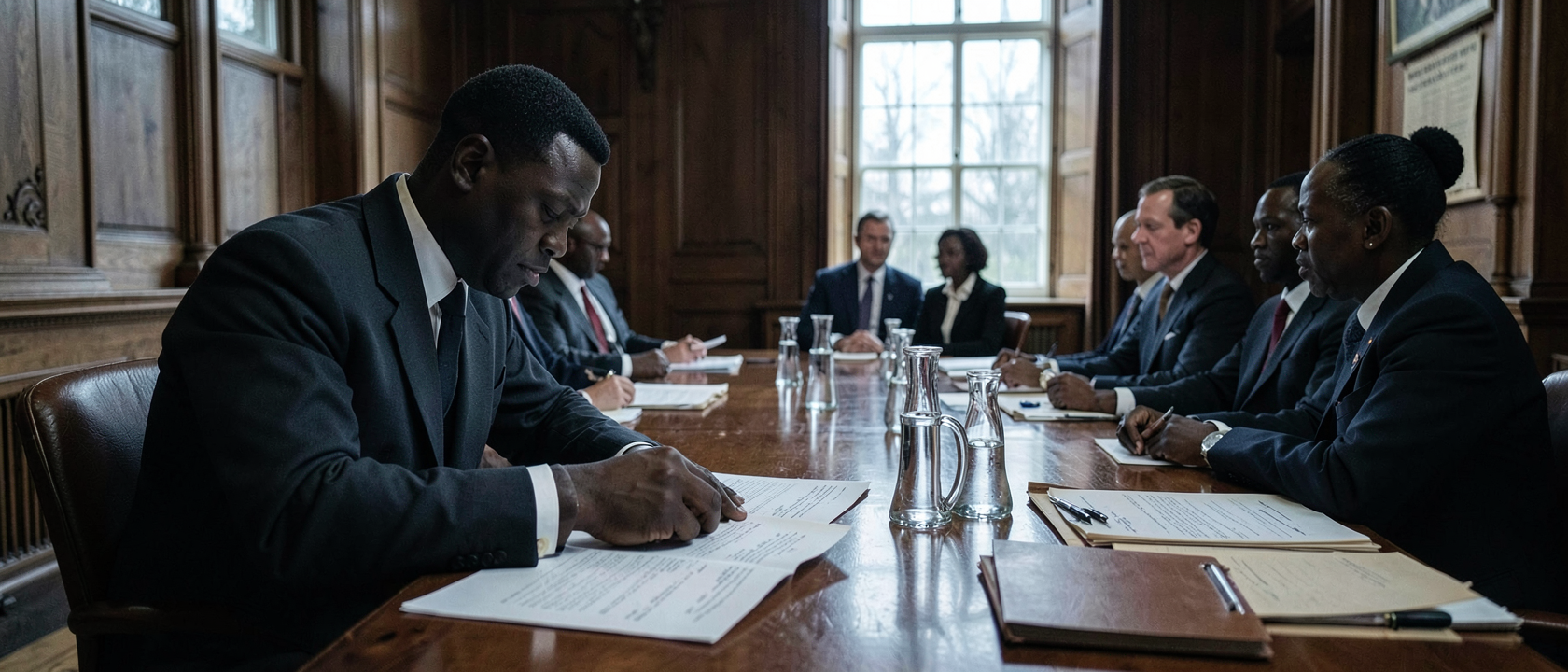
From Kenya he traveled on to London for the first Lancaster House Conference, one of three constitutional conferences held between 1960 and 1963. He was the only person in the room who was neither British nor Kenyan. The Cleveland Call and Post described his job plainly: write a constitution that gave Africans full political power through universal suffrage, while protecting the rights of a white minority outnumbered about 100 to one.
Marshall took the assignment seriously. His February 1960 draft bill of rights drew on the Universal Declaration of Human Rights and on the recent constitutions of Nigeria and Malaya. Its property clause came almost directly from Nigeria’s constitution: the state could not seize private property without paying for it. That was a strong, enforceable guarantee, aimed squarely at reassuring the 64,000 settlers who held the Highlands.
Marshall himself called the U.S. Constitution the best he had ever seen, yet he wrote a Kenyan bill of rights with no American constitutional language in it at all. What carried over instead was his American legal instinct: an assumption that independent courts would enforce these rights, and an emphasis on equality he still hoped to see realized at home. Jomo Kenyatta, released from British detention in 1961, joined the talks as they carried into a second conference in 1962 and a third in 1963. The trade at the heart of the document was plain enough: protect what the settlers owned, and buy a chance that they would not fight to keep it by other means.
Independence Arrives
The third Lancaster House conference closed its work in 1963, ending more than seventy years of British colonial rule. In December 1963, Kenya became independent, and Jomo Kenyatta was sworn in as its first prime minister. There was no settler uprising. There was no collapse into the kind of conflict that had followed Congo’s independence three years earlier. On its own terms, the compromise built at Lancaster House had done its job: a Black-majority government took power, and a small, wealthy settler minority stayed rather than fighting to leave. That was the immediate outcome.
From Prime Minister to President for Life
The peace did not last as democracy. Within about a year, Kenyatta declared himself president, moving beyond the office the 1963 constitution had given him. He went on governing Kenya as a one-party state until his death in 1978, with continued support from both the United States and Britain throughout.
Marshall’s bill of rights had done exactly what it was built to do, on one side of the ledger. The property clause he lifted from Nigeria’s constitution held. The settlers’ land and legal protections endured. On the other side, the document’s larger promise, a government answerable to voters under enforceable rights, did not survive Kenyatta’s consolidation of power. The peace bought at Lancaster House turned out to be durable. The democracy it was supposed to guarantee was not.
The Dispute Historians Won’t Paper Over
How to weigh that trade is where the record gets harder, not easier. Legal scholar Mary Dudziak, whose research provides the fullest account of Marshall’s work in Kenya, has called it an accommodation of injustice, and compared it to the concessions the framers of the U.S. Constitution made over slavery: rights extended to preserve a settlement, at the expense of the people that settlement was meant to protect. Other scholars push further. Legal scholar Makau wa Mutua has argued that Marshall’s insistence on equal protection for Kenya’s white minority, the same principle he was fighting for Black Americans at home, froze settler privilege in place and closed off any real chance of transforming Kenyan society.
What the record does not settle is just as real. Neither account details what Kenyan delegates themselves argued behind closed doors, or how they received Marshall’s property clauses at the time. Nor does either fully explain the mechanism by which a constitution built around courts and enforceable rights failed to stop Kenyatta’s turn toward one-party rule.
After Marshall’s death, a monkey-skin cloak was found draped over an armchair in his office, among his most treasured possessions. It was a gift, he had told his law clerks for years, from the time he was made an honorary tribal chief in Kenya. He talked about the country for the rest of his career as a place where, for one stretch of years, everything had still seemed possible.