
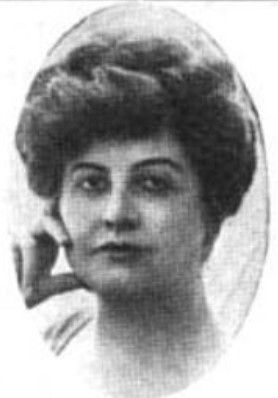
Working under a pen name she adopted because the subject of her first novel struck her as too controversial to publish under her legal name, she made a career out of subjects that polite fiction of her era typically avoided: adultery, divorce, unwed motherhood, and what one contemporary source describes as ‘dope rings.’ Her books appeared under three major publishers and her short stories reached a national magazine readership.
Key facts
- Born: 27 December 1868
- Birthplace: New Philadelphia
- Died: 6 February 1928
- Place of death: Dover
- Occupation: writer
The pen name and the first novel
Frances Elizabeth Janes, as she was born, married Sidney Paine Budgett in 1894. Budgett was an English physician and medical school professor, born on 31 October 1862 in Westbury-on-Trym, Bristol, England. The marriage gave her a new legal surname, but when she sat down to write her first novel she chose neither her birth name nor her married one.
The Winning Chance appeared in 1909 under the name Elizabeth Dejeans, a pen name she selected because the book’s subject struck her as sufficiently controversial to require separation from her personal identity. The novel addressed what its publisher, J. B. Lippincott Company, advertised as ‘the big problem of the American girl.’
A career in controversial themes
Dejeans published at least twelve novels between 1909 and 1926. Her publishers shifted over that span: J. B. Lippincott Company handled her early work, followed by Bobbs-Merrill Company of Indianapolis and Doubleday, Page and Company. The range of themes across those books was consistent: adultery, divorce, unwed motherhood, and what one contemporary source describes as ‘dope rings.’ Within the popular fiction market of the period, she was categorized as a writer of female romances focused on modern women’s lives.
Her fiction appeared alongside a shorter-form output in national magazines. Short stories by Dejeans ran in The Smart Set from July 1909, in Lippincott’s Magazine in August 1910, in Smith’s Magazine in February 1920, and in Ainslee’s Magazine. These placements kept her name in front of readers between novels.
Public positions
In a 1911 interview, Dejeans argued publicly in favor of women’s suffrage, contending that maternal instinct supported the case for the ballot. The statement was documented at the time and places her among American women writers who connected their public advocacy to the suffrage movement.
Later years and death
Sidney Paine Budgett remarried in 1918, the year Dejeans published Nobody’s Child. He died on September 9, 1934, at El Monte, Los Angeles, California, at age 71.
She was 59 years old. Contemporary newspapers reported her death under the headline ‘Elizabeth Dejeans, Writer, is Suicide.’
Did you know
- When Lippincott advertised The Winning Chance (1909) with the phrase ‘the big problem of the American girl,’ a writer in the American Journal of Nursing pushed back in print, arguing that the subject was more accurately described as ‘the problem of the American man.’ (delart.org)
- Her husband Sidney Paine Budgett remarried in 1918, the same year Dejeans published Nobody’s Child, and died on September 9, 1934, at El Monte, Los Angeles, California, at age 71. (findagrave.com)
Data sources
Data updated: 2026-11-01