
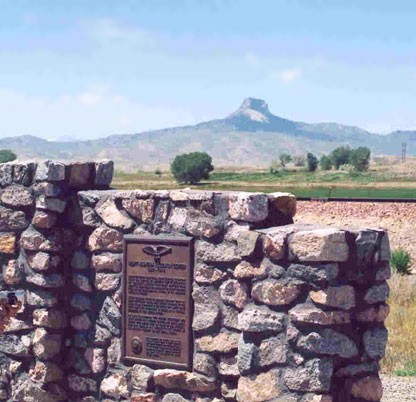
Heart Mountain Relocation Center was a World War II-era concentration camp operated by the United States government in northwestern Wyoming, one of ten such camps used to incarcerate people of Japanese descent. The camp held residents drawn from Los Angeles, Santa Clara, and San Francisco in California; Yakima, Washington; and Oregon. At its peak in January 1943, it confined 10,767 people within approximately one square mile of high-plains terrain near Heart Mountain, a geologically unusual peak whose ancient limestone cap rests atop much younger rock. The camp opened on August 12, 1942 and closed on November 10, 1945.
Key facts
- Country: United States
- Type: concentration camp; Japanese-American relocation camp
- Located in: Wyoming
- Coordinates: 44.6717, -108.9464
- Founded: 1942
Construction and Physical Layout
In June 1942, more than two thousand laborers enclosed 740 acres of arid land with a high barbed-wire fence equipped with nine guard towers and built 650 military-style buildings in a street grid. That grid incorporated administrative, hospital, and support facilities alongside 468 residential dormitories. Construction was directed by the Army Corps of Engineers.
The final count of structures came to 467 buildings covering offices, living quarters, shower and bath facilities, mess halls, and laundry rooms. Two large root cellars, each measuring 310 feet long and nearly 40 feet wide, were built by internees themselves. Those two root cellars are the only surviving World War II camp structures built entirely by Japanese Americans at any of the ten relocation centers.
The Population
The camp held three generations of Japanese-heritage residents. Issei were Japanese immigrants; Nisei were first-generation American-born Japanese; and Sansei were second-generation American-born Japanese. All three groups were subject to forced removal from the West Coast.
People arrived by train from California, Washington, and Oregon beginning on August 12, 1942. The last internee departed on November 10, 1945, after the camp had operated for just over three years.
Internal Economy and Wages
Within the fence, Heart Mountain sustained an internal economy. Internees staffed a hospital, schools, a garment factory, a cabinet shop, a sawmill, and a silk screen shop. Monthly wages ranged from $12 to $19, with the $19 rate reserved for the most skilled positions, including physicians working in the camp hospital.
The wage gap between internees and outside employees was pronounced. Japanese American physicians, whose work was the highest-compensated labor available to internees, received $19 a month. Caucasian nurses working in the same hospital were paid $150 a month.
The camp also produced its own food supply through a substantial agricultural program. Internees first completed the Shoshone Irrigation Project, including a 5,000-foot canal, in spring 1943, then cultivated 45 different crop varieties. Output was large enough to supply not only Heart Mountain but also other relocation camps and nearby towns.
The Heart Mountain Sentinel
The camp published its own newspaper, The Heart Mountain Sentinel, under the first editorship of Bill Hosokawa. The paper reached 6,000 camp households every week and was also mailed to subscribers living outside the camp, maintaining a connection between internees and the broader public.
Military Service and Draft Resistance
Heart Mountain produced one of the more complicated records of any relocation center regarding military conscription. On one side, 799 young Japanese American men, both volunteers and draftees from the center, served in the American military during the war.
On the other side, the camp had 85 draft resisters, the highest rate of draft resistance relative to population of all ten camps. Of those 85, 63 were tried together in Cheyenne in what became the largest mass trial in Wyoming history.
After the Camp Closed
When the center officially closed in November 1945, the federal government sold all barracks to anyone who could remove them for $1 apiece. Much of the surrounding land was subsequently opened to veteran homesteaders, a program from which Japanese Americans were excluded.
Remembrance and Recognition
In April 2024, the Heart Mountain Wyoming Foundation announced that the Heart Mountain Interpretive Center had been designated a Smithsonian Affiliate, making it only the second Wyoming museum to receive that designation.
Also in 2024, the Mineta-Simpson Institute was established at the site, named for former U.S. Secretary of Transportation Norman Mineta and former U.S. Senator Alan Simpson. The two men had first met at Heart Mountain in 1943, when Simpson’s Boy Scout troop from Cody visited the camp, and a friendship formed between them that lasted the rest of their lives.
Heart Mountain: The Geological Feature
The mountain that gave the camp its name is itself a geological anomaly. Ancient limestone at its summit is at least 250 million years older than the Willwood Formation rocks at the base of the mountain, a relationship produced by a prehistoric detachment fault that thrust older rock over younger material.
Did you know
- At its peak population in January 1943, Heart Mountain held 10,767 residents within approximately one square mile. The nearby town of Cody covers about 10 square miles with a comparable population size. (bethreiber.com)
- Norman Mineta, later U.S. Secretary of Transportation, and Alan Simpson, later a U.S. Senator, first met as Boy Scouts in 1943 when Simpson’s troop from Cody visited Heart Mountain. Mineta was a prisoner; Simpson was a free visitor. Their friendship, which lasted decades, inspired the 2024 Mineta-Simpson Institute at the site. (rafu.com)
- Japanese American physicians at Heart Mountain earned $19 a month, the highest wage available to any internee. Caucasian nurses working in the same hospital earned $150 a month. (wyofile.com)
- The Heart Mountain agricultural program began in spring 1943 after internees completed the Shoshone Irrigation Project, which included a 5,000-foot canal. The program grew 45 different crop varieties and produced enough food to supply the camp, other relocation camps, and nearby towns. (bethreiber.com)
Data sources
- Wikidata
- eacc.janm.org
- wyominghistoryday.org
- places.wyo.gov
- nps.gov
- wyohistory.org
- yellowstonepark.com
- powelltribune.com
- dvidshub.net
- bethreiber.com
Where it appears
Data updated: 2026-11-02