
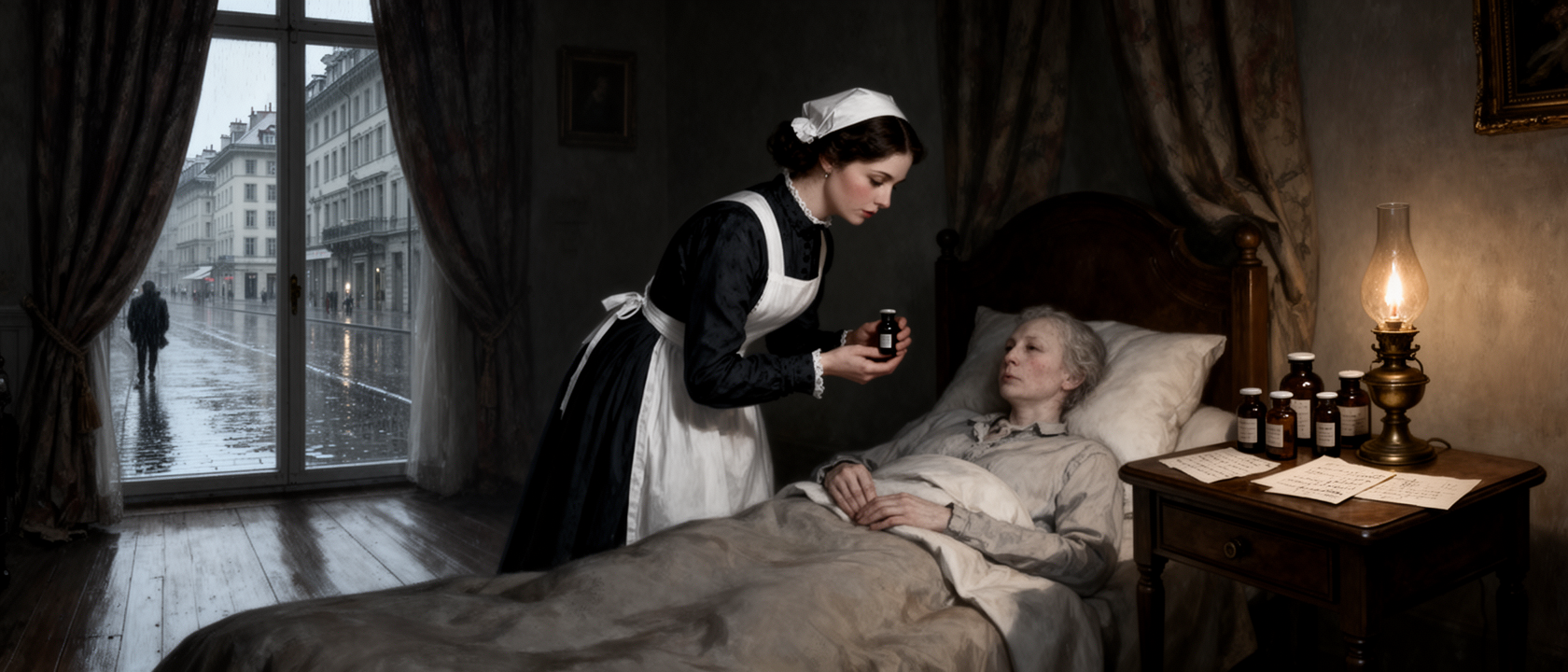
The Incident at Pension Desarzens
In June 1868, a 24-year-old woman named Marie-Catherine Fritzgès collapsed at the Pension Desarzens boarding house in Geneva’s Plainpalais district. Her physician recognized poisoning symptoms and notified the authorities. Fritzgès survived. The nurse assigned to her care, a 32-year-old from Le Locle named Marie Jeanneret, was arrested on June 28, 1868.
The investigation revealed not a single incident but a sustained campaign going back at least to late 1867. The formal indictment, handed down on November 23, 1868, charged Jeanneret with six murders and three further poisoning attempts. The total number of people she may have harmed was, by some estimates, close to 30.
Method and Access
Marie Jeanneret was born on January 13, 1836, in Le Locle, canton of Neuchâtel. Her parents died while she was young; she inherited enough from their estate to support herself without paid employment. That financial independence was central to how she operated. Private nursing in mid-19th-century Switzerland was a service well-to-do families paid for considerably. Jeanneret offered it for free, which gave her close, largely unsupervised access to her patients.
Her chosen method combined morphine and atropine, an alkaloid derived from deadly nightshade. Administered together, each compound’s visible effects partially masked those of the other, presenting an examining physician with a confusing picture rather than a clear signature of poisoning.
Jeanneret’s own medical history was unusual. Doctors considered her symptoms largely imaginary, yet she sought out painful interventions, including demanding that a physician burn her back with a red-hot iron; the welts along her spine were recorded. Whether this illuminates her conduct as a nurse is a question the trial did not resolve.
The Ledger of Victims
The indictment covers late 1867 through June 1868, during which at least six people in Jeanneret’s care died. Sources disagree on the precise count: the formal indictment gives six confirmed murders; the Dictionary of Women Worldwide puts the figure at seven; a contemporary newspaper account from December 1868 reported nine. The discrepancy most likely reflects different thresholds of proof rather than different underlying facts.
The youngest identified victim was Jenny-Julie Juvet, eleven years old, poisoned via bonbons Jeanneret called “princesses.” The oldest was Louise-Marie Lenoir, aged 72. The gap between the cases counted in the most expansive contemporary tallies and the estimated 30 total reflects what the forensic chemistry of the period could and could not prove; exhumations were carried out in 1868 and tissue samples tested for alkaloid compounds.
The Verdict and the Legal Pivot
The trial opened in Geneva on November 23, 1868, before Court President Eugène Colladon, with Public Prosecutor William Turrettini leading the case and defense lawyer Gaspard Zurlinden representing Jeanneret. On November 26, the jury returned a verdict of guilty under extenuating circumstances. The charges carried the possibility of a death sentence; the jury declined to apply it. Extenuating circumstances capped the penalty at 20 years in prison.
That refusal became part of the argument for removing the option from the statute books entirely. Politician Marc Héridier led the subsequent campaign, and in 1871 Geneva permanently abolished the death penalty. Switzerland followed when Article 65 of the federal Constitution abolished capital punishment nationwide in 1874. The Jeanneret case was not the sole cause, but the trial record made the jury’s reluctance visible and fed directly into the legislative debate.
The Contradiction of Motive
At trial, Jeanneret did not deny administering the substances. She argued she had done so believing she was helping her patients and that the deaths were mistakes. No material motive surfaced: she had not stolen from the victims, had not been named in any will, and had no documented financial relationship with anyone who died.
Her explanation sits uneasily against the record. A woman who had demanded a physician burn her back with heated metal and who administered a pharmacological combination specifically suited to confusing medical diagnosis was not simply miscalculating dosages. The jury’s verdict, guilty with extenuating circumstances, reflects that unresolved tension. They found she had killed; they stopped short of treating her as a deliberate murderer warranting execution. The question of why she continued is one the trial left open.
Marie Jeanneret died in Geneva on April 4, 1884, at the age of 48, before completing her sentence. The federal abolition of capital punishment she had, at some remove, helped bring about was already ten years old by then.