
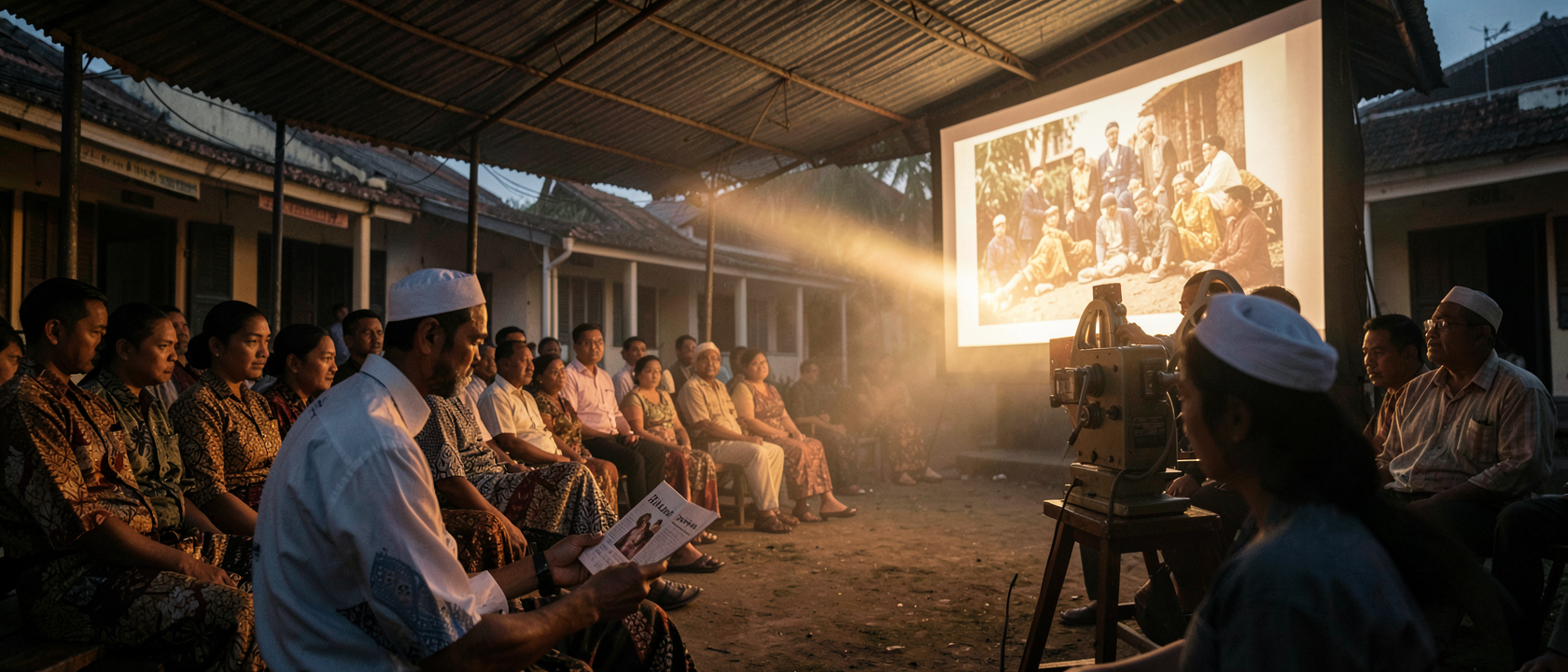
The Studio on the Strait
Singapore in 1940 was a British Crown Colony, a major port, and a city moving fast. Workers were arriving from across the region, cash wages were replacing older arrangements, and the population was acquiring habits that could not have existed a generation before. One of those habits was cinema.
Before 1940, Malay-language films shown in Singapore had been produced elsewhere, mainly in Java and the Philippines. That year, the Chinese-owned Shaw Brothers studio began producing Malay-language films in Singapore itself, for distribution through their theater network across Malaya. By 1941, at least eight films had been made locally in the Malay language, a confirmed lower bound drawn from the research of Timothy P. Barnard, Associate Professor of History at the National University of Singapore. His 2010 academic study notes separately that at least 20 Malay-language films were released in Singapore in 1941 alone, a figure that includes imported productions. The two numbers do not contradict each other.
The actors came largely from bangsawan troupes. Bangsawan was the traditional Malay opera form that had dominated popular entertainment across Singapore and Malaya since the nineteenth century; the arrival of sound films was eating into its audiences and converting its venues into movie theaters. The directors were predominantly Chinese. No organized infrastructure for a film industry existed: no recognized critics, no distribution networks beyond Shaw’s own circuit, no established stars in the new medium.
No footage from any of these films has survived.
Five Issues
In May 1941, a magazine called Film Melayu (Malay Film) began publication in Singapore, the first Malay film magazine ever published. It ran through December of that year, producing more than five issues in total; exactly how many is not known. Five have survived, and they are the sole documentary record of what this cinema looked like, what it argued about, and who it was for.
The magazine carried film advertisements that went well beyond listing titles and showtimes. Extended plot summaries were a consistent feature, a practical response to poor audio quality at screenings that frequently left audiences unable to follow dialogue. The magazine also ran a letters section and editorial commentary that together produced something closer to a public forum than a trade publication. By August 1941, the cover price had risen to 15 cents, attributed to wartime paper and printing costs.
The Editor’s Alphabet
Before the first issue appeared, editor Haji Abdullah bin Ja’afar chose to publish Film Melayu in Rumi script, the Roman alphabet, rather than in Jawi, the Arabic-based script that was the established written form of Malay. Barnard describes this as a radical departure: by the late 1930s, few if any Rumi newspapers or magazines had found lasting success on the Malay Peninsula. Jawi carried cultural and religious weight; Rumi was both practical and ideological. The Dutch East Indies used Rumi as its preferred script, meaning the magazine could reach readers across the archipelago in a way a Jawi publication could not.
Barnard interprets the choice as reflecting a conception of bangsa, community or nation, that extended beyond ethnic Malay identity to encompass a wider, archipelago-wide readership. The situation carried its own tensions. Film Melayu was financially backed by Shaw Brothers and published under the imprint of Utusan Melayu Press, which Barnard characterizes as ethno-nationalist in orientation. Haji Abdullah professed editorial independence from his financial backers; no independent source has confirmed that claim. The letters section did not always share the editor’s inclusive framing.
What the Letters Said
Readers disagreed in print about nearly everything. The acting debate centered on bangsawan. Performers trained in that tradition brought a heightened, stylized physical vocabulary suited to large venues; on screen, at close range, that same vocabulary read as unnatural. Readers pushed back against the mannerisms specifically, and the demand was concrete: screen performance required a different approach, and the films had not made the adjustment.
The identity debates were sharper. Readers questioned whether Javanese actors whose command of Malay was limited, or Chinese directors who did not speak Malay at all, had any legitimate place in productions marketed to Malay audiences, arguments that sat in direct tension with the editorial logic behind the Rumi choice.
Running through the films themselves, reconstructed from plot summaries in the magazine’s advertisements, was a recurring preoccupation with marriage under pressure or collapse. Barnard connects this to the period’s social disruptions: urban migration pulling individuals from extended family structures, and a cash economy rewiring older patterns of obligation.
Nitrate
Every pre-war Malay film was printed on cellulose nitrate stock. Nitrate is chemically unstable; it degrades even under controlled conditions requiring sub-zero temperatures, low humidity, and isolation from other film stock. Those conditions were not available in post-war Southeast Asia at any meaningful scale for this material.
At some point after 1941, the films ceased to exist. No deliberate destruction was involved. The films were printed on a material that could not hold what had been recorded on it, and eventually that material failed. Not a single frame of pre-war Malay-language cinema is held in any archive anywhere in the world. What survives are scattered still photographs and references in Film Melayu and contemporary newspapers, sources in which, as Barnard notes, the plots are rarely explained.
The Shape of What’s Left
Barnard’s reconstruction, published in the Journal of Southeast Asian Studies in February 2010, rests entirely on those five surviving issues. Eight films is a confirmed lower bound for Singapore-produced Malay-language films in 1940 and 1941; the true count cannot be determined because not all issues have come down to us.
What the five surviving issues establish is this: a Malay-language cinema existed in Singapore in 1940 and 1941, commercially backed by a Chinese-owned studio, generating a genuine public argument about identity, performance, and what the new medium owed its audience, all before the studio infrastructure of the golden age took shape in the 1950s and 1960s. Shaw Brothers’ studio on Jalan Ampas would not reopen until 1947, and the more than 250 Malay-language films that followed were still entirely in the future.
The loss is permanent. The nitrate is gone, and the films went with it. The arguments they sparked and the faces in them survive now only as references in five small issues of a magazine that almost no one has read in eighty-five years.