A House Set Apart
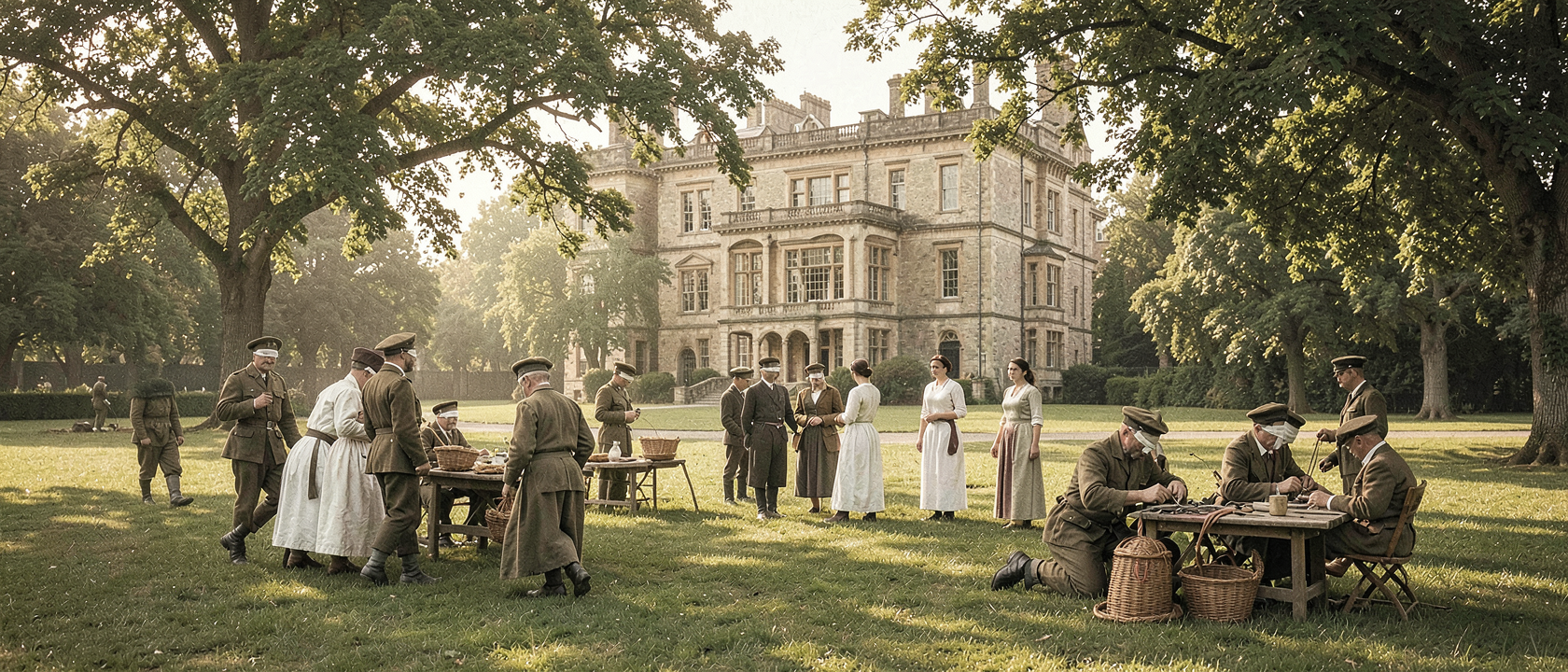
On March 26, 1915, sixteen blinded soldiers and sailors moved into St Dunstan’s Lodge in Regent’s Park, London. The house had been lent, free of charge, by Otto Hermann Kahn, an American financier who also maintained the 15-acre (roughly 6-hectare) grounds and permitted structural alterations. The villa’s name derived from a large clock originally from the church of St Dunstan-in-the-West, acquired by the Marquess of Hertford when that church was demolished in 1829–30.
The charity behind the move had been registered only weeks earlier, on January 29, 1915, as the Blinded Soldiers and Sailors Care Committee. Its founder, Sir Cyril Arthur Pearson, was himself blind. Glaucoma had begun taking his sight around 1908; by the end of 1913 it was gone entirely. A newspaper magnate who had built Pearson’s Weekly and launched the Daily Express, he had turned after his diagnosis to advocacy for blind people, becoming president of the National Institution for the Blind in 1914. His model was not one of passive relief. The aim was vocational training, physiotherapy, typing, telephone operating, carpentry, poultry farming, with each man leaving equipped for a trade and, where possible, a home and working premises.
By the end of 1918, more than 1,500 names were on the charity’s books. The institution would not formally take the name “St Dunstan’s” until 1923; it now operates as Blind Veterans UK.
The charitable landscape of those years operated at an unprecedented scale. According to one academic project source, though the figure rests on a single source and has not been independently verified, something in the region of 18,000 new organizations appeared in Britain during the war, a roughly 50 percent rise from 1914, with volunteer numbers tripling from around 400,000 to approximately 1.2 million. Parliament passed the War Charities Act in 1916, requiring registration before money could be solicited. The public was being asked, repeatedly and simultaneously, to support many hundreds of causes at once.
What Visibility Actually Meant
In that environment, a charity’s survival was tied directly to whether ordinary people knew it existed. A newspaper column, a drawing-room mention, a book bought as a gift: each gave one organization a concrete edge over another that had gone unnoticed.
For St Dunstan’s, this created a structural problem that needs no commentary to be felt. The institution existed to serve men who had lost their sight. Its financial survival depended entirely on the attention of those who still had it. The specificity of its work, residential care and rehabilitation for a defined group with a defined injury, gave it a particular story to tell: a concrete address, a founder whose own blindness was public record, and a mission that could be stated plainly in a sentence.
A Product, Not a Pamphlet
In 1916, the charity published The Blinded Soldiers and Sailors Gift Book through Jarrold and Sons in London; G. P. Putnam’s Sons in New York issued a US edition. The Imperial War Museum catalogue and the journal History Today both record 1916; the IWM is treated here as the authoritative source.
The book was not a fundraising leaflet. By the IWM’s count it ran to 226 pages with 15 leaves of plates, some in color, and stood just under 10 inches (25 centimeters) tall. The frontispiece was by Hugh Thomson; color plates included work by W. Heath Robinson. Contributors included H. G. Wells, G. K. Chesterton, John Galsworthy, Edmund Gosse, E. Nesbit, Anthony Hope, Beatrice Harraden, Austin Dobson, and Eden Phillpotts, among others. All profits went to the charity.
The foreword, by George Goodchild, acknowledged that “innumerable calls” had already been made on the artistic professions by charitable causes, meaning participation in this volume was a considered act. Buying the book was a transaction, not a donation appeal, the purchaser received something to read, display, or pass along as a present, which put the charity’s name before readers who came for the literature rather than the appeal.
St Dunstan’s also sold pictorial postcards from 1916 onward. According to one academic project source, three sets were printed between 1916 and late 1917, the first containing five cards, the next two containing six each, sold at sixpence per set or a penny individually. This detail rests on a single source and has not been independently verified.
The Figures Nobody Kept, or Nobody Preserved
The surviving record does not say what The Blinded Soldiers and Sailors Gift Book raised, what the postcard sets raised, or what the charity’s total income or operating costs amounted to at any point during the war. The scale of underlying need can be stated with more precision: 1,833 British servicemen were permanently blinded during the First World War, according to the University of Birmingham’s Voices of War and Peace project, and approximately 95 percent of them spent time at St Dunstan’s. Those figures define the institution’s scope but say nothing about the cost of running it or how its finances shifted as the war continued. These are genuine absences in the historical record, not gaps that approximations can responsibly fill.
What Cannot Be Proved
The source on which this article draws describes St Dunstan’s as the most publicly visible of all British wartime charities. No comparative evidence appears in the surviving record to confirm it; it should be read as an assertion rather than a documented finding. What the record does support is that the charity was unusually attentive to the problem of visibility, and that the gift book represents one concrete, documented response to it. Whether St Dunstan’s employed a broader range of fundraising methods is not established by the available materials.
The book existed, its logic was sound, and what it raised, or whether it secured the attention it was designed to attract, was never put on record.