
The Ledger of 1938
In 1938, seven pounds in every ten of food value eaten in Britain had been grown or raised abroad and shipped in. Grain, meat, cheese, and butter were the categories most exposed. No other country in Europe came close: the nearest rival, Switzerland, imported only 35 percent of what it consumed, roughly half Britain’s figure. Moving that volume of food, plus the fodder and fertilizer behind it, took an estimated 23 million tons of shipping space a year.
None of this was a wartime discovery. It was the settled result of a free-trade policy that had let in cheap foreign cereals, meat, and dairy for decades, and the arithmetic of it had been debated in Britain well before 1938. What changed, eventually, was not the fact of the dependency but the willingness to act on it.
How the Land Got There: The 1870s Turn
The dependency had a traceable start. In the 1870s, a run of poor harvests coincided with a surge of cheap grain and meat from overseas, and English and Welsh farmers found themselves undercut at home. Many abandoned mixed arable-livestock farming, which demanded labor and constant plowing, for an extensive, low-input style of grazing contemporaries called “dog and stick farming”: stock turned out on permanent pasture and largely left alone.
For a farmer watching grain prices fall year after year, the switch made sense. It cost less, risked less, and employed fewer hands. Nobody set out, in the 1870s, to leave Britain dependent on foreign ships for most of its food. But the pattern that decade set went unreversed for two generations.
A Standing Pattern: The 1930s Grassland
By the 1930s, the shift was no longer a response to crisis. It was simply how English and Welsh farming worked. Roughly a third of the country’s grassland was still mown for hay every year, its yields flat for decades. There was no mystery in why nobody improved it: imported feed was cheap and abundant, so there was no money in putting labor into land that already produced adequate hay for free.
This is the link between the 1938 ledger and the 1870s turn. The 70 percent import figure was not bad luck. It was the output of a system running on the same low-input logic for sixty years, with nothing in the market to disturb it.
The Ministry Turns the Plow
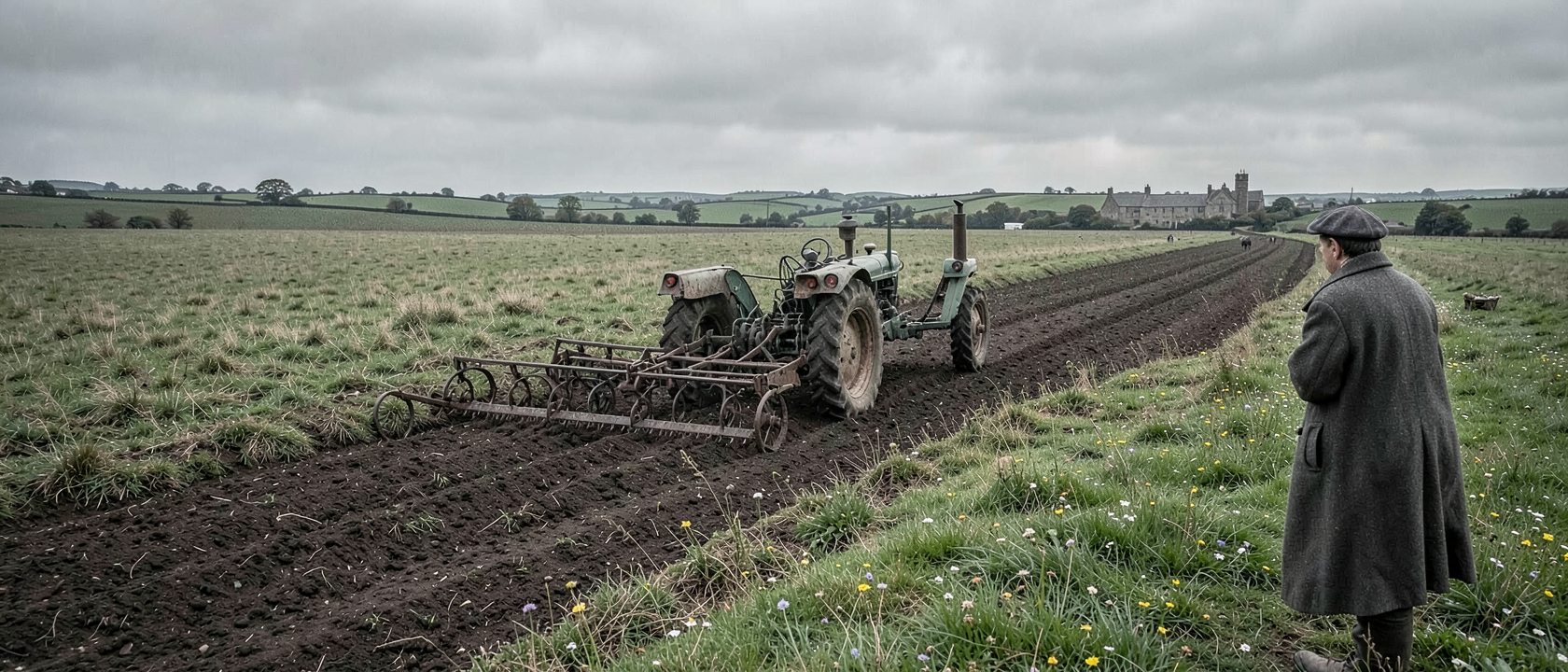
Government disturbed it before Britain was even formally at war. In May 1939, the Chamberlain government offered farmers £2 per acre to plow up old permanent grassland for crops, with subsidies for lime and fertilizer. The Minister of Agriculture, Sir Reginald Dorman-Smith, called for “not only the big man with the plough, but also the little man with the spade to get busy this autumn.” After war was declared that September, the Ministry set a target of adding more than 2 million acres of arable land, and county committees were handed quotas requiring roughly 10 percent of local permanent grass to be turned over.
The numbers moved fast. Between 1939 and 1944, cultivated land rose from about 12 million acres (4.9 million hectares) to 18 million acres (7.3 million hectares), while grassland fell from 17 million acres (6.9 million hectares) to 11 million acres (4.5 million hectares). Potato acreage more than doubled; wheat rose by two-thirds. What began as a wartime emergency did not stop when the war did. After 1945, the Ministry treated the reversal of the 1870s pattern as settled policy, and the Agriculture Act of 1947 locked it in with price guarantees and capital grants that kept arable acreage climbing for decades. The record used here gives no precise year for when this longer postwar campaign is considered to have ended, and this piece will not supply one that isn’t there.
“A Success”: According to Whom?
Historians writing about this period routinely call the plow-up campaign a success, without specifying success by what measure. Wartime self-sufficiency, measured in calories produced at home, rose from 33 percent to 44 percent, but even that did not make Britain self-sufficient, since much of the newly plowed land was marginal ground poorly suited to crops. And the wartime gains came almost entirely from plowing more acres, not from growing more per acre: the sustained rise in arable yields arrived later, in the postwar decades, not during the campaign that usually gets the credit for it.
No figure in the record states how many acres the postwar campaign itself converted, what it cost the Treasury, or what it cost the farmers who had to buy plows, fertilizer, and machinery they had never needed under the old pastoral system. A policy can be praised in outline for a long time before anyone goes back and totals the bill.
The Named but Undescribed: Unexpected Consequences
The record states plainly that the plow-up had unexpected consequences, environmental and social, and then moves on without describing most of them. One effect is documented: the plowing, pressed on through the war and continued under postwar policy, converted ecologically diverse pasture and wildflower meadows along with ordinary hayfields. Historians also note that the arguments over the grassland plow-up were still being felt into the twenty-first century, and that even the rationalization of Europe’s Common Agricultural Policy in the 1980s changed the resulting area of arable land only marginally.
Who bore those costs, in what measure, and over what span of years is not spelled out in the source this piece draws on, and nothing here will fill that gap with a guess. The lesson of 1938 was learned. What the learning cost, in full, was never entered in the same ledger.
—
**Edit notes:**, “Plough-Up” in the headline is a proper-name/title usage referring to the historical campaign and “plow/plough” appears in both spellings in the source; standardized body text to American “plow/plowing/plowed” throughout for consistency, while leaving the headline’s title-style name and the direct quotation (“the big man with the plough”) untouched since quotations preserve original wording. No subject–verb agreement errors found. No article (a/an/the) errors found. No verb tense inconsistencies found. No pronoun/homophone errors found. Punctuation and capitalization were already consistent; quotation marks matched correctly. No relative-to-today date phrases present; all time references are absolute calendar dates or year-based comparisons, which are permitted.