
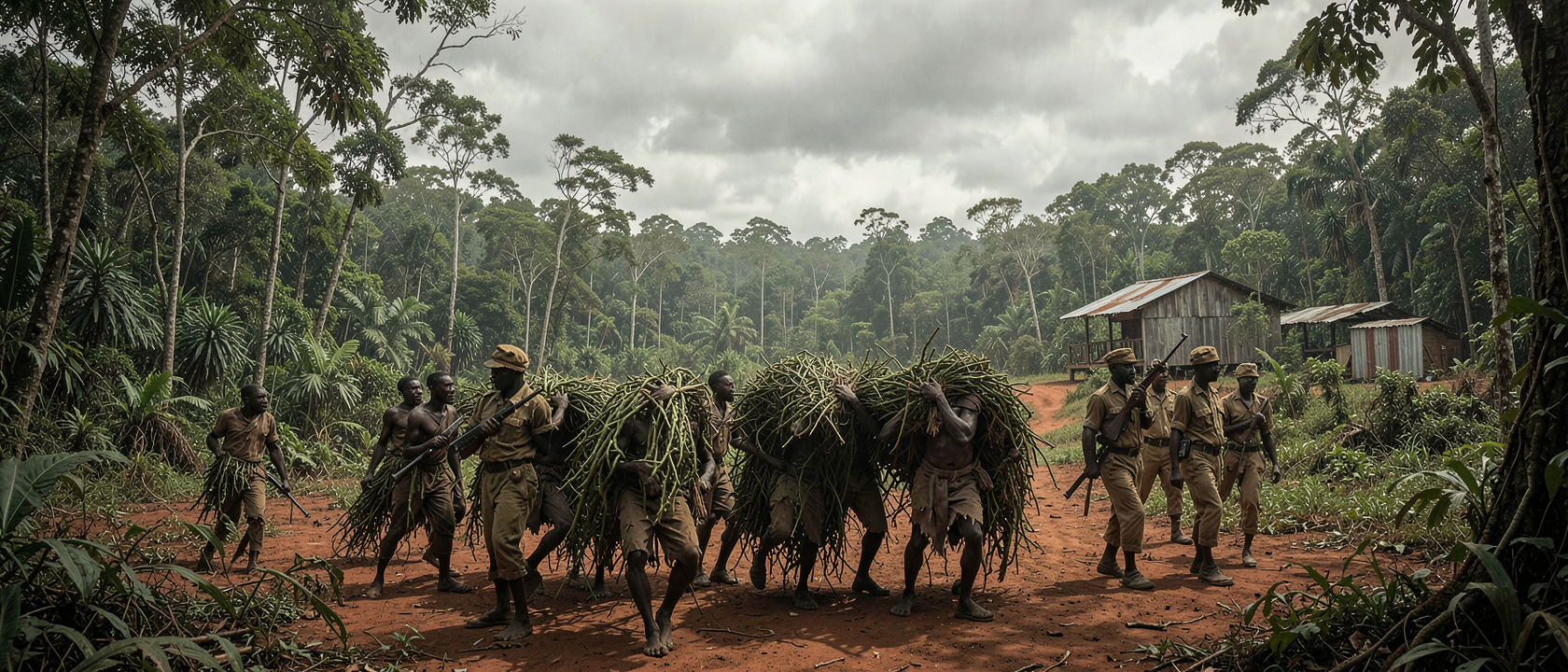
Eighty-One Hands by the Fire
In the mid-1890s, at a gendarmerie outpost enforcing rubber quotas deep inside the Congo Free State, the missionary William Henry Sheppard was led to a fire where, according to his own diary account, eighty-one human hands hung smoking in the heat. Sheppard, a Black American Presbyterian missionary who had spent years working in the territory, recorded the scene himself. Soldiers were issued a fixed number of cartridges and had to account for every round fired. A bullet spent on an antelope left nothing to show a superior officer; only a severed hand counted as proof. Sheppard counted them himself. Eighty-one.
A King Without a Country’s Money
Leopold II was born in Brussels on April 9, 1835, and became king of the Belgians on December 17, 1865. He wanted a colony, but the Belgian parliament would not pay for one, so he financed the Congo project himself rather than as a state venture. That effort produced international recognition at the Berlin Conference of 1885, where European governments formalized colonial claims in Africa, for a personal territory he called the Congo Free State, reportedly some seventy-six times the size of Belgium. It belonged to Leopold, not to Belgium, and for years cost him more than it returned. That changed once global demand for rubber, driven by new markets for bicycle and then automobile tires, surged in the 1890s. A colony that had drained Leopold’s finances turned a profit, setting the forced-labor system in motion.
The Congo Free State, on Paper
The Congo Free State became official on July 1, 1885, recognized by the other European powers, its roughly nine million inhabitants (a figure from a 1907 survey) nominally subjects of a king most would never see. Each village was assigned a rubber quota, and Leopold’s police force, the Force Publique, was sent to collect it. When a village failed to deliver, huts burned, women and children were taken hostage until the rubber came in, and those who still failed to produce enough were killed outright. This was not soldiers running out of control on their own initiative; it was the system working as designed, built into how quotas were set and enforcement judged.
Mlumba Nkusa’s Count
One of the men enforcing that system was Mlumba Nkusa, a Congolese recruit into the Force Publique. According to Sheppard’s diary, when he visited Nkusa’s post, the officer told him plainly that after a single missed quota, his men had killed between eighty and ninety workers. This account rests on Sheppard’s own testimony and has not been independently corroborated, but within that account Nkusa was not described as a rogue operator; he was carrying out exactly what the quota system had been designed to produce. The hands Sheppard counted over the fire were not an isolated horror but where counts like Nkusa’s, repeated at posts across the territory, ended up.
A Novel Catches Up to the Reports
In 1899, Joseph Conrad published Heart of Darkness, a novel set in the Congo and shaped by his own journey up the Congo River some years earlier. It reached readers that missionary dispatches and reform pamphlets never did, carrying word of conditions in the Congo Free State out of specialist circles and into general conversation. Whether Conrad’s fiction darkened the picture beyond what was actually happening, or simply matched what missionaries like Sheppard were already recording in their own plain accounts, is a question the record leaves open.
Belgium Takes the Colony Back
Pressure built through the 1900s from missionary testimony, international journalism, and diplomatic maneuvering. In 1904, British consul Roger Casement produced a report estimating that as many as three million Congolese had died since 1888. Under pressure from critics in Belgium, including the politician Émile Vandervelde, Leopold was forced to set up his own commission of inquiry in 1904 and 1905, which confirmed what the missionaries had been saying all along: systemic killing, mutilation, and forced labor, not scattered incidents. The Belgian Parliament passed an annexation treaty in September 1908, and on November 15, 1908, in the port town of Boma, the territory passed formally from Leopold’s personal ownership into the hands of the Belgian state as the Belgian Congo. What changed was who owned it and who ran it; colonial rule itself did not end there.
The Bill
Historians’ estimates for how many Congolese died under this system range from roughly one million to fifteen million, and the width of that range says something on its own: no census existed in the Congo Free State before 1924, so any total has to be built backward from mission records, trade figures, and population counts taken years apart, not from a direct tally. Alongside the deaths came mass mutilation, rape, and enslavement, used as tools of quota enforcement rather than as separate crimes. Leopold profited personally from the rubber trade for the whole of his rule over the territory, right up to the moment he lost it. He died in Laeken, near Brussels, on December 17, 1909, a year after losing the Congo, at the age of 74. Accounts describe his funeral procession being met with boos from the crowd, though that detail rests on a single source and has not been independently confirmed elsewhere.
What We Still Don’t Know
Three things about this story remain genuinely open. The death toll is clearest: alongside that wide range, individual historians have proposed their own figures, from Casement’s three million since 1888 to a central estimate near ten million drawn from demographic work on the territory’s population collapse, and these numbers do not converge. The record is also thin on exactly how Leopold persuaded the other European powers to recognize his personal claim at the Berlin Conference in 1885; what survives is the outcome of that diplomacy, not the maneuvering behind it. And the question Conrad’s novel raises cuts both ways: much of what is known about the Congo Free State, including the hands by the fire, rests on missionary testimony that was itself partial, gathered by outsiders moving through a small part of an enormous territory. None of that is a reason to distrust the record. It is a reason to hold it the way a historian does. Knowing that the number is disputed, and why, tells you more about what happened than a single tidy figure ever could.