
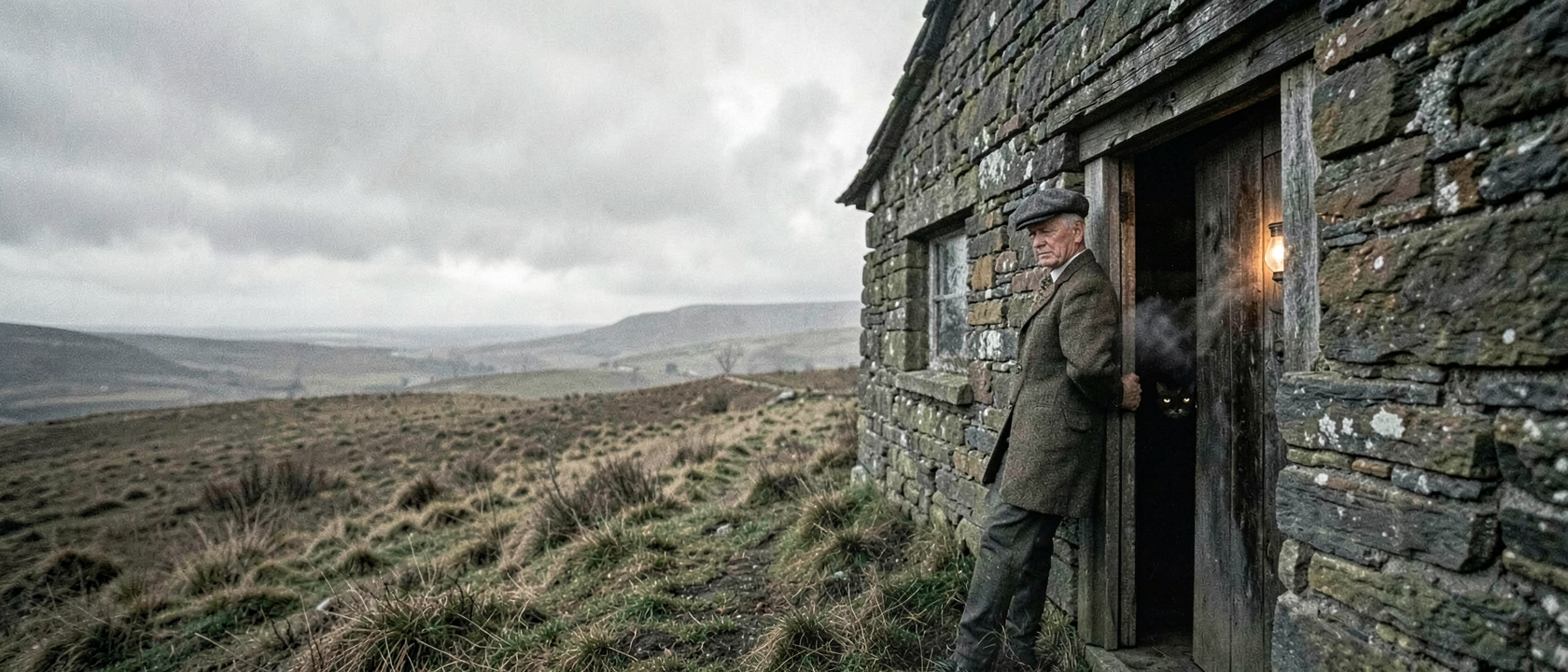
The Farmhouse
Doarlish Cashen, Manx for “Cashen’s Gap,” was a sheep farm set about 725 feet (221 meters) up a hillside near the hamlet of Dalby on the Isle of Man, in country long tied in local folklore to fairies. James and Margaret Irving had settled there around 1916 or 1917 with their daughter Voirrey, who was twelve or thirteen in 1931. It was an isolated life, with few neighbors and a solitary daughter who spent her days largely on her own.
In September 1931, the Irvings began hearing scratching behind the attic wall, then blowing, then a low growl that softened into something closer to an infant’s gurgle than an animal’s. James Irving met it with curiosity, talking to the sound the way one talks to a baby learning words. By his account, the sound began repeating his phrases back, and within weeks it was answering in full English sentences.
“My Name Is Gef”
The voice gave itself a name: Gef. It claimed to be a mongoose born in Delhi, India, on a Monday in June 1852, a detail nobody could verify, offered by the voice itself and never confirmed by anyone. It guessed the value of coins held out of sight, caught and returned small objects thrown to it, and repeated gossip it said it had picked up at neighboring farms.
Around 1933, teenage cousins Harry Hall and Will Cubbon visited and later described hearing the voice themselves, playing catch with it and watching it guess coins. Its temper did not hold steady: the same voice that joked and played games could turn obscene or threatening within minutes, and it commented, uninvited, on private moments inside the house, including Margaret Irving dressing. James Irving left blocks of soft plasticine out overnight for Gef to walk across, and the resulting paw prints went to investigator Harry Price, who passed them to the British Museum’s zoological department. One print was identified as a dog’s, the rest as an American raccoon’s. None matched a mongoose, and nobody who visited the farmhouse ever reported actually seeing Gef.
The Press and the Professor
By the mid-1930s, Britain’s tabloid press was covering Doarlish Cashen extensively. Reporters climbed up to the farmhouse to see it for themselves, while investigators worked the case from a distance, weighing evidence the family mailed out rather than finding any to hold.
Among those watching closely was Nandor Fodor, a Hungarian-born psychoanalyst and parapsychologist working in London. Fodor rejected the standard idea that poltergeists were ghosts of the dead. His own theory, shaped by Freud and controversial even among his peers, held that such disturbances were unconscious psychic projections thrown off by a living person, sometimes rooted in suppressed emotional or sexual tension. Needing a live case to test that idea directly, he arranged in February 1937 to lodge with the Irving family at Doarlish Cashen for about a week.
A Week of Silence
Fodor’s week at the farmhouse was methodical. He interviewed James, Margaret, and Voirrey Irving at length, took notes, and examined the attic space where the family said Gef lived and moved. In all that time, he never heard Gef speak and never saw any creature resembling one.
When he left, he set out chocolate and biscuits and a farewell note addressed, by name, to Gef, a gesture toward something he had traveled to study and could not pin down in any way he could present as proof.
The Bill
Fodor did not drop the case. In 1951, he published his conclusions in “Haunted People: Story of the Poltergeist Down the Centuries,” arguing that Gef was a psychic projection cast off by James Irving’s restless, understimulated mind, a conclusion he reached without ever having heard or seen Gef himself.
The theory never took hold among his peers. Rather than cementing his reputation as a serious researcher, it left him tied for good to a case he had never been able to close on his own terms. Public interest in Doarlish Cashen eventually faded after James Irving’s death, which ended the story in practice without ever settling the question it had raised.
What’s Disputed
Two readings of the case persist, and neither can be proven from what survives. Historian Kate Summerscale has suggested Fodor arrived at Doarlish Cashen already holding the theory he claimed the case would test, raising the question of whether he was testing it at all or simply fitting it to events he had already decided on.
The other reading points at the family itself. Media scholar Jeffrey Sconce has argued the likeliest explanation is that Gef was an imaginary companion invented by the Irvings’ “extra, extra clever” daughter. Christopher Josiffe, who wrote a nearly 400-page study of the case, has said he privately fears someday finding a diary in which Voirrey confessed to inventing the voice herself. No such diary, confession, or physical evidence has ever surfaced. Both readings remain informed suspicion, not proof.
The Mongoose Afterward
The case got a second life as comedy. “Nandor Fodor and the Talking Mongoose,” a British film with a limited U.S. theatrical release on September 1, 2023, cast Simon Pegg as Fodor, gave Gef’s voice to author Neil Gaiman, and cast Christopher Lloyd as Harry Price. The film builds its ending on the same gap Fodor left behind in 1937: no creature, no confession, just a note and a plate of biscuits addressed to something nobody ever saw.
That gap is the reason the story still gets told. Gef was never confirmed as a hoax, a haunting, or a mind playing tricks on itself. That unresolved ending is the whole shape of the story, not a loose thread to tie off. It is a case that can be argued either way, and it has stayed that way for nearly a century.