
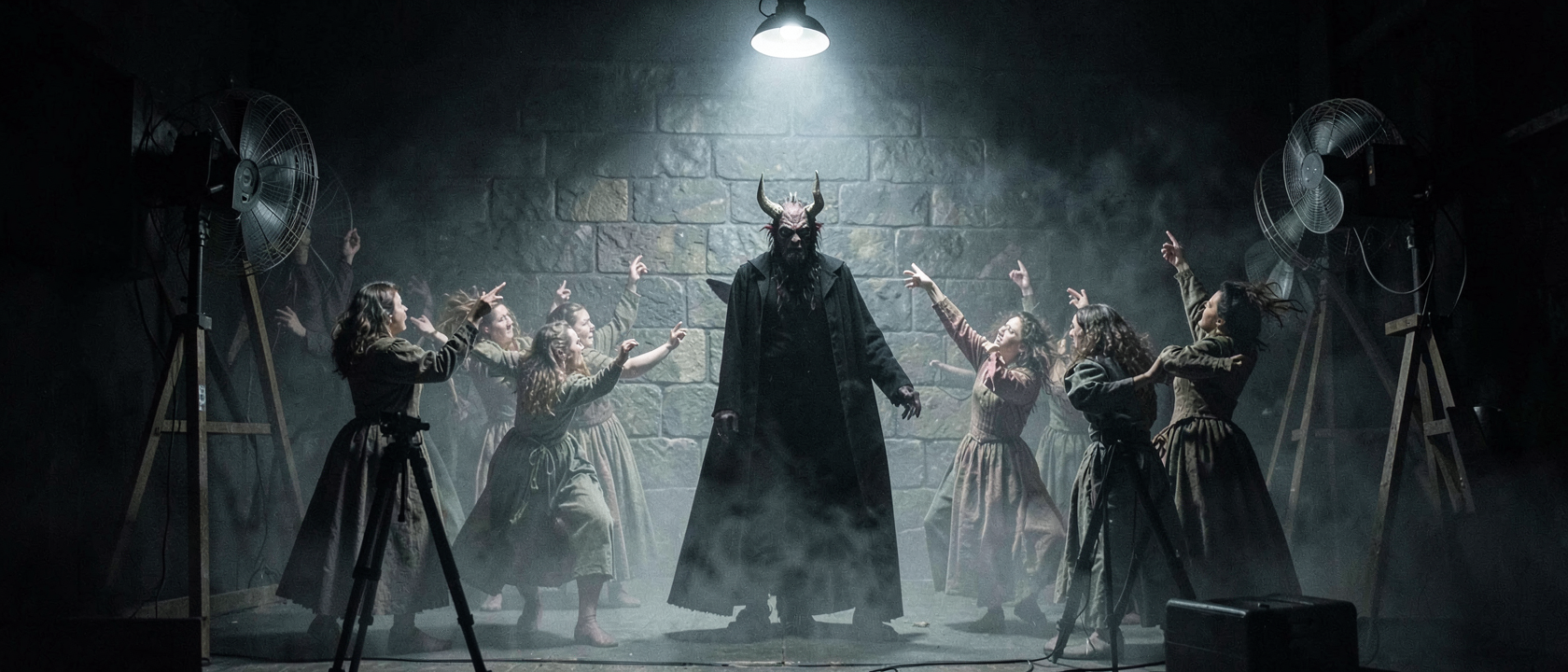
People who recognize the name Häxan usually remember one image: a Danish director in horns and a forked tongue, playing Satan in his own film. Fewer know that the same picture was pitched to its first audiences as serious science, that it was banned in the United States within a year of its American release, and that the scandal reportedly helped put its director on a studio payroll in Hollywood. The gap between how Häxan was sold and what it actually cost the people who made it is most of the story.
A Lecture With an Orchestra
On September 18, 1922, Häxan premiered across Sweden, including Stockholm, with a full orchestra in the pit and illustrated playbills handed out at the door. Audiences settled in for a film running close to 91 minutes in that original cut, something that fit no single category: part scientific lecture on medieval witch persecution, part staged horror, cut together into one sitting. The film had been financed by the Swedish studio Svensk Filmindustri and was already being promoted as the most expensive production any Scandinavian company had backed. Nobody in those theaters had anything to compare it to.
Years in the Making, No Guarantee
The money behind Häxan shows how much the studio was risking. Around 1919, Christensen had tried to make this project in Denmark; later accounts describe Danish censorship norms of the period as ruling out his darker, more blasphemous treatment of witchcraft, though the specifics of that rule are not independently confirmed. He took the idea to Sweden instead, where Svensk Filmindustri agreed to fund it: a reported 2 million Swedish kronor, three to four times what an average Danish feature cost, spread over roughly two to three years of preparation and filming that ran into 1922. There was no guarantee an audience existed for a film this strange, on a subject that had already proven too much for one country’s censors.
Medicine, Opera, Champagne, Film
Christensen did not arrive at filmmaking directly. He studied medicine, trained toward acting at the Royal Danish Theatre starting in 1901, and by some accounts worked as an opera singer around that time, before moving into stage acting in Aarhus starting in 1907 and then selling wine. He returned to performing during Denmark’s silent film boom, acting onscreen from 1911 and directing his first picture, the spy melodrama The Mysterious X (Det hemmelighedsfulde X), in 1914. By the time he planned the witchcraft project, he had built a reputation directing Danish dramas. The clinical, lecture-hall shape of Häxan was no accident. It came out of a résumé that ran through medicine before it ever reached film.
Seven Chapters, One Bibliography
The finished film unfolds in seven chapters, moving between illustrated-lecture segments on medieval belief and dramatized scenes of torture, confession, and demonic ritual. Christensen plays the film’s Satan himself, horned and leering, a role he wrote for his own performance. He handed audiences a printed bibliography of the religious texts behind the picture, unusual for something playing as entertainment. He avoided trained actors wherever he could; one woman playing an accused witch, Maren Pedersen, is described in some accounts as a flower seller cast for how authentically medieval she looked, though that detail rests on a single source. For one flight sequence, Christensen and cameraman Johan Ankerstjerne photographed seventy-five women individually while airplane engines blew wind through their clothes to fake movement. The closing argument ties it together: symptoms described in medieval accounts of witchcraft, the film claims, map onto what modern psychology was beginning to call hysteria.
Banned in America, Noticed in Hollywood
When Häxan reached American screens in 1923, Variety’s reviewer praised its “morbid realism” but concluded the film was “absolutely unfit for public exhibition.” That verdict helped keep it out of American theaters in anything close to its original form for years. According to a widely repeated but unverified anecdote, MGM’s studio chief Louis B. Mayer watched the film in 1924 and wondered aloud whether Christensen was “crazy or a genius,” then signed him anyway. What is better documented is that Christensen moved first to Germany, working at the studio UFA, before arriving in Hollywood by 1925, where he directed gothic horror films for MGM, including Seven Footprints to Satan in 1929, trading on the reputation Häxan had built him.
A Rerelease, Then a Midnight Movie
According to a single account, Häxan returned to Danish theaters in 1941 in a respectful, dignified rerelease, decades removed from the scandal of its first run; this detail has not been independently confirmed. What is well documented is the 1968 American reissue: a distributor released a heavily trimmed version, running roughly 74 minutes by most listings, fitted with a jazz score featuring musicians including Jean-Luc Ponty and narrated by the writer William S. Burroughs. That cut played late-night screenings aimed at a counterculture crowd looking for something strange, not a serious treatise on medieval belief. Same footage, two audiences who would not have recognized each other’s version of the film.
The Malleus Story, and the Missing Cut Comparison
One story about Häxan’s origin gets repeated often: that Christensen stumbled on a copy of the medieval witch-hunting manual the Malleus Maleficarum and was so struck by it that he built a film around it. Scholars Richard Baxstrom and Todd Meyers, who have written about the film’s scientific ambitions in their book Realizing the Witch, treat that story with skepticism, closer to a myth that grew up around Christensen than a documented fact. The film’s physical history is just as unsettled. The 1922 premiere reportedly ran about 91 minutes, the 1968 Burroughs cut roughly 74, and the modern Criterion restoration runs about 105 minutes, with runtimes varying somewhat by source. No one has laid out, cut by cut, exactly what was trimmed or restored between versions.
A Hundred Years Later, Still Two Films at Once
The film’s hundredth anniversary in 2022 reportedly brought renewed attention from horror fans and silent-film audiences, and the film’s influence has reportedly been cited by modern directors such as Robert Eggers, though that claim traces to a single source and has not been independently confirmed. What is not in dispute is how the film still resists settling into one category. It was built, on paper, as a scientific lecture on witch persecution with footnotes to prove it. It plays, on screen, as a horror film with a director in devil’s makeup staring back at the camera. Both readings are still available, a century after the orchestra in Stockholm went quiet.