
Rome Declares, the World Takes Notice
At midnight on May 23, 1915, Italy declared war on Austria-Hungary. On April 26, Rome had signed a secret agreement with Britain, France, and Russia, the Pact of London, promising Italy territory for joining the Allied side, and on May 3 the government tore up its old alliance with Austria-Hungary and Germany. Prime Minister Antonio Salandra and Foreign Minister Sidney Sonnino pushed the move through over Giovanni Giolitti’s objections, and on May 20 the Chamber of Deputies backed emergency war powers 407 to 74.
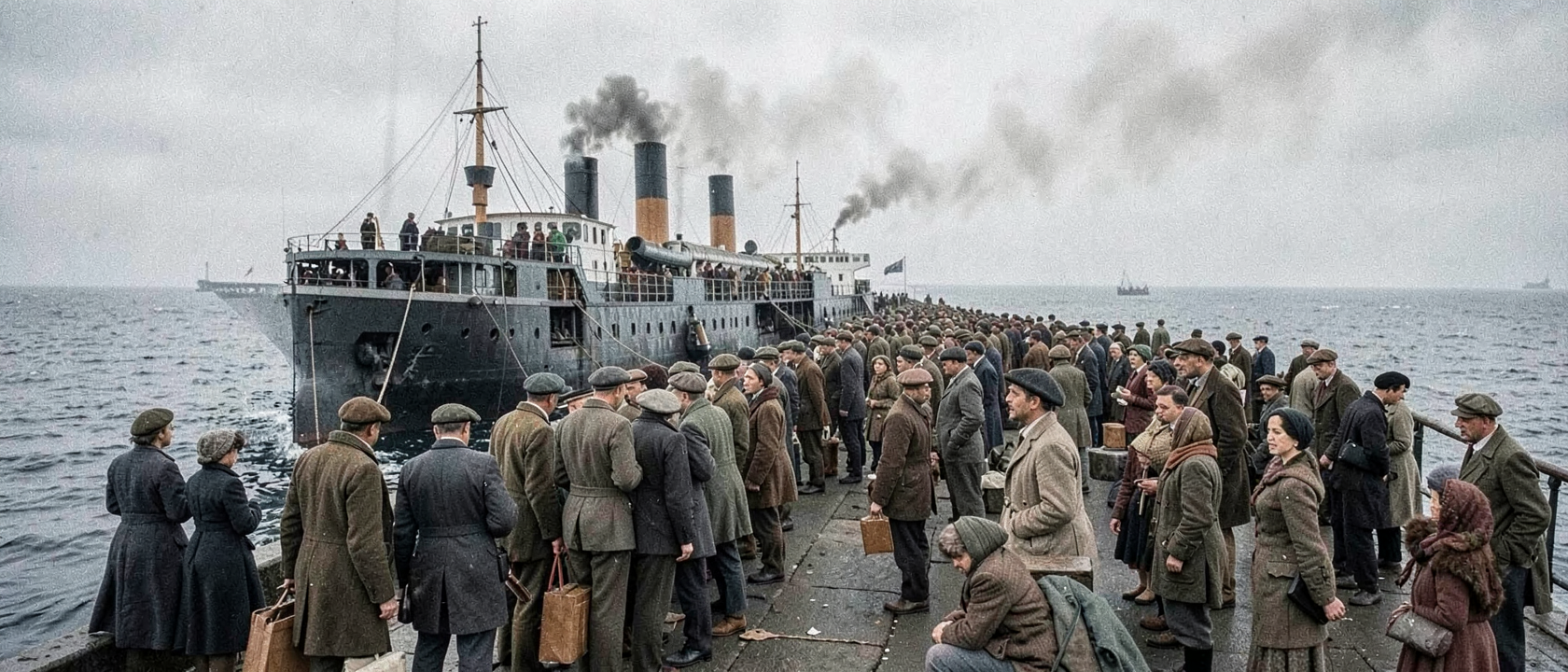
Conscription law applied to every Italian man of military age, wherever he lived. In 1911, roughly 5 million Italians lived abroad, about one-sixth of the country’s population, across the Americas, Europe, Australia, and North Africa. Italian consulates in each of those places were now responsible for finding reservists, notifying them, and arranging their passage home at government expense.
What Hung on It
For the Italian state, this was a gamble with no guarantee. A man living in Buenos Aires or Scranton, Pennsylvania, was beyond the reach of any police officer or draft board. The government could issue the order and pay the fare, but it could not force compliance across an ocean.
For the men themselves, the stakes were personal. Many had left Italy years earlier for work, building jobs, households, and sometimes families elsewhere. The declaration asked each of them whether a country they had left still had a claim on them, and whether they still had one on it. What followed in the newspapers answered only the visible part, by counting who boarded the boat.
Rochester, May 25
Two days after the declaration, the Democrat and Chronicle in Rochester, New York, ran the headline “War Spirit High in Italian Reservists,” describing local Italian men of military age responding with enthusiasm and making plans to leave. Alone, it would be a curiosity. It did not stay alone for long.
Vancouver, Two Days Later
On May 27, the Vancouver Daily World ran its own version under “Local Italians Keen to Join the Colors,” telling almost the same story: word of war from home, readiness to go. Two newspapers, two days apart, describing the same reaction from opposite sides of a continent, the mobilization and the news of it moving at the same pace.
The Pattern Spreads
Over the following weeks, the same story ran in papers in Nice, New York, Sydney, Suez, Buenos Aires, and Boston, each describing Italian emigrant communities organizing to return home and enlist. Six cities on five continents, filing near-identical headlines inside the same summer.
One documented departure shows what this looked like on the ground. At the end of July 1915, Fortunata Mazzella, a 23-year-old newlywed from the island of Ponza, near Naples, was recorded boarding a train out of Scranton, Pennsylvania, as local reservists left for the war amid scenes the record describes as jubilant. She accompanied her husband’s departure as one of hundreds of thousands of similar departures that summer, most of them left undocumented by name.
The Number: 300,000
The figure most often cited for Italian emigrants who returned to serve is 300,000, repeated across newspapers and later histories. The most detailed accounting, from a single academic study, puts the exact figure at 303,919 men conscripted after returning from abroad, about two-thirds crossing between May and December 1915: 103,269 from North America, 51,754 from South America, and 128,570 from Europe, more than 90,000 from France alone, 22,000 from Switzerland, 19,500 from North Africa, and 8,500 from Great Britain.
Against roughly 5 million Italians abroad, 300,000 is a modest slice, about 13 percent of men liable for conscription outside Italy. In the United States alone, more than 700,000 Italian men over 21 were potential draftees in 1915; only a fraction returned. Within the Italian army, returnees made up close to 7 percent of the force, a share one historian compares to Dominion troops in the British army or colonial troops in the French one. Historians read this differently: Mark Choate calls the return a dramatic act of international solidarity, while Selena Daly’s research notes far more eligible men stayed abroad than came back, complicating any story of a universal patriotic rush.
What the Record Doesn’t Say
The 1915 coverage stops at the gangplank. It does not say which units absorbed these men, where they were sent, or how a soldier who had spent a decade in Buenos Aires was received by officers and comrades raised in Italian villages. Italy’s army had fewer than 300,000 men when the war began; mobilization pushed that to between 1.2 million and 1.5 million by that spring, and past 5 million by November 1918. Italy suffered an estimated 460,000 dead and 955,000 wounded over the war, which also opened a new front of about 373 miles (600 km) along the Austro-Hungarian border, where troops advanced into South Tyrol and toward the Isonzo River that same year. Whether any emigrant returnees fought there, or where they fall within Italy’s casualty totals, the sources do not say.
One cost is documented, though it fell on families left behind. Wives of emigrant reservists were mostly not citizens of the countries where they lived, so they had no claim on local state aid. The subsidy Italy sent them was described at the time as insufficient, and the war that called the men home left the people they left behind to manage on less.
Italian Enough?
None of the 1915 reporting answers the question underneath it: whether a man who had spent years in New York or Vancouver or Buenos Aires, perhaps speaking Italian with an accent or not knowing his home province’s dialect at all, was treated by the army and country as fully Italian, or as something adjacent to it. Selena Daly’s 2025 study, “Emigrant Soldiers: Mobilising Italians Abroad in the First World War,” follows four such men, from the United States, Brazil, France, and Britain, through enlistment, combat, demobilization, and the decades after, into Fascism and the Second World War. Even that longer view does not settle the question outright.
What remains is the gap between two things that are both true: newspapers on five continents reported the same enthusiasm in the same season, and no source gathered here says plainly whether Italy, once the men arrived, treated them as it treated a conscript who had never left.