
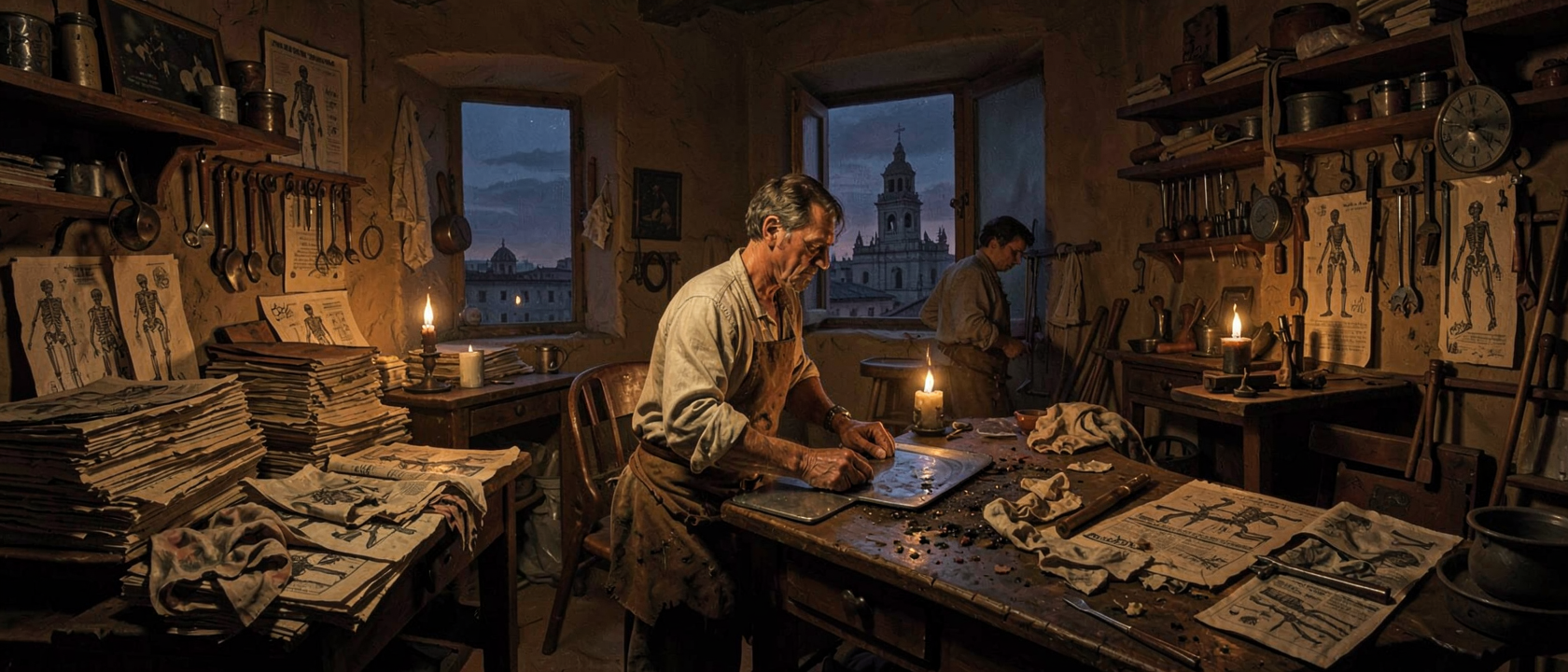
A Print Shop on Old Tenochtitlan Ground
José Guadalupe Posada Aguilar was born on February 2, 1852, in Aguascalientes City, in central Mexico, the son of Germán Posada Serna and Petra Aguilar Portillo. Around 1870, a date different sources place anywhere between 1866 and 1870, he joined the print studio of José Trinidad Pedroza, learning lithography and engraving and placing his first political cartoons in a sheet called El Jicote, “The Wasp.” In 1872 he moved with Pedroza to the city of León, in the state of Guanajuato, to help set up a printing business and to teach lithography on the side.
Floods wrecked much of León in 1888, and Posada moved to Mexico City, where he stayed the rest of his life. His workshop stood on ground that had once been part of the Aztec capital of Tenochtitlan, within sight of the city’s cathedral and its main square. From there he supplied drawings, on deadline, to newspapers, magazines, broadside printers, and publishers of the hojas volantes, cheap ballad sheets sold on street corners for a few coins. He was not a gallery artist. He made pictures for people who could not afford much else.
Satire Without a Safety Net
Mexico in the decades before 1910 offered no protection to an engraver who mocked the wrong people. There was no guaranteed press freedom, no fine-art status to shelter him, no institution standing between Posada and anyone who took offense at a drawing. His signature figure became the calavera: a skeleton dancing, drinking, pedaling a bicycle, playing a guitar, dressed as a politician or a society lady. He used these figures to needle corrupt officials, mock the fashions of the rich, and poke at the pretensions of ordinary life.
The calavera drew on two traditions at once: the ritual and artistic culture of pre-Columbian Mexico, and the medieval European danse macabre, the “dance of death,” which had placed skeletons among the living in woodcuts for centuries. What made this risky was not that it reached intellectuals. It was that it reached everyone else. His prints were cheap, fast, and everywhere, which meant they landed in front of people who couldn’t afford to ignore politics, and in front of authorities who couldn’t afford to ignore the prints.
Twenty Thousand Engravings and a Revolution
Across a career that ran from Pedroza’s studio to his final years in Mexico City, Posada is estimated to have produced more than 20,000 engravings, though the number is not a verified count; other estimates put it closer to 15,000. Either figure describes a volume large enough that his skeletons and devils became a regular sight on newsstands and walls across the capital.
In 1910, the Mexican Revolution broke out. One artist later described the uprising as a Posada “still” come to life, a remark reported secondhand and impossible to verify now, but one that suggests how closely his engraved scenes of conflict had already tracked the country’s mood before the fighting began.
A Pauper’s Grave, January 1913
Posada died in Mexico City on January 20, 1913, at the age of 60, reportedly of gastroenteritis. He died with no money. No newspaper marked the death of a man who had supplied newspapers with images for decades. No ceremony acknowledged a career spent drawing the city’s politics and its street life back at itself. He was buried in an unmarked pauper’s grave, and by some accounts no one ever came forward to claim his remains, so his body was later moved into a common grave.
Found Again, a Decade Later
His engravings began to resurface in the early 1920s, though sources disagree on exactly when and how: some place the turning point around 1920, others closer to 1930. One strand of that story credits the French-born artist Jean Charlot, who came across Posada’s prints while visiting the painter Diego Rivera. The muralist José Clemente Orozco, who had known Posada as a young man, also later pointed to him as an influence on his own work. Rivera went on to rank Posada with Francisco Goya, calling his work “the supreme achievement of classical Mexican art, by which I mean pre-Columbian art.”
Among the images that outlived him was La Calavera Catrina, a female skeleton dressed in the fashions of the European upper class, likely a jab at Mexican elites imitating foreign style; the verse printed beneath her, written by someone else, mocked working-class chickpea vendors instead. It first appeared in a broadside the year Posada died. Rivera later enlarged that same figure into a full-scale presence in his mural A Dream of a Sunday Afternoon in the Alameda Park, and the grinning, finely dressed skeleton has gone on to stand for Mexican identity itself, something Posada, buried without a headstone, never lived to see.