
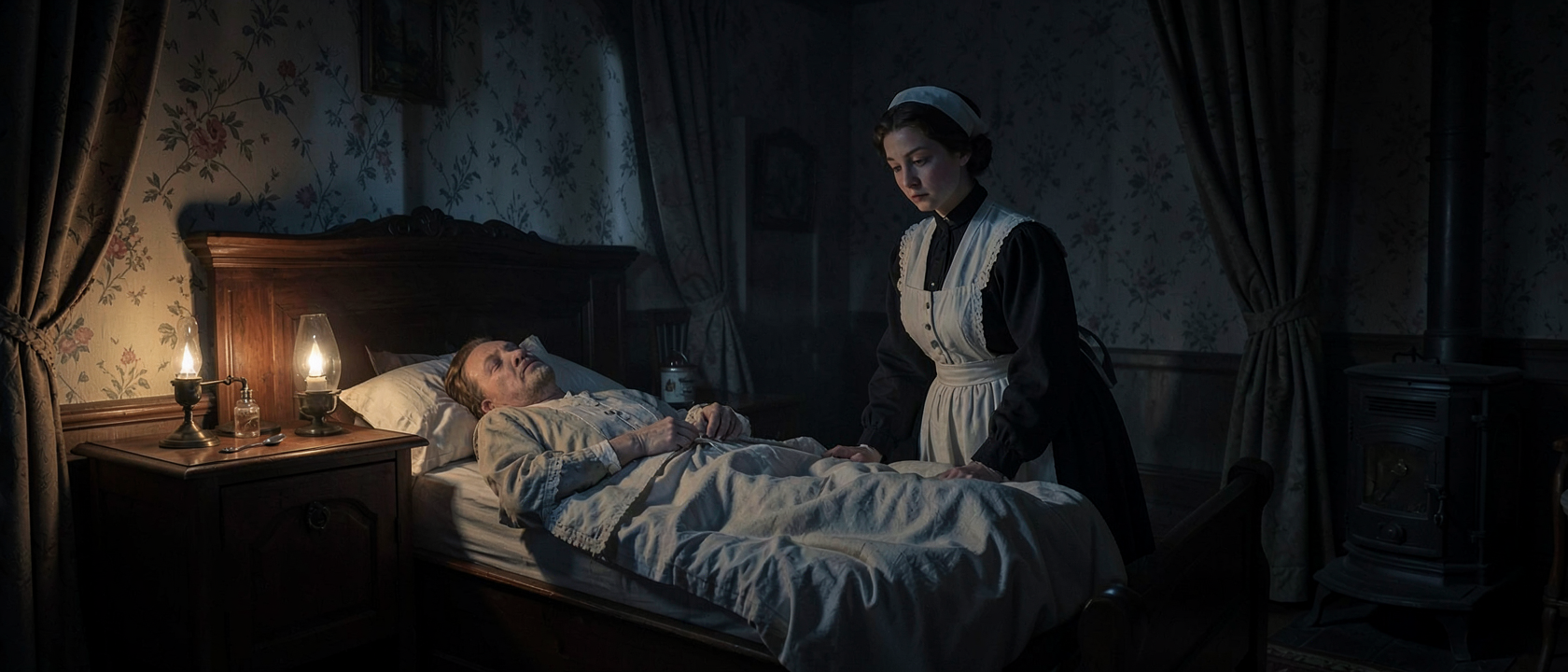
The Pension Desarzens, June 1868
In June 1868, a 24-year-old woman named Marie-Catherine Fritzgès was staying at the Pension Desarzens, a boarding house in the Plainpalais district of Geneva. A fellow guest, a private nurse named Marie Jeanneret, then 32, had befriended her. Soon afterward, Fritzgès fell seriously ill.
She survived. That alone set her case apart. In the months before her illness, other people under Jeanneret’s care had sickened and died without anyone connecting the deaths to the woman who nursed them. Fritzgès lived to describe what had happened to her, and it was her illness that finally turned suspicion toward Jeanneret. Doctors who examined the case would later identify the substance used against her as atropine, a derivative of the belladonna plant, poisonous in sufficient doses.
A Childhood Spent on Her Own Body
Marie Jeanneret was born on January 13, 1836, in Le Locle, in the Swiss canton of Neuchâtel. She was orphaned young. As a young woman she became preoccupied with her own health in ways that struck doctors as unusual: she sought out painful treatments, and at one point asked a physician to cauterize her back with a hot iron. She carried the scars afterward.
The record does not explain why she turned this intensity toward her own body, only that she did, years before she began nursing other people.
Nurse Without a Wage
By the late 1860s, Jeanneret was working as a private nurse in and around Geneva. She took no fee: her parents had left her enough money to live on, and she offered her services free of charge. That arrangement gave her access to boarding houses and private homes across the city, with no institution checking on her work. Her patients ranged from an 11-year-old girl, Jenny-Julie Juvet, who died after eating bonbons Jeanneret had poisoned and nicknamed “princesses,” to a 72-year-old woman, Louise-Marie Lenoir.
Her method was to give two poisons together, atropine and morphine. Each drug could mask the symptoms the other produced, which made it harder for an attending doctor to see poisoning for what it was. Jeanneret carried into her patients’ sickrooms the same mistrust of doctors she had shown about her own body years earlier, and no one in a position to stop her ever did.
Months of Deaths
The exact timeline is not settled. History Today, drawing on the case, describes at least six deaths in the roughly nine months before Fritzgès fell ill in June 1868. Court records, by contrast, give a narrower and better-verified span: between the end of October 1867 and mid-January 1868, Jeanneret was accused of murdering six people by poison and poisoning three others who survived. The two framings disagree on how long the killing went on, but they agree on the core number. Six confirmed deaths are traced to one woman, across boarding houses and private homes in and around Geneva. Fritzgès’s survival broke the pattern, and the investigation that followed led to Jeanneret’s arrest at the Pension Desarzens in June 1868.
The Trial: Confession Without Guilt
Jeanneret’s trial opened in Geneva in November 1868; the date most often given, November 23, rests on a single source and should be read as likely rather than certain. She did not deny giving her patients atropine and morphine. She told the court she had believed the treatments would make them better. When the judge asked why she had kept administering them after watching patients grow worse rather than improve, she had no good answer.
Her defense rested entirely on intention. She was not disputing that the poisonings had happened; she was arguing that they were not crimes, only mistakes made by someone trying to help. The court had to weigh that claim against six confirmed deaths and a pattern that ran across months and multiple households. Accounts differ on exactly how many victims were named in the indictment, figures of six, seven, and nine all appear in different sources, but six deaths remain the best-supported minimum.
A Sentence That Changed the Law
Under Geneva’s criminal code, the death penalty could be imposed for crimes like hers. The jury would not apply it. Jeanneret was convicted, with what the court recorded as extenuating circumstances, and sentenced to 20 years in prison instead of the gallows.
That reluctance had a consequence beyond her own case. Geneva’s authorities, reading the jury’s unwillingness to send her to her death as a sign the penalty itself had lost its footing, withdrew capital punishment from the law afterward. The city’s abolition of the death penalty is traced directly to the jury’s refusal in Jeanneret’s trial.
What the Record Doesn’t Say
Six deaths were confirmed. How many more attempts there were is not. Historians estimate Jeanneret likely tried to poison around 30 people in total, a figure built from scattered cases rather than a court count, since not every family was willing to have a loved one’s body exhumed to check. The true number was never fixed.
Her motive is just as unsettled. She told the court she believed in her own treatments; the judge’s question about why she kept going suggests he did not believe her. The record does not resolve which reading is correct: genuine delusion, or calculated harm carried out under its cover.
What happened to her during the years that followed is barely documented at all. The record goes quiet after the 1868 trial and surfaces again only at the end: Marie Jeanneret died in Geneva on April 4, 1884, at the age of 48.