
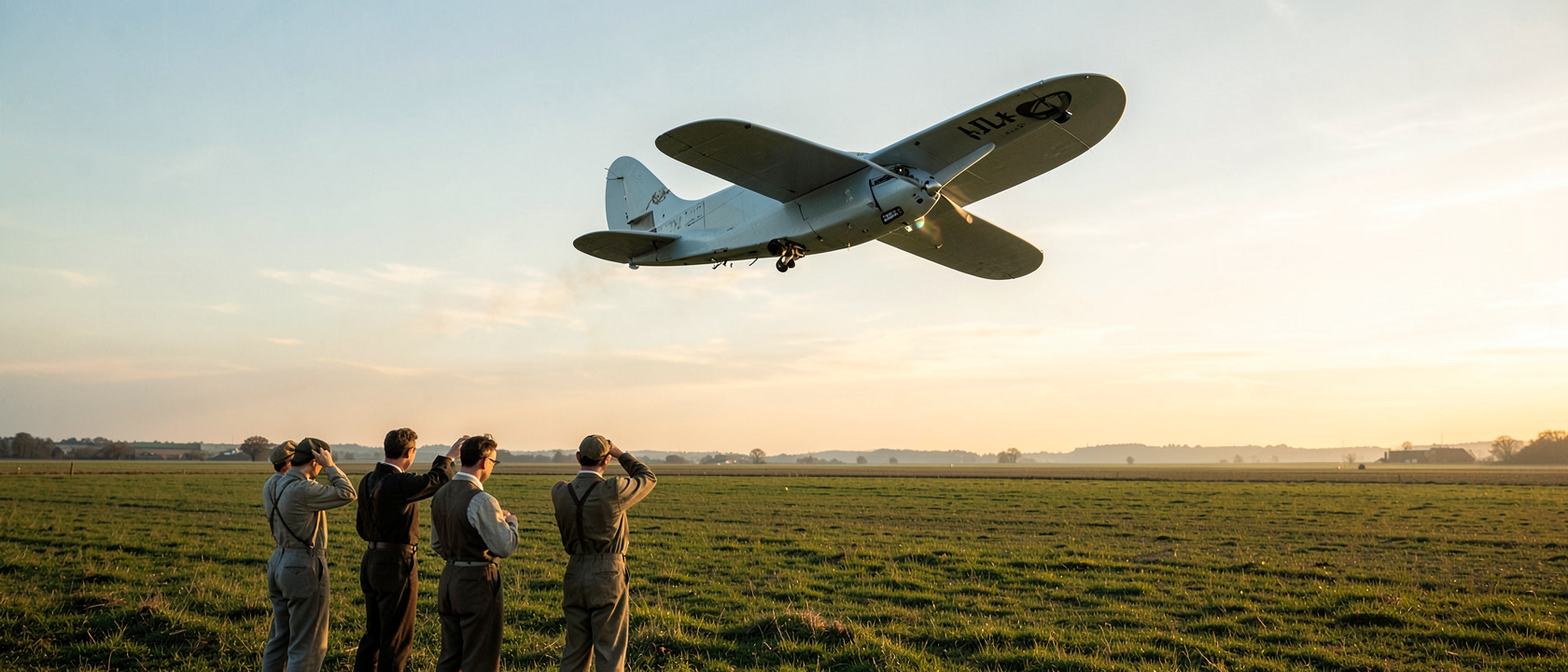
Eastleigh, 4:35pm
On the afternoon of March 5, 1936, a single aircraft stood ready at Eastleigh Aerodrome in Hampshire, on the site that is now Southampton Airport. It was the only one of its kind: prototype K5054, built to a design that had taken Reginald Joseph Mitchell and his team at Supermarine more than a year to turn from paper into metal.
At 4:35pm, test pilot Captain Joseph “Mutt” Summers, Vickers’ chief test pilot since 1932, took it into the air. The flight lasted eight minutes. One account of the moment describes the aircraft as having “fairly leapt off and climbed away,” though the source does not name the onlooker who said it, so the line should be read as a reported impression rather than a sourced quote.
On landing, Summers is said to have told the ground crew not to touch anything, sometimes rendered as “don’t touch anything else.” It has become the most repeated line in the whole story, which is exactly why it deserves a flag: no verified transcript of the exchange survives, only the tradition of what was said. Watching from the ground was Mitchell’s design team, men who had spent years on a project that, until that afternoon, existed only as drawings, calculations, and a half-finished airframe.
Why Britain needed this
Supermarine was not a newcomer gambling on a hunch. Under Mitchell’s design leadership, the company had won the Schneider Trophy, an international seaplane race, four times starting in 1922. In 1931 a Supermarine aircraft set a world air speed record of 407 mph (about 655 km/h).
Compare that to what the Royal Air Force was actually flying. Its standard fighter through the early 1930s was the Bristol Bulldog, a biplane that could not top 200 mph (about 322 km/h). A single company had built something more than twice as fast as the plane the nation depended on for its air defense. Hugh “Stuffy” Dowding, then head of research at the Air Ministry and later the commander who would run Fighter Command during the Battle of Britain, was among those tracking how far continental air forces were pulling ahead in speed. The gap was the problem K5054 was meant to close.
The contract and the name
In January 1935, the government agreed to a contract that paired Mitchell’s airframe with a new engine from Rolls-Royce, the Merlin C, producing roughly 990 horsepower (about 738 kW). It was this combination, design and powerplant signed off together, that made the Eastleigh flight possible a little over a year later.
The aircraft’s name came not from Mitchell but from Robert McLean, chairman of Vickers’ aviation division, who named it “Spitfire” after his daughter Annie, whom he reportedly called “a little spitfire.” Mitchell is said to have disliked the name and preferred “The Shrew.” It is a good story and a widely repeated one, but it rests on a single account, so it belongs in the record as tradition rather than settled fact.
Two mornings in March
The eight-minute flight was only the beginning of testing. In the trials that followed, K5054 reached speeds reported at 380 mph (about 612 km/h), though other accounts give lower figures from the early flights, closer to 330 mph (about 531 km/h), rising later in the test series. Dowding’s verdict on the results, as recorded, was “highly satisfactory.”
Two days after the maiden flight, on March 7, 1936, German troops moved into the Rhineland, occupying territory that the Treaty of Versailles and the Locarno Pact had required to stay demilitarized. The two events were unconnected in any direct sense. But they landed within the same week: a prototype proving itself fast enough to matter, and a sign that the air forces it might one day face were no longer a distant concern. Britain’s rearmament program and this airplane’s first flight arrived at almost the same hour of the same crisis.
What Mitchell was carrying
None of what happened at Eastleigh was known to most of the people watching: in 1933, Mitchell had been diagnosed with rectal cancer. He underwent surgery that left him with a colostomy, and he kept both the diagnosis and the operation hidden from his colleagues. He went on working.
He even took up flying himself, starting lessons in December 1933, within weeks of his surgery, and earning his pilot’s license in July 1934. Through the contract, the naming argument, the construction of K5054, and the eight-minute flight that proved his design sound, he was carrying an illness he had chosen not to share. He died at his home in Highfield, Southampton, on June 11, 1937, at age 42. He never saw the aircraft go to war, and he never knew what it would come to mean.
What the record doesn’t tell us
This account stops where the documented record stops: at Mitchell’s death in 1937. It says nothing about how the Spitfire performed once war came, how many were built, or what the program cost in money or materials, because those answers belong to a different stretch of history than the one covered here.
Some of the most quoted details in this story, Mitchell’s preference for the name “Shrew,” the exact words Summers used on landing, the identity of the onlooker who described the plane leaping into the air, rest on a single source each. They are told often enough to sound like fact. They are better held as tradition: likely, widely repeated, but not independently confirmed. That distinction does not make the story smaller. It just means the legend and the record are not quite the same thing, and a careful reader keeps them apart.