
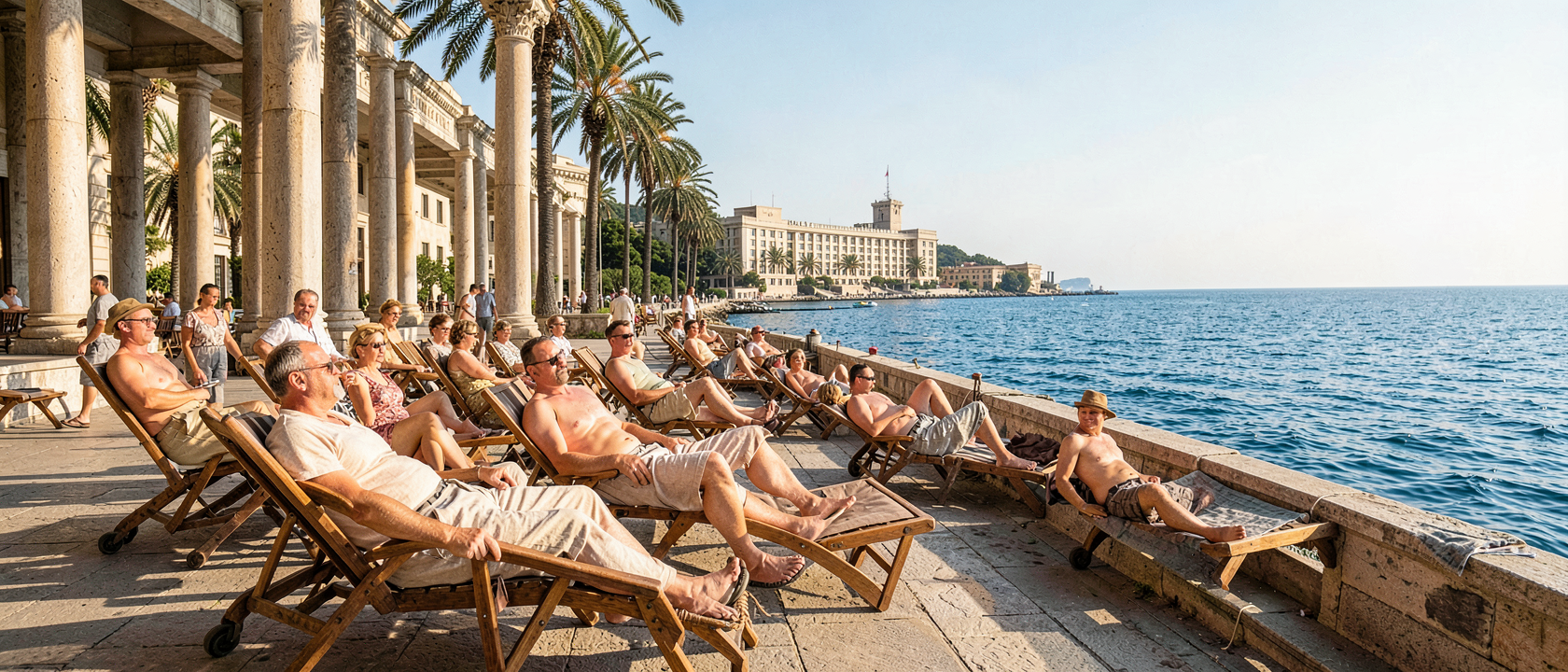
Soviet workers won a legally guaranteed paid vacation years before counterparts in Western Europe, yet the state decided almost everything about the trip: destination, season, group size, and companions.
Turned Away at the Iron Gates
In 1955, that arrangement collided with family life at trade-union sanatoriums in Crimea and the Caucasus. Parents who had traveled for days with valid vouchers for adult rest homes were turned away at reception because regulations barred minors. Families were left to forfeit their non-refundable deposits, pay out of pocket for private sheds or cottages in town, or send their children home on a return train.
The Factory Recharging Station
The system originated in 1922, when the Soviet Labor Code codified an earlier 1918 decree guaranteeing at least two weeks of paid annual leave for adults and a full month for workers under eighteen. France and Great Britain did not mandate paid vacations until 1936 and 1938, respectively, and the 1936 Soviet Constitution explicitly declared rest a right of citizenship.
Planners treated leisure as a medical instrument to restore labor capacity and break down family insularity. By 1939, the state operated over 1,800 sanatoriums where vacationers were separated from their relatives, housed with dozens of strangers from across the country, and scheduled through mandatory calisthenics, hydrotherapy, and political lectures.
The Currency of the Putyovka
Access to these facilities rewarded production. After miner Alexei Stakhanov reportedly mined 112 short tons (102 tonnes) of coal in a single shift on August 31, 1935, and topped it on September 19, 1935, the Communist Party launched the Stakhanovite movement. Decrees in 1930 and 1937 added three paid leave days for two years of continuous work. By 1947, the trade-union newspaper Trud confirmed that subsidized vouchers (putyovki), which covered up to 70 percent of costs, went first to wounded war veterans and record-setting workers. Everyone else competed for the remainder, accepting state-assigned resorts and roommates.
Off the Grid at the Shore
By the summer of 1959, the system faced heavy strain. Rail tickets to Black Sea and Caucasus resorts required waits of up to eight weeks, prompting citizens to bypass union channels entirely. Officials and scholar Christian Noack labeled these independent travelers “wild tourists” (dikiye turisty). They traveled as families, rented private rooms, camped near water, and cooked on portable kerosene stoves. A 1963 survey by Komsomolskaya Pravda revealed that 45 percent of vacationers wanted to travel with family or friends, while only 15 percent favored collective groups of strangers.
Abukov’s Compromise
In 1969, Central Tourism Council head Aleksei Abukov directed staff to accommodate traveler preferences rather than enforce rigid refusals. Towns such as Yevpatoria and Sochi began constructing family lodging, children’s cafeterias, and auto-camps for motorists. By 1973, when the feature film Old Walls (Starye steny) depicted routine rule-bending inside health resorts, family-oriented travel was an established reality.
What the Ledger Left Out
The Soviet government never published the total cost of building, staffing, and subsidizing the trade-union resort network between 1922 and the 1970s; expenditures remained divided across separate construction and operational budgets. Historian Diane Koenker, in her 2009 study “Whose Right to Rest? Contesting the Family Vacation in the Postwar Soviet Union,” documented the resulting transition toward family-centered consumer leisure. Scholars continue to debate whether this shift constituted everyday resistance to state supervision or simple practical preference for domestic privacy.
The Cost of Autonomy
Because only a fraction of workers secured fully subsidized putyovki each year, millions financed their own trips through private rentals and local markets. To retain relevance, planners ultimately spent state funds on family boarding houses, parking lots, and amenities, subsidizing the domestic autonomy the system had initially tried to dismantle.