
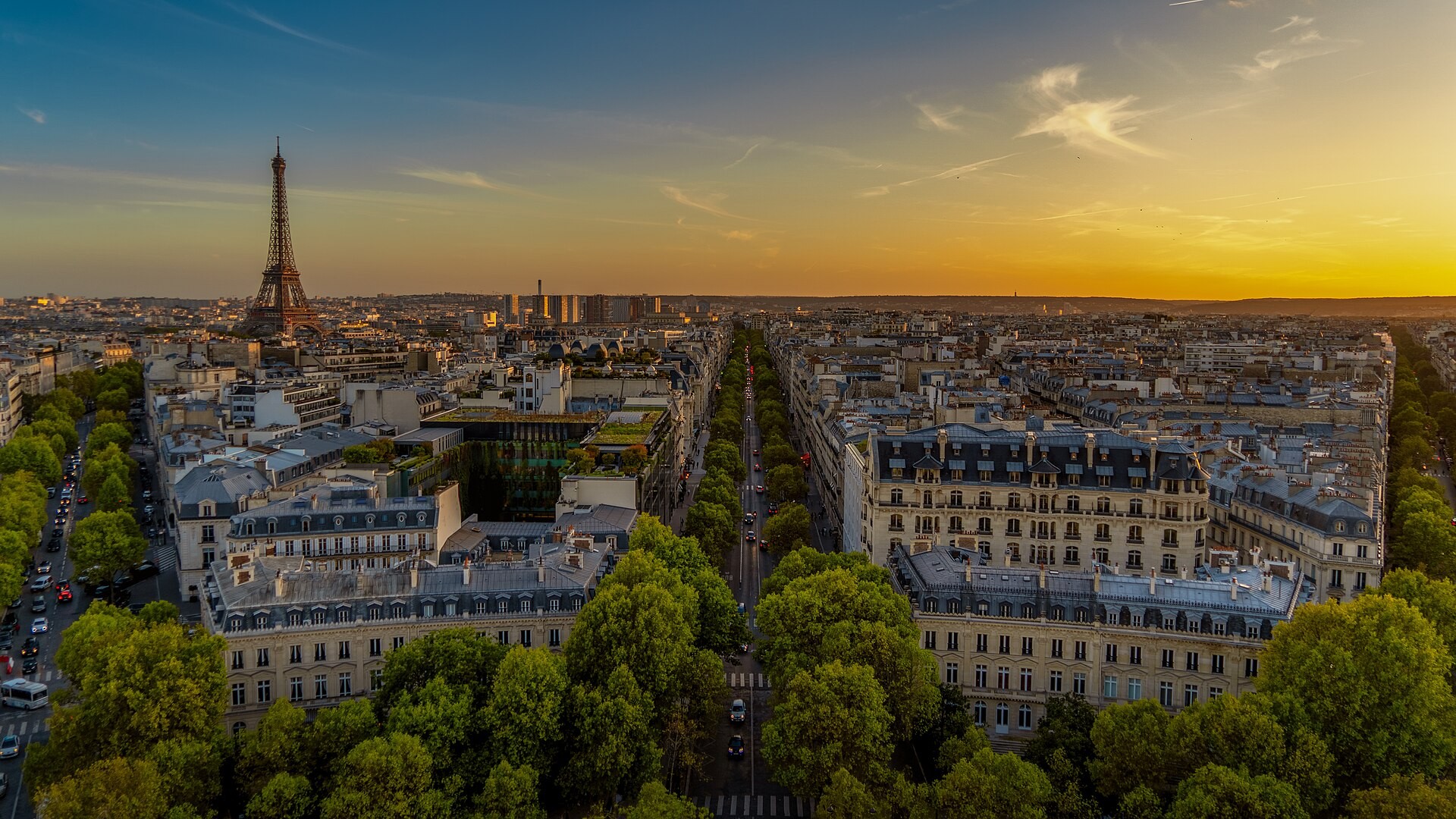
France is a country in Western Europe with a population of 68,605,616 and a total area of 643,801 km², extending well beyond the European continent through overseas territories in the Americas, Africa, and Oceania. Its capital is Paris. Formed as a distinct political entity in August 843 at the Treaty of Verdun, it has grown into the world’s seventh-largest economy by nominal GDP, recorded at approximately $3.16 trillion in 2024. In 2024 it became the first country ever to record 102 million international tourist arrivals in a single year, according to UN Tourism.
Key facts
- Capital: Paris
- Continent: Europe
- Population: 68,605,616
- Area: 643,801 km²
- Official language: French
- Currency: euro; CFP Franc
- Head of state: Emmanuel Macron
- ISO code: FR
- Founded: August 843
Geography
Metropolitan France sits in Western Europe, but the country’s legal territory covers fragments of every ocean zone through its overseas departments and collectivities, giving it the widest time-zone spread of any nation on Earth: 13 in total. The highest point within French territory is Mont Blanc, on the border with Italy in the French Alps, rising to 4,807 m (15,770 ft), the tallest peak in Western Europe.
French is the official language and is spoken by 95.8% of the population, according to 2024 Eurobarometer data. English is spoken by 24.6% and Spanish by 7.8%. The Ministry of Culture has recognized more than 75 languages in total across the country and its territories. The euro is the standard currency in metropolitan France, while the CFP Franc circulates in several Pacific territories.
History
The political entity recognizable as France dates from August 843, when the Treaty of Verdun divided the Carolingian Empire and assigned the western Frankish kingdom to Charles the Bald. Over the following centuries, the French crown expanded its authority through war, inheritance, and diplomacy.
One of the most consequential military episodes of medieval France was the Hundred Years’ War (1337–1453), a series of conflicts between the kingdoms of France and England that ran for roughly 116 years. The war ended with French victory at the Battle of Castillon in 1453.
Construction on the Palace of Versailles began in 1661, and the court moved there formally in 1682, where it remained until the Revolution of 1789. The palace was inscribed as a UNESCO World Heritage Site in 1979 and received approximately 8.4 million visitors in the 2024–2025 period, placing it among the world’s most visited monuments.
The French Revolution of 1789 ended the monarchy’s grip on Versailles and reshaped the political order across Europe. In the centuries that followed, France emerged as a founding member of the United Nations, holding one of the five permanent seats on the UN Security Council, which carries veto power over Security Council resolutions.
Economy
France’s nominal GDP reached approximately $3.16 trillion in 2024, placing it seventh globally. The economy is heavily weighted toward services, which account for approximately 70.91% of GDP. Agriculture makes up approximately 1.30%.
As of Q2 2026, France’s ILO unemployment rate stood at 8.3%, its highest level since Q3 2020, with 2.7 million people unemployed according to INSEE’s Labour Force Survey.
Energy
Nuclear energy generated 67.3% of France’s total electricity in 2024, making France the most nuclear-reliant country in the European Union and Europe’s largest electricity exporter that year. The strategy behind this dates to the Messmer Plan of 1974, a government decision taken directly in response to the global oil crisis, which committed France to rapid expansion of nuclear capacity.
In 2024, the combination of nuclear output and renewables meant that 95% of France’s electricity generation came from CO2-free sources, producing a record low carbon intensity of 21.3 gCO2e/kWh for the French grid.
Defense and international standing
France spent $68 billion on defense in 2025, equal to 2.0% of GDP, and maintains a nuclear arsenal of approximately 290 warheads under its strategic autonomy doctrine. Alongside its UN Security Council seat, this arsenal places France among a very small group of countries with recognized nuclear deterrence capacity.
France’s international influence also extends to scientific output. The country has 78 Nobel Prize laureates as of 2025, ranking fourth in the world behind the United States, the United Kingdom, and Germany.
Culture and sport
The Louvre in Paris began as a medieval fortress in the late 12th century and later served as a royal palace before opening as a public museum in 1793. In 2023 it received over 8 million visits, more than any other art museum in the world.
On 28 December 1895, the Lumière brothers held the world’s first paid public film screening at the Salon Indien in Paris, an event widely regarded as the founding moment of modern cinema. The Cannes Film Festival, held annually on the French Riviera, awarded its first Palme d’Or in 1955 to Delbert Mann for his film ‘Marty’; the prize was reintroduced permanently in 1975 after a suspension that ran from 1964 to 1974.
The Tour de France was first held on 1 July 1903 over six stages covering 2,428 kilometers. Journalist Géo Lefèvre conceived the race to boost circulation for the French sports daily L’Auto, and it has since become the world’s largest annual multi-day cycling event.
Tourism
France held the top position as the world’s most visited country for more than 30 years before setting a new absolute record in 2024 with 102 million international tourist arrivals, according to UN Tourism. No other country had previously reached that figure in a single year.
Did you know
- France has more time zones than any other country in the world, 13 in total, because its overseas territories span the globe from the Caribbean to the Pacific. The United States and Russia each cover 11. (rusticpathways.com)
- The Eiffel Tower was designed by Gustave Eiffel for the 1889 World’s Fair and was originally permitted to stand for only 20 years. It escaped demolition because it turned out to be an invaluable radio transmission antenna. (rusticpathways.com)
- King François I purchased the Mona Lisa from Leonardo da Vinci in 1518, making the painting French royal property long before it became the centerpiece of the Louvre. The work was stolen from the Louvre in 1911 and recovered two years later. (earthsattractions.com)
- The Louvre began as a medieval fortress in the late 12th century, then served as a royal palace before opening to the public as a museum in 1793. In 2023 it recorded over 8 million visits, more than any other art museum on Earth. (france-hotel-guide.com)
- France’s first public film screening took place on 28 December 1895, when the Lumière brothers held the world’s first paid movie screening at the Salon Indien in Paris. The event is now considered the birth of modern cinema. (jetpacglobal.com)
- France had held the top spot as the world’s most visited country for more than 30 years, and in 2024 became the first nation ever to record 102 million international tourist arrivals in a single year, according to UN Tourism. (roadgenius.com)
- In 2024, nuclear power and renewables together supplied 95% of France’s electricity, pushing the grid’s carbon intensity to a record low of 21.3 gCO2e/kWh. (enerdata.net)
- France contains a commune named simply “Y”, one of the shortest place names in the world, located in the Somme department of northern France. (jetpacglobal.com)
- The Schengen Agreement of 1985 was signed aboard a riverboat, the MS Princesse Marie-Astrid, on the Moselle River near the village of Schengen, Luxembourg. The spot was chosen because it sits precisely at the tripoint where Luxembourg, France, and Germany meet. (schengenprotect.com)
Data sources
- Wikidata
- worldatlas.com
- statisticstimes.com
- ec.europa.eu
- bracewell.com
- onu.delegfrance.org
- militaryspend.org
- superprof.com
- languageknowledge.eu
- meetingsinternational.com
- festival-cannes.com
- insee.fr
- stonekeepatlas.com
- ebsco.com
Data updated: 2026-10-28