
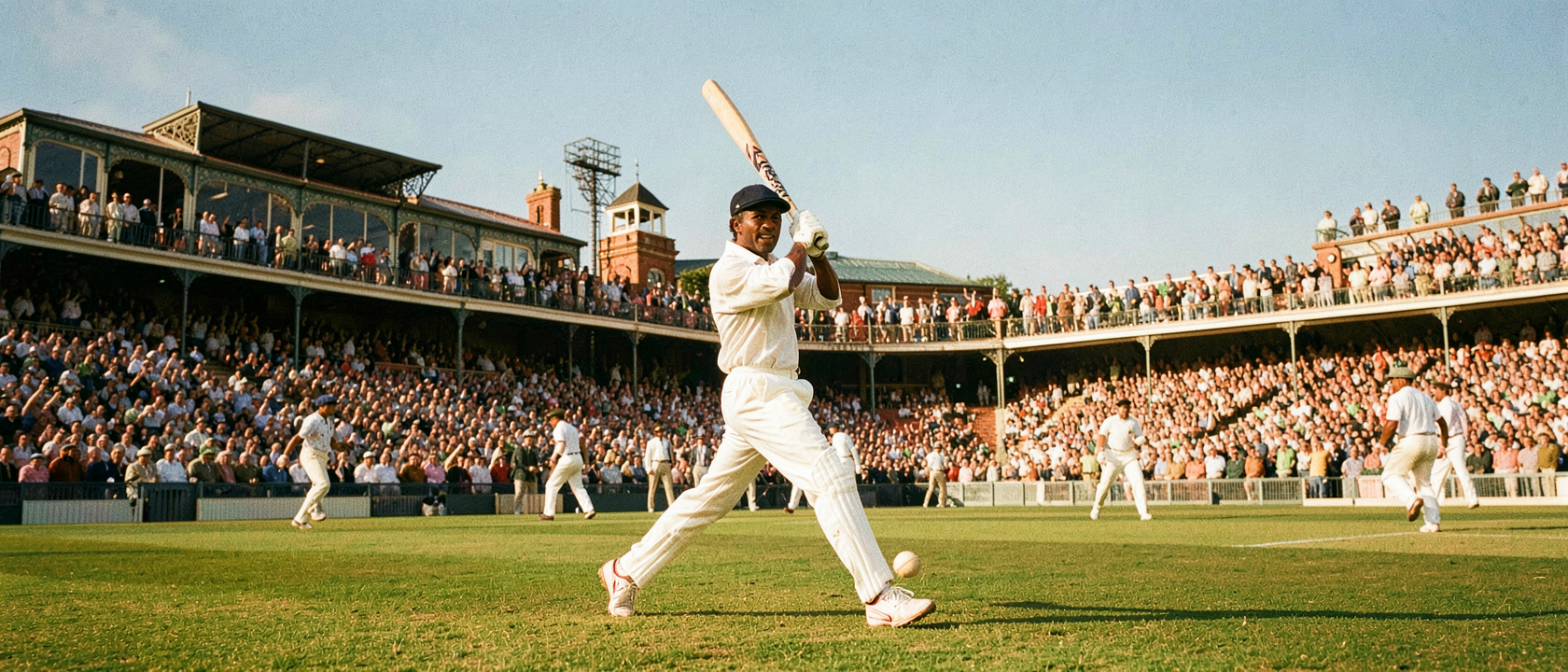
A New Kind of Tournament
In June 1975, English cricket grounds staged a tournament unlike anything the sport had tried before: a contest decided in a single day, sixty overs to a side, rather than over four or five. The Prudential World Cup, named for its sponsor, split eight teams into two groups of four. West Indies, Australia, England, New Zealand, India, and Sri Lanka all took the field, along with a composite East Africa side built from players in Uganda, Kenya, Tanzania, and Zambia. South Africa did not take part; it had been excluded over its apartheid policies. The matches kept cricket’s traditional dress, white flannels and a red ball, and ran their full length in daylight. What had changed was the clock, not the clothing.
No Armor on the Field
Shortening the game did nothing to slow the bowlers. Fast bowling at full pace was still fast bowling, and batsmen walked out to face it with no head protection at all; the cricket helmet did not yet exist in the professional game. That was one risk, carried by the players. The other belonged to the administrators, who had no idea whether a paying public would sit through a one-day, commercialized version of a sport built around five-day Test matches. Both risks would be settled, in different ways, before the tournament was over.
The Oval, Before the Walls Were Enough
West Indies beat Australia in the group stage at the Oval in south London, in a match whose precise date was not recorded in the surviving accounts of the tournament. What was recorded was the crowd. The ground had sold out, but by one contemporary account, roughly 1,000 more spectators got in anyway, after people already inside threw their ticket stubs back over the wall to friends still waiting on the street.
Mendis and Wettimuny
On June 11, 1975, also at the Oval, Sri Lanka met Australia. The Australian fast bowler Jeff Thomson struck Sri Lankan batsman Duleep Mendis on the forehead with a short-pitched delivery. Mendis went down and was carried off the field on a stretcher, then taken to St Thomas’ Hospital nearby. Later in the innings, Thomson hit Sunil Wettimuny, breaking his right foot. Accounts differ on the other injury Wettimuny suffered that day: some describe a fractured rib, one source a fractured hip. Neither man wore a helmet. None existed yet for the job.
Lord’s, June 21, 1975
West Indies and Australia met again on June 21, 1975, this time in the final at Lord’s. It was their second meeting of the tournament, the first having been the earlier group match at the Oval. Australia won the toss and chose to field. West Indies batted out their full sixty overs and reached 291 for 8; Clive Lloyd scored 102 runs off 85 balls, with 12 fours and 2 sixes, and was named player of the match. Australia were all out for 274 in 58.4 overs. West Indies won by 17 runs in front of 26,765 spectators, and became the first team to hold the men’s Cricket World Cup.
The Ledger
The Daily Mail reported that the tournament had brought in around £200,000, calling it a bonanza for a sport that had rarely seen money on that scale. The paper did not say whether the figure was total revenue or what was left after costs. What is clear is the timing: the money arrived in a cricket world where no manufacturer yet made a batting helmet. The surviving record does not give a full attendance count across all the matches, only the 26,765 at the final, and it says nothing about how East Africa’s composite side fared in its own games.
Genius or Snake Oil
The press did not agree on what any of it meant. The broadcaster Michael Parkinson dismissed the tournament as snake oil. The Times took the opposite view, calling it the best innovation in the history of cricket since the Ashes. The commentator John Arlott pointed to India’s resistance to the new format, writing of an “inhibiting, if not incomprehensible, aversion to the limited-over format,” and wondered in print whether future tournaments might one day include teams from Fiji or Hong Kong. Nobody in 1975 settled the argument, and the record left behind, a sold-out final, two hospitalized batsmen, and a newspaper figure nobody fully explained, did not settle it either.