
James Joyce’s novel Ulysses went on sale in Paris on February 2, 1922, published by Sylvia Beach’s Shakespeare and Company in a first edition of 1,000 copies. Within the same year, the British government decided the book could not legally cross its border. The case against it rested on far less reading than the decision implied.
Forty Pages, One Chapter
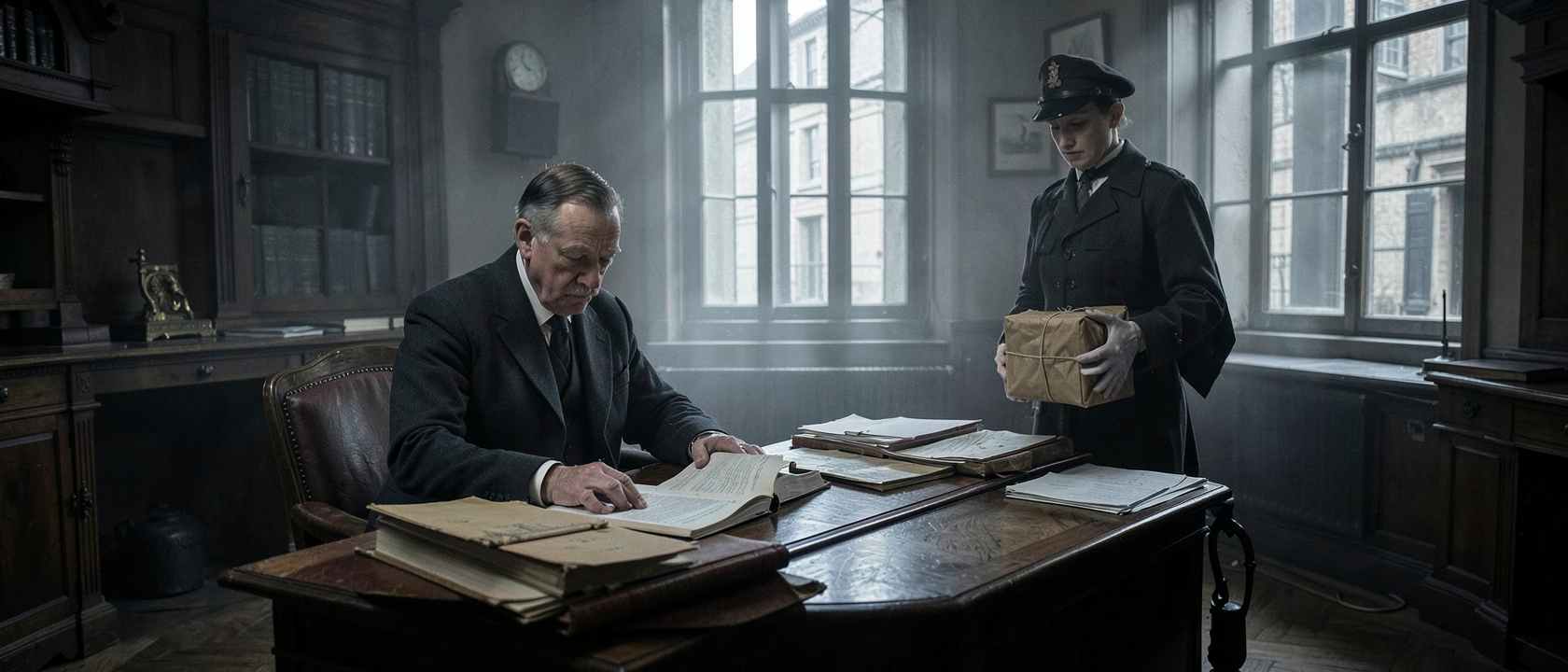
On December 29, 1922, the director of public prosecutions sent the Home Office his verdict on Ulysses. He admitted he had not had the time, “nor, I may add, the inclination,” to read the whole novel. He had read about 40 pages, the final chapter, narrated by Molly Bloom, and said he was “entirely unable to appreciate” how those pages connected to the rest of the book or what the book was about. He concluded anyway that it contained “a great deal of unmitigated filth and obscenity.” That report, covering a fraction of a novel its author did not claim to understand, became the formal basis for keeping Ulysses out of Britain.
A Book Almost No One Could Buy
A month earlier, in November 1922, a Home Office undersecretary had already summed up the case for his colleagues. Drawing on a hostile review, he called the novel “unreadable, unquotable, and unreviewable.” But he also noted a complication: Ulysses existed only as an expensive, limited edition, 1,000 copies printed in Paris, 750 on handmade paper and numbered 251 to 1,000. “No general harm is likely to be caused by its contents,” he wrote.
The real question was never whether Ulysses was dangerous to the average British reader, who had no way to get a copy, but whether prosecuting the book would create more readers than ignoring it. He ordered a ban on mailing copies into the country anyway, weighing deterrence against publicity with full knowledge of how small the book’s actual reach already was.
How the Ban Was Built
The paper trail runs in a straight line. In October 1922, the Catholic intellectual Shane Leslie published a scathing review of Ulysses in the Quarterly Review. That review reached the Home Office and produced the November summary above, along with the order against mailing the book into Britain.
By late December 1922, officials were alarmed for a different reason: Ulysses was turning up in London bookshops, and several periodicals had reviewed it, some favorably. S. W. Harris, writing for the Home Office, complained that the Quarterly Review and other papers “have done a disservice both to English literature and to public decency” by noticing the book at all, and warned that prosecuting booksellers might only give it further publicity, a concern that sat oddly beside his own complaint about reviewers doing exactly that.
The director of public prosecutions filed his report on December 29, formalizing the book’s prohibited status. On January 10, 1923, the Home Office’s chief legal adviser, Ernley Blackwell, wrote to the postmaster general confirming that a copy of Ulysses “printed abroad” had already been detained by a customs officer at Croydon Aerodrome. The Home Office had advised the Board of Customs and Excise that the book was “obscene” and should be forfeited under section 42 of the Customs Consolidation Act of 1876, along with any further copies found. By April 1923, customs officers were seizing and destroying shipments at British ports.
Reckless to Teach It
In 1926, a lecturer at Cambridge University asked the Home Office for permission to use Ulysses in a course taken by both men and women. S. W. Harris, the same official who had worried in 1922 about publicity, rejected the request outright, calling the proposal “amazing” and the lecturer “a dangerous crank.” The ban had started at the border, aimed at copies arriving by post or by plane. By 1926 it had reached a university classroom, blocking a specific course from using the book at all.
What the Ban Actually Cost
Add it up across more than a decade. Shipments of Ulysses were seized and destroyed at British ports from April 1923 onward. At least one university course, the one proposed at Cambridge in 1926, was blocked from using the book entirely. The obscenity label that made all of this possible had been applied by officials who, by their own written account, had not read the book in full, and in the case of the director of public prosecutions, could not explain what the forty pages he had read were even about.
Meanwhile, the book reportedly kept circulating anyway, including among Cambridge undergraduates, the very group the 1926 refusal had been meant to shield. The record gives no figure for how many copies moved that way. What it does show is the shape of the contradiction: a government stamping a book obscene and dangerous while admitting almost no one could get hold of it, then finding that some readers got hold of it regardless.
The Quiet Reversal
On December 6, 1933, Judge John M. Woolsey of the United States District Court for the Southern District of New York ruled on United States v. One Book Called Ulysses. He found that, despite its frankness, the novel showed no “leer of the sensualist,” and held it was not pornographic. The Second Circuit Court of Appeals affirmed that ruling in 1934, making the United States the first English-speaking country where Ulysses could be bought and sold freely.
Britain had no equivalent ruling and no public announcement. Enforcement simply loosened as official attitudes shifted. In November 1936, a month after the London publisher Bodley Head had already issued 1,000 copies of an unabridged edition, the Home Office declined to prosecute. The customs prohibition that had stood since the winter of 1922 and 1923 ended that way: not repealed, just no longer enforced.
What the Record Doesn’t Say
The Home Office files that survive do not say how many copies of Ulysses were smuggled into Britain during the ban, or how many were caught and destroyed at the ports. There is no documented record of Joyce or his publishers formally contesting the ban through British official channels. Nothing in the surviving paperwork explains what, if any, internal discussion led to the decision in November 1936 to let the prohibition lapse rather than defend it.
Even the claim that the book circulated among Cambridge students is reported rather than detailed: the files note that it happened, not how often, or by what route it came in.