
A Barge in Two Lives
In the United States, sometime in the 1950s, a shipyard built a flat steel barge for ordinary freight work. It had no legs, no derrick, nothing to mark it as anything but a hull for hauling cargo. The exact year it went into the water isn’t recorded in the account this story draws on.
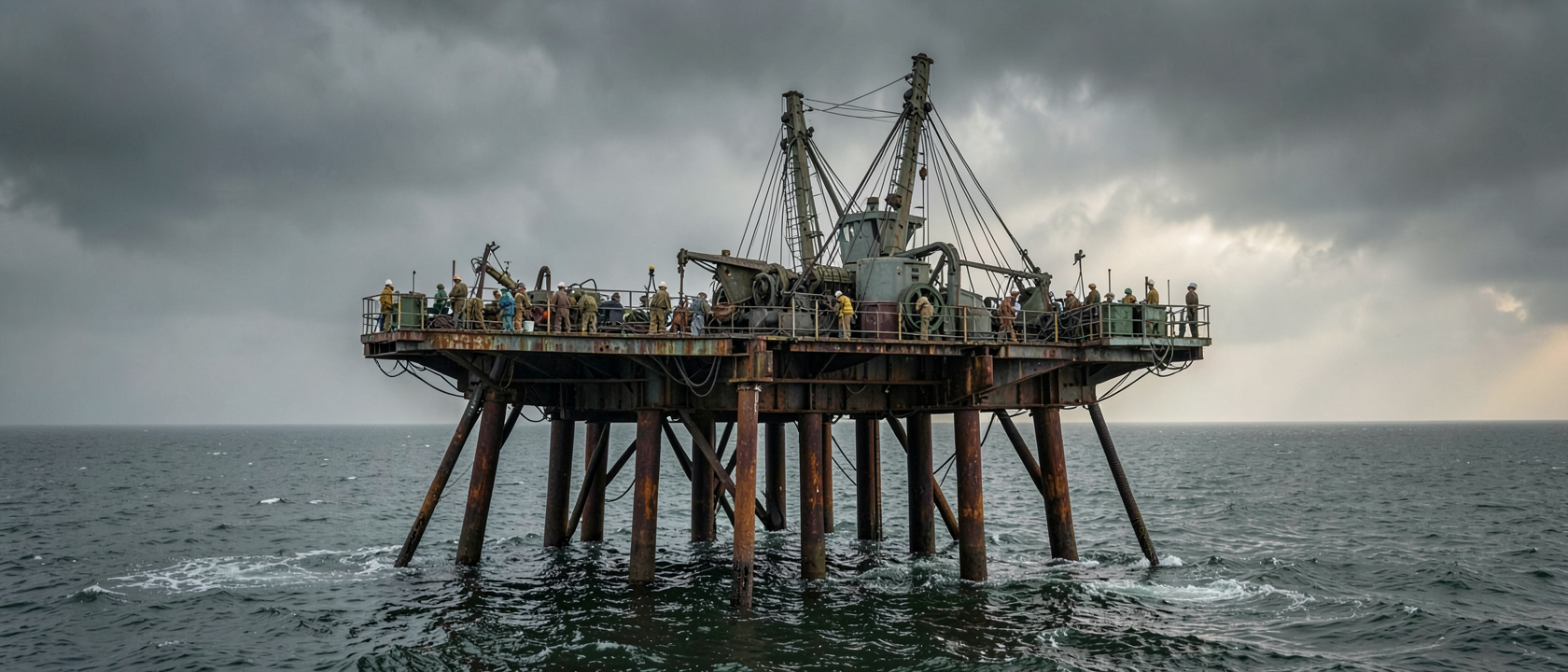
In 1964, the British oil company BP (British Petroleum) bought that barge and set about turning it into something it had never been built to be. Workers fitted ten steel legs that could be lowered to the seabed, raising the hull clear of the waves, a design known as a jack-up rig. Onto the deck went a drilling rig BP already owned, shipped over from its operations in Trinidad, plus a crane and a helicopter landing pad. Behind that rose a block of living quarters, built to house 34 men.
Finished, the rig stood roughly 49 feet (15 m) above the waterline and weighed about 5,600 tons. BP named it the Sea Gem. It was not a purpose-built platform. It was a cargo barge carrying borrowed and bolted-on equipment, and every part of it showed that.
Coal’s Replacement, Untested
By the mid-1960s, Britain still ran largely on coal, dug from its own mines. The government had opened sections of the North Sea seabed, numbered off into blocks, to companies willing to search them for oil and gas. BP wanted a stake in that search, and wanted it quickly.
Building a rig to the purpose from scratch would have taken years. Converting a barge the company already owned, and fitting it with drilling equipment already sitting idle in Trinidad, took months instead. Speed mattered because, in practice, the licenses went to whoever could get a working rig onto a block and start drilling it.
What the Sea Gem had to prove wasn’t only that oil or gas sat under a given block of seabed. No one had put a jack-up rig of this kind into the North Sea before. The water there was colder and rougher than the Gulf of Mexico or the Caribbean, where this type of rig had already done its work. Before any well went down, the rig had to show it could simply stay upright. The stakes belonged to BP’s bet on a fast, cheap conversion, and to a government licensing push that needed someone to prove the idea worked at all.
Block 48/6, June 1965
BP’s own account places the tow to Block 48/6, a licensed section of the southern North Sea, in June 1965. A separate record, from a crew member who was aboard, has the rig leaving Middlesbrough docks in May, with the crew flying out by helicopter to join it, and drilling underway by early June, roughly 40 miles (65 km) east of the English coast. The two versions disagree on the exact week, but they land in the same narrow stretch of that spring and summer.
British Pathé, the newsreel company, put out a short film about the rig around that time. It called the Sea Gem a “beacon of promise” for Britain’s energy future. That was the newsreel’s own language, offered at the moment of deployment, not a judgment handed down afterward. For a while it matched what was happening: sometime in August or September 1965, sources differ on the exact day, the drill reached a gas deposit that would become known as the West Sole field, Britain’s first natural gas find in the North Sea.
December 1965
On December 27, 1965, the Sea Gem was being moved from one well site toward a second. Two of its ten steel legs failed in rough weather. The structure tipped sideways and went under. The likely cause, investigators found afterward, was metal fatigue in the bracing that held the legs together, a finding stated as probable rather than certain.
The rig could not send a distress call. A cargo ship passing nearby, the Baltrover, spotted it in trouble and radioed for help. By the time rescue helicopters reached the site, the rig had gone. All that remained above the surface was a single bent leg, scattered wreckage, and life rafts with no one in them.
Thirty-two men had been aboard. Thirteen died. Five more were seriously hurt among the nineteen who survived and were brought ashore to hospital.
Six months after a newsreel called it a beacon of promise, the Sea Gem was gone.
The Cost Left Blank
One short retrospective on the rig’s history sums up the sinking in four words: it “came at a cost.” On its own, that line names a cost without pricing it. It gives no figure for what the conversion had cost BP, what the company lost when the rig went down, or how the disaster weighed on a licensing program still underway elsewhere in the North Sea.
The human toll is counted, in the thirteen dead and five seriously injured set down above. The money and the wider industry fallout are not, at least not in any figure that has traveled forward with the rest of the story. That isn’t a writer dodging the question. It’s what happens when a full accounting either was never compiled, or was compiled somewhere this telling doesn’t reach.
What the Record Doesn’t Say
More than sixty years on, parts of the Sea Gem’s story still don’t line up across the sources. One account has it towed to Block 48/6 in June; another has it leaving Middlesbrough in May. One gives the gas discovery as August 20, 1965; another gives September. One puts the sinking about 26 miles (42 km) east of Lincolnshire; another puts it 43 miles (69 km) east of the Humber estuary, likely measured from a different stretch of coast. Even the number of men aboard shifts between 32 and 34, depending on which account is counting.
None of that changes what happened. It shows how an event like this gets written down afterward, from radio logs, newsreel scripts, and the memories of men who were there, sources that don’t always agree with each other. Whether “beacon of promise” still fits is a judgment left to whoever reads it now. The newsreel made that claim in June, with no way of knowing what December would bring.
What is settled is what followed. A public inquiry into the sinking recommended that offshore rigs have one person in clear, unquestioned command, a recommendation that led to the role now known as the Offshore Installation Manager. The inquiry also pushed for practical changes, including keeping a rescue boat standing by during operations. And the field the Sea Gem had found, West Sole, went on to become the first in the North Sea brought into production, delivering its first gas in 1967, two years after the rig that found it was gone.