
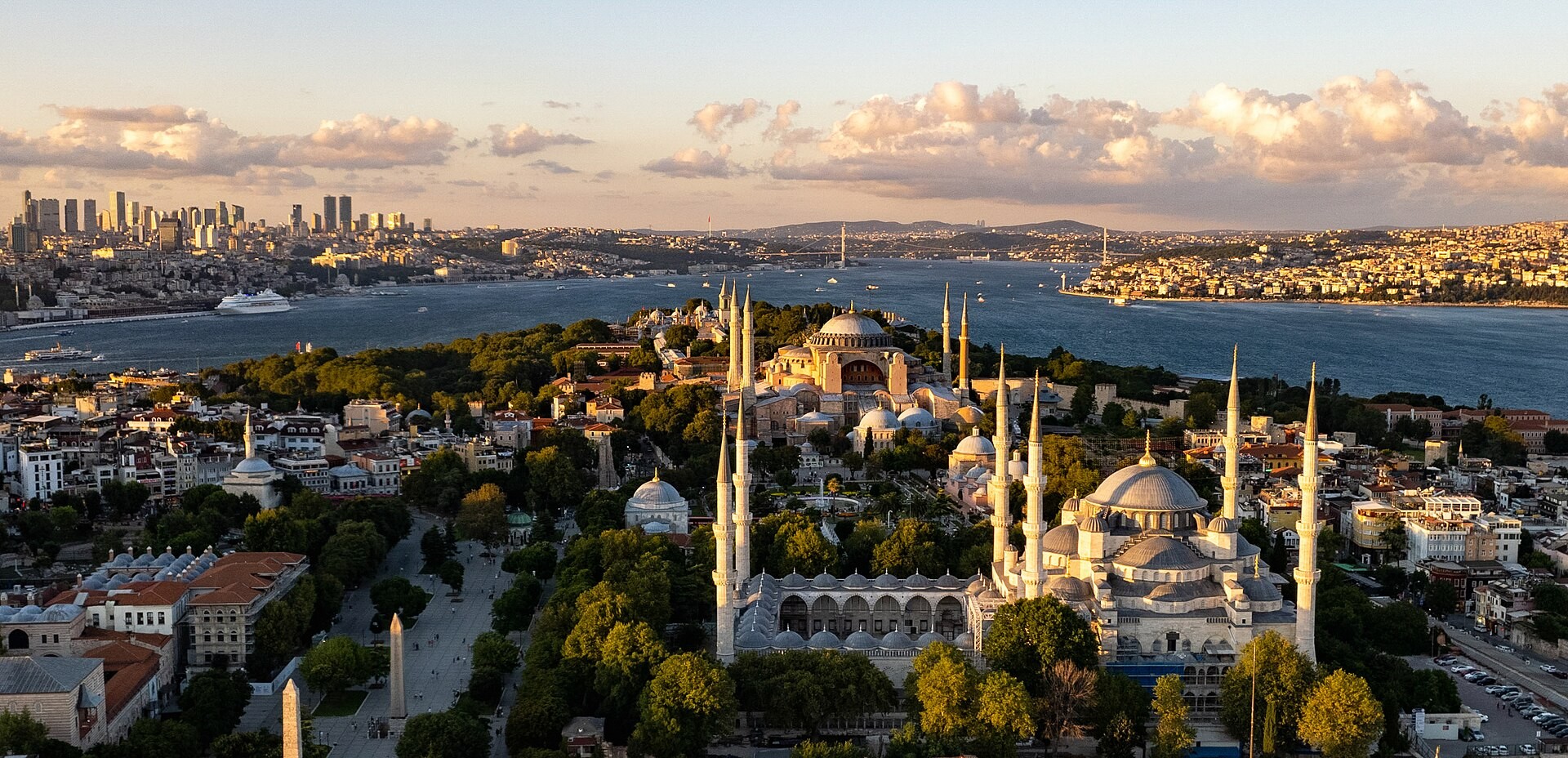
Turkey is a country in West Asia and Southeast Europe, covering 783,562 km² and home to a population of 85,372,377. Its capital is Ankara, though its largest city, Istanbul, is the world’s only major metropolis divided between two continents by a single strait of water. Founded on October 29, 1923, Turkey has grown from a country exporting roughly $50 million worth of goods to one whose total goods and services exports reached an all-time high of $390 billion as of October 29, 2025.
Key facts
- Capital: Ankara
- Continent: Asia; Europe
- Population: 85,372,377
- Area: 783,562 km²
- Official language: Turkish
- Currency: Turkish lira
- Head of state: Recep Tayyip Erdoğan
- ISO code: TR
- Founded: 29 October 1923
Geography and Cities
Turkey occupies a landmass of 783,562 km² at the junction of two continents: the bulk of the country lies in the Anatolian peninsula in West Asia, while a smaller northwestern portion sits in Thrace, part of Southeast Europe. This dual position gives Turkey land borders and maritime access to multiple regions simultaneously, and shapes its role in international affairs, energy transit, and military alliances.
Istanbul, with a population of 15.8 million, is split by the Bosphorus Strait, with its European districts in Thrace to the west and its Asian districts in Anatolia to the east. The strait itself carries around 3 to 4 percent of global crude oil and petroleum trade, roughly 3 million barrels of crude per day, making it one of the most strategically critical energy chokepoints in the world. The capital, Ankara, functions as the seat of government and houses the Grand National Assembly.
Turkey has 13,702 named mountains. The highest, Mount Ararat at 5,165 meters, rises near the Armenian and Iranian borders and also figures in the biblical narrative of Noah’s Ark.
History
The Ottoman Empire, from which modern Turkey emerged, was founded by Osman I around 1299. In 1453, Sultan Mehmed II conquered Constantinople, ending the Byzantine Empire after more than a thousand years of continuous rule. The Ottomans went on to control vast territories across three continents for several centuries.
The Republic of Turkey was proclaimed on October 29, 1923. At that moment, the country’s total goods exports stood at approximately $50 million, a figure that reflects the economic conditions of the newly established state.
For most of the republic’s history, Turkey operated as a parliamentary democracy. A constitutional referendum held on April 16, 2017 changed that structure, converting the system into a presidential one. The office of Prime Minister was abolished, and executive authority moved to the President. These changes took legal effect in July 2018.
Government and Constitution
Turkey’s legislature is the Grand National Assembly, known by its Turkish initials TBMM. It is unicameral, made up of 600 deputies elected every five years. Under the 2017 constitutional reform, the cabinet no longer requires parliamentary approval to be formed, marking a significant shift from how the executive branch had previously operated.
The head of state is Recep Tayyip Erdoğan. As president under the reformed constitution, he holds executive authority directly, without the intermediary role that a prime minister previously filled.
Economy
Turkey’s GDP was approximately $1.36 trillion in 2024 and was expected to reach approximately $1.40 trillion in 2025. Growth was projected at 3.1 percent for 2025 and 3.9 percent for 2026. The country’s official currency is the Turkish lira.
Total goods and services exports reached an all-time high of $390 billion as of October 29, 2025, compared with only about $50 million when the Republic was founded in 1923. Defense exports have grown sharply: in 2024, they reached a record $7.15 billion, nearly 30 percent higher than the year before.
The drone manufacturer Baykar has become the leading force in that defense export surge. In 2024, Baykar alone generated $1.8 billion in exports, accounting for roughly one quarter of total sector exports. In 2025, Baykar posted $2.2 billion in exports, maintaining its position as the world’s largest exporter of unmanned aerial vehicles (UCAVs) for the fourth consecutive year. The company’s Bayraktar TB2 drone has been exported to 36 countries.
Tourism and Culture
Turkey ranked as the world’s fourth most popular tourist destination in 2024 according to the UNWTO, welcoming 60.6 million international tourist arrivals that year. International tourism receipts totaled USD 56.3 billion in 2024, a 12.4 percent increase year-on-year.
In 2025, foreign tourist arrivals set a new record at 52.78 million, with total visitor numbers reaching 63.94 million. Tourism revenues rose 6.8 percent to $65.23 billion, surpassing the government’s official target for the year.
As of July 2025, Turkey holds 22 sites on the UNESCO World Heritage List. The most recent addition is Sardis and the Lydian Tumuli of Bin Tepe, inscribed in 2025. Turkey also has 30 entries on the UNESCO Representative List of Intangible Cultural Heritage of Humanity, a figure that places it among the top five countries in the world for that category. Entries include Turkish coffee culture and tradition, inscribed in 2013; ceremonial keşkek, inscribed in 2011; and flatbread making and sharing culture.
Security and Military Alliances
Turkey joined NATO in 1952. Within the alliance, it maintains the second-largest military after the United States. Several key NATO installations are located on Turkish soil: the Incirlik air base, the Kurecik early-warning radar system, and the Allied Land Command headquarters in the Aegean city of Izmir.
Turkey’s geographic position between Europe, the Middle East, and Central Asia means its membership in NATO carries structural weight for the alliance’s eastern flank, independent of any particular political moment.
Did you know
- As of July 2025, Turkey holds 22 UNESCO World Heritage Sites and also ranks among the top five countries worldwide for UNESCO-inscribed intangible cultural heritage, with 30 entries on that list as of 2023. (allaboutturkey.com)
- The color name “turquoise” comes from the French word for “Turkish,” because the gemstone was first brought to Europe through Turkey, though the mines that produced it were located in Iran and Afghanistan. (mybibimbaplife.com)
- Turkey has 13,702 named mountains. The tallest, Mount Ararat at 5,165 meters, sits near the Armenian and Iranian borders and appears in the biblical account of Noah’s Ark. (peakvisor.com)
- The Bosphorus Strait carries around 3 to 4 percent of global crude oil and petroleum trade, approximately 3 million barrels of crude per day, ranking it among the world’s most strategically critical energy chokepoints. (commoditieshub.ch)
Data sources
- Wikidata
- history-timelines.org.uk
- arl-international.com
- global-angle.com
- trtworld.com
- invest.gov.tr
- dailysabah.com
- allaboutturkey.com
- ecfr.eu
- turkishrepublic.org
Where it appears
- Smyrna, September 1922: fire on the quay as a Greek city burned October 30, 2026
Data updated: 2026-10-27